Dexter was a badass — a stone-cold killer and a beheader of bunnies. A rescue cat who was about six months old when we adopted him, he was an orange tabby who I would describe as friendly, but not too friendly. I love the above photo of him, taken eight years ago. We have plenty of pictures that are more in focus, but none that captures his attitude quite like this one.
In 2006
Dexter died early today. We celebrated his 21st birthday in March even though we weren’t entirely sure of his birth date. He’d been slowing down for quite some time and was obviously failing during the past week or so. But his final passing came quietly, without the need for any final trip to the vet.
My favorite memory of him is from when he was young and strong. He brought a live bird into the kitchen and let it go so that it was flying around. I opened the top of a window. The bird flew out and Dexter leaped after him, through the open space and out into the backyard.
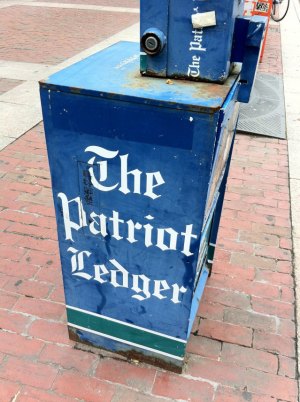
I’ve been trying to find out how widespread this is, but to no avail. Recently I learned that The Patriot Ledger of Quincy, a Gannett daily and, back in the misty past, one of the best medium-size papers in the country, is going to end home delivery and switch to the postal service instead.
What this means for print customers is unclear. You’d think there’s no way they will receive that day’s paper until the next day, or possibly the day after, although, as you’ll see in the message below, the Ledger is promising same-day mail delivery. Of course, this comes on top of the pending closure of 19 Gannett weeklies in Massachusetts, the end of Saturday print editions at many of the dailies, and numerous other cuts — including at the Ledger itself, which will switch from a print paper to an e-edition on Mondays.
As best as I can tell, the move to the USPS is being rolled out slowly at a few Gannett dailies here and there. It doesn’t seem like an all-at-once sort of thing. For instance, when I plugged some of the language from the Ledger announcement into Google, I discovered that Gannett switched to mail delivery at The Ithaca Journal of New York and The Banner-Press of Brenham, Texas, in December. I’m not coming up with others, but that doesn’t mean they’re not out there.
The message to Patriot Ledger subscribers, from a post office box in August, Georgia, was provided to me by a customer who lives in Quincy. It’s hard to see much good in here given that Gannett continues to cut its newsrooms and its coverage. It’s also very bad news for the paper’s loyal newspaper carriers; I reproduce a message from one of them below.
I have to say, though, that there are a few things in here that sound interesting. Ledger subscribers will be able to access any Gannett e-edition in the country, including the flagship USA Today. I might just get a digital subscription to USA Today if it means I can access other Gannett papers. Here’s most of the message:
Dear Subscriber:
The Patriot Ledger has been a vital part of the fabric of our community since its inception, bringing readers the reliable, local and passionate journalism you know and expect. While our commitment remains steadfast, we want to inform you of changes to your subscription.
Labor shortages have impacted newspaper deliveries across the country including the area and we want to make sure that your paper delivery is consistent. Beginning May 3, 2022, we will no longer provide home delivery of The Patriot Ledger. Delivery of your newspaper will continue and be provided via the U.S. Postal Service. The last day of home delivery will be May 2, 2022. You can expect delivery of your newspaper at the same time as your daily mail service. There will be no change to your current subscription rate.
Additionally, with more of our readers engaging with our content online, we are announcing a bold step towards our digital future. Beginning May 9, 2022, The Patriot Ledger will transition from delivering the Monday print edition to providing you a full Monday electronic edition (e-Edition), a digital version of our newspaper, available to you early morning. With the exception of Monday, you will continue to receive the print edition via USPS according to your delivery schedule.
As a loyal subscriber, we understand this change will impact you, which is why we are taking every step to ensure you have easy access to the news, sports, events and information you value most.
While a printed newspaper once was the sole means of accessing news and information, we offer many ways to connect with The Patriot Ledger. Your subscription includes unlimited digital access to patriotledger.com, where our team of journalists post updates and breaking news throughout the day, as well as our mobile apps, video, newsletters and the e-Edition….
Your local e-Edition also includes bonus magzines on various topics of interest and the full edition of USA TODAY. For quick tips on how to navigate the e-Edition visit patriotledger.com/eeditiontips.
As we make this transition, we are adding additional benefits to your subscription!
• Ad-free, 24/7 access to our USA TODAY Crossword puzzle! You can enjoy daily games by visiting puzzles.usatoday.com or through the USA TODAY Crossword app available on your iPhone or Android device.
• Universal access to all e-Editions throughout the USA TODAY Network in cities across the country, accessible via your own e-Edition. To access other newspapers, once inside the e-Edition, simply click on the icon titled Universal on the right-side navigation bar….
Thank you for your continued loyalty and support of our community-focused journalism.
Greg Mathis
Editor
So, is Gannett really making this move because of problems with its home-delivery network? Perhaps. But another Ledger customer sent me a message he received recently from a carrier who’s now out of work. Here it is:
Hello; I am writing to inform you that as of May 2, 2022, I will no longer be delivering your Patriot Ledger. The Parent company of the Patriot Ledger is the Gannett Company, they decided in their ultimate wisdom to get rid of all the Patriot Ledger Paper Carriers.
The Gannett Company has decided that they would rather pay more to have their paper delivered by the United States Postal Service. The average pay for a Patriot Ledger carrier is around $1.20 for 6 days papers (that is for all 6 days deliver $1.20). The USPS will be charging far more than this rate.
At the beginning of the pandemic, I was told that I was essential worker, and I delivered the Patriot Ledger throughout Covid every day. And now that things are getting a little better, for some reason that is beyond me, my job has been eliminated. I have enjoyed all your friendships all along the way. I feel fortunate for having the opportunity to meet you all. And hope that I also helped you by delivering your paper on time and where you wanted it.
The Patriot Ledger is also going to a 5-day newspaper, Tuesday Thru Saturday. They are stopping Monday deliveries. Gannett has continued to cut services and they are now saying to their customers you will no longer have your weekday Patriot Ledger at the time you have been receiving it and you will NEVER have your Saturday paper by 8:00am.
Many of the Patriot Ledger Carriers have been with the Patriot Ledger for many years, some for well over 20 years. We had our legally signed contracts with the Gannett Company voided because the contract has always been written in favor of the Company.
I have met the nicest guys that are also doing routes husbands, fathers, grandfathers, and ladies that have delivered the Patriot Ledger longer than most of the men. I have met the nicest customers because of this route too. Have enjoyed your friendships and your many kindnesses and gifts.
I want to say it has been a pleasure delivering your Patriot Ledger, and I will miss the friends I have made over these many years. For a while both our kids were in the Military and they also were deployed to the Middle East at the same time. This very route helped me to keep my mind off everythig too. They are both thankfully home.
Sincerely,
Your Patriot Ledger Carrier.
(name redacted)
Do you know of other daily newspapers that are dropping home delivery in favor of mailing it out? Please let me know in the comments.
Moscow University. Or is that Moskva? Photo (cc) 2007 by annaspies.
This morning I thought I’d indulge in a little linguistic trivia arising from Russia’s war of aggression against Ukraine. I’m hardly an expert — I took Russian for a few years in high school and college but never learned to speak it. (At one time I could read it — very, very slowly.) So take this with a few grains of salt.
First, the name of the Russian missile cruiser that was attacked and heavily damaged by Ukrainian forces has been identified as the Moskva. You may also know that Moskva is the Russian word for Moscow. In the Cyrillic alphabet, it’s Москва. So why do we Anglicize the name of the city but not the ship? It is one of the great mysteries.
Second, we are told that Volodymyr Zelenskyy prefers the English version of his name with two y’s on the end. The Associated Press has decided to go with that preference as well. But others, including The New York Times, spell it Zelensky, with one “y.”
I would argue that Zelensky with one “y” actually makes more sense. President Zelenskyy is not a native English speaker (although he’s pretty fluent), and went with Zelenskiy before settling on two “y’s.” The Cyrillic version of his name is closer to Zelenskee than Zelenskyy. You may have seen what it looks like on Zelenskyy’s Twitter profile: Зеленський. Proper transliteration should be based on pronunciation.
Finally, what’s up with Kyiv versus Kiev? Here, at least, I think we’ve all gotten it right. Kyiv is pronounced slightly differently, and the Ukrainians argue that Kiev is an artifact of Russian domination. So Kyiv it is.
No guest this week as co-hosts Ellen Clegg and I run down a number of news stories, including a major deal in New Jersey: the nonprofit Corporation for New Jersey Local Media (CNJLM) acquired 14 weekly newspapers serving some 50 municipalities. The papers were owned by the New Jersey Hills Media Group.
The deal is similar to one announced last year when Colorado Community Media sold its 24 weekly and monthly newspapers in a complex deal involving several nonprofit organizations. The difference is that management of the Colorado papers was turned over to The Colorado Sun, a digital start-up that was awarded an ownership share and could eventually become the majority owner. In New Jersey, the sellers, Liz and Steve Parker, will remain in charge.
Ellen unpacks the story behind a glaring omission in the award-winning documentary film, “Storm Lake,” and we both try to grapple with the blockchain and how Web3 might affect local newsrooms.
I thought you might enjoy a little slice of local newspaper history that I dug up Tuesday while doing some research. Mike Rosenberg of The Bedford Citizen once told me that Alan Adams, the former owner of the Lexington Minuteman and, eventually, five other papers, had a building named after him. Today I located the building and learned a little bit about Adams.
First, the building. It’s right next to the Minuteman Bikeway in the center of Lexington, across Meriam Street from the Lexington Visitors Center on the other side of the street. It’s pretty nondescript if you view it from the bikeway, since you’re looking at the side of the building. From Mudge, though, it’s quite striking — white and brick with four large white columns, with “Adams Building” written across the top. It has long ceased to serve as a newspaper headquarters and today mainly comprises professional offices.
Adams died in 1975 at the age of 70. According to his obituary in The Boston Globe, he began working at the Lexington Minuteman (also known variously as the Minute-man, or the Minute-Man) in 1930, and bought the paper in 1932. He also served as a local politico. Among other things, he chaired the Republican Town Committee and held elected office as a town selectman. Presumably he got good press. Obviously it’s not the sort of conflict that anyone would tolerate today, but it wasn’t that uncommon at the time.
From Richard Kollen’s history of Lexington. I’m going to go out on a limb and assume this photo isn’t protected by copyright.
According to a 2004 book by Lexington historian Richard Kollen titled “Lexington: From Liberty’s Birthplace to Progressive Suburb,” Adams used the Minuteman’s pages during World War II to promote wartime measures such as keeping the lights turned off at night so that the pilots of any incoming German bombers wouldn’t be able to see their targets. Adams also admonished his fellow townspeople for not taking those precautions seriously enough, once writing: “Seven stores were reported with unsatisfactory preparations and … all too many houses have not taken care of their porch lights properly.”
Adams sold his papers in 1971, according to the Globe obit. I’m not sure what their immediate fate was, but I know that at some point they were combined with another local chain called Beacon. The Beacon-Minuteman Corp., based in Acton, was eventually acquired by Fidelity’s Community Newspaper Co., then by Boston Herald publisher Pat Purcell, and then GateHouse Media, which merged several years ago with Gannett.
Today the Lexington Minuteman is a shell of what it once was, though it was among a handful of Gannett weeklies that escaped being targeted for shutdown or a merger during a recent round of cost-cutting. Adams himself represented a different era in local journalism — one that was ethically lax in some respects, but that served as the voice of the community in ways that we rarely see anymore.
Less than a year ago, it looked like the federal government might be ready to pass legislation aimed at addressing the local news crisis. The ideas in play were far from perfect, but they might have provided some needed assistance, at least for the short term. Now those proposals appear to be all but dead.
Rick Edmonds, who analyzes the news business for Poynter, wrote recently that the Local Journalism Sustainability Act, or LJSA, seems likely to fall victim to Washington’s dysfunctional political environment.
The LJSA would create three tax credits for a period of five years. One would allow news consumers to write off the cost of subscriptions on their taxes. Another would be aimed at businesses that advertise in local news outlets, and a third would subsidize publishers who hire or retain journalists.
Late last year, though, the credit for publishers was broken off and added to the Build Back Better bill, which died because of intransigence on the part of all 50 Republicans plus Democratic Sen. Joe Manchin. As Edmonds observes, the LJSA could be revived and considered as a discrete piece of legislation. But, he writes, “separate breakout legislation would need to go through committees and get 60 votes. A subsidy for journalism is probably not so popular as to command those 10 added votes.”
Meanwhile, another Democratic senator, Amy Klobuchar, is pushing a bill that would allow the news business to bargain with Facebook and Google to share some of their ad revenues. That bill, dubbed the Journalism Competition and Preservation Act, or JCPA, is modeled after a law adopted in Australia. But the JCPA may also be dead on arrival, Edmonds reports, as Republican Sen. Mike Lee has trashed it by saying that “the last thing we should do is to accept a cartel — or create one — colluding against a business partner.”
Yet a third bill sponsored by Democratic Rep. Mark DeSaulnier may prove less controversial. The DeSaulnier legislation would make it easier for a for-profit news organization to convert to nonprofit status, something that is currently not covered by the IRS code. But given that the IRS has shown quite a bit of willingness to approve such conversions in recent years, the effect of that particular proposal may be minimal. (Disclosure: I had a hand in drafting the DeSaulnier legislation.)
As I said, these proposals are problematic. The LJSA would reward corporate chain owners along with independent operators, thus subsidizing a model that has failed to provide communities with news and information they need. In Australia, the revenue-sharing scheme with Google and Facebook has mainly served to further enrich Rupert Murdoch.
There is no substitute for innovation and passion at the local level. Still, given the dire straits in which local news finds itself, a helping hand from the government would be welcome. Sadly, it doesn’t look like it’s going to happen.
The deal is similar to one announced last year when Colorado Community Media sold its 24 weekly and monthly newspapers in a complex deal involving several nonprofit organizations. The difference is that management of the Colorado papers was turned over to The Colorado Sun, a digital start-up that was awarded an ownership share and could eventually become the majority owner. In New Jersey, the sellers, Liz and Steve Parker, will remain in charge.
As with the Colorado deal, terms of the Hills Media transaction were not disclosed. According to an announcement on the CNJLM website, the organization sought to raise $500,000 to purchase the Hills papers, though it’s not clear whether that covered all or just part of the cost.
According to an email announcement by Amanda Richardson, executive director of CJNLM, the Hills Media papers will be reorganized as a “societal benefits corporation.” A New Jersey guide to benefit corporations explains it this way: “While traditional corporations have the single duty to maximize profit, benefit corporations have the increased purpose of considering society and the environment in addition to seeking a profit.”
Public benefit corporations are increasingly being set up as the ownership vehicle of choice for news outlets since they do not operate under some of the restrictions that traditional nonprofits must contend with, such as a prohibition against endorsing political candidates or specific pieces of legislation on their editorial pages. The Sun, The Philadelphia Inquirer and, closer to home, The Provincetown Independent are all public benefit corporations. All three also have nonprofit affiliations that allow them to raise tax-exempt money for in-depth reporting projects.
Confusingly, Hills Media’s own story claims that the company will become a nonprofit and incorrectly describes the Inquirer, Colorado Community Media and the Tampa Bay Times as nonprofits. The Inquirer and the Times are for-profit newspapers owned by nonprofit organizations.
The Corporation for New Jersey Local Media, part of the Community Foundation of New Jersey, is “dedicated to preserving and expanding the quality and accessibility of professional journalism that is vital to informed civic engagement and the practice of democracy.”
Hills Media serves Morris, Somerset, Essex and Hunterdon counties, which are directly east of Newark.
Correction: I must have read Hills Media’s story too quickly. In fact, it does state that the newspapers will be reorganized as a societal benefits corporation.




 No guest this week as co-hosts Ellen Clegg and I run down a number of news stories, including a major deal in New Jersey: the nonprofit


