David Joyner is leaving his position as executive editor of the North of Boston Media Group newspapers, which comprise four dailies — The Eagle-Tribune of North Andover, The Daily News of Newburyport, The Salem News and the Gloucester Daily Times — as well as some affiliated publications. His announcement to the staff, which I obtained from a trusted source earlier today, is as follows:
Good morning,
I hope this note gets ahead of the rumor mill but it may only serve to confirm it. I want to let you all know that I will be moving on from my role as executive editor of the North of Boston Media Group, effective Oct. 1. John Celestino, our publisher, will announce plans as to my successor in the near future.
I want to take this opportunity to tell you all what a privilege it’s been to work with you. The work we do is important. When news breaks or we land a big story, it’s super-energizing. But the most rewarding part of this job is — always has been — working with you.
I’m not certain of next steps, apart from taking a few days to finish a couple of books and go to hockey practice and the bus stop. But we’re not planning to leave Andover. So, if I don’t get a chance to see you in the next couple of weeks, please don’t be a stranger.
My best to all of you,
David
The North of Boston papers are owned by the CNHI chain of Montgomery, Alabama.
Bedford Citizen managing editor Julie McCay Turner, right, takes a photo of students and staff from Shawsheen Tech along with Bedford Police Chief Robert Bongiorno.
Community events give local news organizations an opportunity to connect with their audience — and to expand their audience as well. With that in mind, I drove to Bedford, Massachusetts, on Saturday morning for Bedford Town Day in order to check in with The Bedford Citizen, a nonprofit website that combines paid and volunteer staff.
The Citizen, like about 100 other organizations, had set up a booth. Four or five volunteers rotated in and out while managing editor Julie McCay Turner and staff reporter Mike Rosenberg made their way through the crowd, which I’d estimate in the hundreds but could have been larger.
“We hope to get a few sign-ups,” said executive director Teri Morrow. She added that another goal was to get story ideas from community members. One person she had talked to, she said, had suggested profiles of interesting but relatively unknown people and organizations.
On the table were business cards and a larger sign with a QR code taking you to the Citizen’s website as well as free copies of the Citizen’s 2020 and 2021 Bedford Guide, a glossy publication that’s fill with ads and that serves as a fundraiser for the organization.
Turner was making her way through the fairgrounds, taking pictures and greeting people. She connected with Brian O’Donnell, a Bedford representative on the Shawsheen Valley Technical High School in nearby Billerica. O’Donnell introduced her to Allison Cammarata, the school’s brand-new director of community services and workforce development, who serves as the school’s public relations person.
Table sign with QR code
“We are relentlessly local,” Turner told Cammarata, explaining that she wants to run stories about Shawsheen in the Citizen but only if they feature Bedford students. Turner then called out “Bob! Bob!” Police Chief Robert Bongiorno, was walking by, and he stopped and chatted.
The Citizen competes with a Gannett weekly, the Bedford Minuteman, a once independent paper that now provides minimal coverage of the town. The Minuteman did not have a booth at Town Day, although it did send a photographer.
O’Donnell praised the Minuteman’s coverage of Shawsheen, saying that the school, which serves five towns, fits with the paper’s mission of reporting on regional news. “But in terms of what’s happening in Bedford — events, issues, discussions, exchanges — that’s happening in the Citizen now,” he said.
As I made the rounds and talked with people about where they get their local news, I found a high level of awareness about the Citizen, which was founded in 2012.
“The thing I like about the Citizen is that if there’s anything with the school committee or the select board or any issues that come up, they report on both sides of the issue,” said Alice Churella. “It seems to me to be totally unbiased.”
Others, though, said they got their news mainly through word of mouth, Facebook groups, the official town website and emails from the school department.
“I don’t read it regularly,” said Anna Smiechowski of the Citizen. “If I know something’s happening in town or I want to look something up, I’ll search it.”
It’s something I’ve seen over and over in tracking the state of local news for the past dozen years. Despite the very real challenges community journalism faces from technological and cultural change, news organizations that are not burdened by corporate chain ownership can continue to serve as vital, financially sustainable operations.
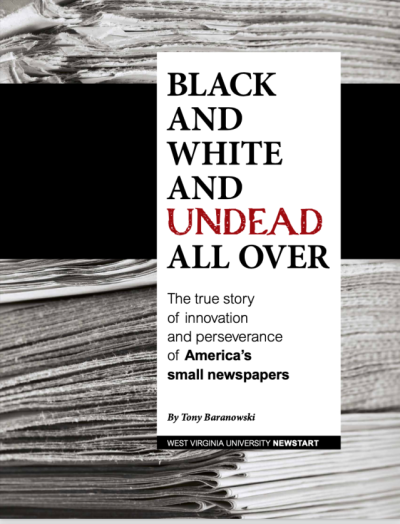
A new report by Tony Baranowski, director of local media for Times Citizen Communications in Iowa Falls, Iowa, makes the point. While he was a fellow at the West Virginia University Reed College of Media and the West Virginia Press Association’s NewStart Program, he studied several newspapers in the Upper Midwest in depth and surveyed more than 50 small newspaper publishers across the country.
What he found was that, despite the narrative that local newspapers are dying, these independent papers were keeping their heads above water. Baranowski writes:
The strongest community news outlets are locally owned and managed by families or individuals with local ties that stretch back decades. That’s not an easy circumstance to replicate for a would-be publisher looking to buy or launch a news organization in a rural town, but it’s not a prerequisite, either. In fact, the common denominator is less longevity than fostering community spirit and pride within both staff-generated content and advertising in a traditional newspaper’s pages.
Among the people interviewed in Baranowski’s report is Jim Slonoff, the co-founder and publisher of The Hinsdalean, a free paper launched in suburban Chicago in 2006. I wrote about The Hinsdalean a couple of months ago to highlight its practice of signing up members of the community to write essays on a variety of topics. Although running unpaid columns is hardly new territory for local newspapers, The Hinsdalean actively recruits writers and limits them to a two-year term, ensuring a steady stream of fresh voices.
Like many of the people Baranowski spoke with, Slonoff said The Hinsdalean’s emphasis remains on print rather than digital. Slonoff said:
That’s the thing I don’t get about newspapers in general, because so many of them put so much money and resources into their websites with no return. We took the 180 degrees approach and said our money is coming from display advertising and real estate advertising. Why would we not focus on that? Facebook doesn’t bring us any money, Twitter and Instagram don’t. There’s nothing I get out of it that I know of, except we’re there. And we get a lot of likes and things and get a lot of this and comments and that feels good.
That might seem like a retrograde approach, but it’s one I’ve heard from a number of publishers who have to figure out how to break even.
The Provincetown Independent actually charges more for digital subscriptions than for a print-plus-digital combination, telling readers that “if we were to go online only, the savings in not having to print and mail the paper would not be anywhere near enough to make up for the loss of print advertising revenue.”
Last week I interviewed Jerry and Ann Healey, who sold their Colorado Community Media newspaper group earlier this year to The Colorado Sun, a start-up digital news organization, in a deal put together by the National Trust for Local News. They told me that, in many cases, when they offered a package combining digital and print, their advertisers weren’t interested — they wanted to be seen in the print newspaper. “In the community newspaper space, print is still a viable thing,” Jerry Healey said, “and the advertisers know that too.”
Then there’s Kris O’Leary of Central Wisconsin Newspapers, who told Baranowski that her readership includes Amish and Mennonite communities. Not much digital potential there.
Another of Baranowski’s findings is that newspapers with offices in the communities they cover tend to be healthier than those that have consolidated operations far from the people they serve.
If this sounds like Baranowski is recommending a back-to-the-future approach, it may be because he’s surveying local journalism in the rural heartland. A digital-first approach makes sense in affluent urban and suburban areas where readers can be persuaded to sign up for online-only subscriptions.
But in some parts of the country, technological advances have not changed the media all that much over the past several decades. It is in such places that journalism can do well by following a model that would have been familiar to our grandparents — independently owned newspapers, rooted in the community and supported by local businesses.
I’m in Denver for a week of reporting on The Colorado Sun and the Denver media ecosystem. And the food is outstanding at Henry’s Tavern. That’s a copy of Westword, the city’s still-kicking alt-weekly, on the left.
Washington Post columnist Jennifer Rubin ignored one of the most basic rules of going off the record this week — and got burned as a result.
Politico’s West Wing Playbook on Thursday ran a longish item on Rubin’s favorable coverage of the Biden White House, including her adopting some of the same complaints about media coverage used by administration officials.
“One Post employee said some people in the newsroom are increasingly frustrated that Rubin is parroting the administration’s critiques of the media, which they believe emboldens the administration to push back on journalists even further,” write Politico’s Alex Thompson and Nick Niedzwiadek. “Two others say they just try to ignore her or don’t read her columns.”
Thompson and Niedzwiadek write that they contacted Rubin for comment, and she responded with an email whose subject line was “OFF THE RECORD.” They proceeded to publish her response in full:
How utterly predictable that Politico would run the zillionth hit piece on a prominent woman, especially one candid in her critiques of Politico’s hysterical, clickbait style of coverage. The notion that I am polarizing in a newsroom (as opposed to any of the dozens of other opinion writers) is a “take” only Politico could come up with — by of course running around to ask the question in the first place. I trust the Post’s superb news side folks spend zero time thinking about me (as is entirely appropriate). My only surprise is that Sam [Stein, POLITICO’s White House editor], a very good journalist, would become enmeshed in such an obviously misogynistic publication. Surely there are finer publications that would have him.
And btw, what a low class move to do this on Yom Kippur at the last moment.
So what’s going on here? Both parties have to agree in order for something to be off the record. Thompson and Niedzwiadek write that they had no such agreement with Rubin — she simply sent her email assuming they would respect her wishes. They didn’t, nor should they. Journalists sometimes going along with such requests, especially if they come from a source with whom they have a longstanding relationship. But it should never be taken for granted. Rubin knows that, of course, and I wonder if she wrote her response half-expecting that Politico would use it.
In case you’re not familiar with her, Rubin has morphed over the years from a staunch conservative to a Never Trump conservative and now into a moderate liberal.
Finally, the Politico item is very Politico, snarky and assuming without evidence that Rubin is somehow acting in bad faith by writing favorably about President Biden and agreeing with the White House’s often-valid gripes about the media. Without her not-off-the-record quote, it wouldn’t be worth a read.
Their goal is to raise $300 million in order to finance deals like the purchase earlier this year of Colorado Community Media, a chain of two dozen weekly and monthly papers in the Denver suburbs. The papers are now being run by The Colorado Sun, a start-up website founded by a number of former Denver Post journalists.
My colleague Ellen Clegg and I interviewed Hansen Shapiro recently to ask her about the National Trust. We especially wanted to learn more about how she had arrived at the $300 million figure, which she had told Ben Smith of The New York Times might be enough to save every independent community paper in the United States that is at risk of shutting down or being sold off to a chain owner.
She told us that her estimate was based on research showing that there are about 4,000 independent weekly and daily papers — what she called “sub-large-chain titles,” to include those held by small regional chains — with perhaps as many as 2,400 owners. Here is how she described the National Trust’s strategy:
We’re approaching it two ways. One is inbound interest from publishers who are ready to retire and want to figure out what the next move is. Some of them have successors lined up, but they don’t have financing. Some of them don’t have successors lined up and their businesses are failing. And that’s the house-on-fire version. And some of them have great businesses. They don’t have a successor. They think they want to be out of the business in two years, and they’re like, could we start a conversation now so that so we can figure out something?
Any paper can be kept out of the hands of a hedge fund or a corporate chain is a victory.
Like all of us who are old enough, I have vivid memories of Sept. 11, 2001, just as our older brothers and sisters do about the assassination of John F. Kennedy and as our parents and grandparents did about the attack on Pearl Harbor. As others have said over and over again, it was a cool, clear morning, a preview of fall. I was working at The Boston Phoenix, where I covered media and politics. I stepped outside to get coffee and ran into an old acquaintance.
“Isn’t it terrible what happened at the World Trade Center?” she asked.
I didn’t know what she was talking about. I hurried inside. American Airlines Flight 11, which originated at Logan Airport in Boston, had crashed into the North Tower. There was talk of terrorism.
The Phoenix did not have what you would call a well-equipped newsroom. We had a TV that got a handful of channels but no cable. It was obvious what I would be writing about, so I raced to my car and hurried home to the North Shore. I turned on the radio and listened to coverage of the second tower’s collapse just as I was rounding the bend to Route 1. And then I sat down in front of the television set, watching for hour after hour and wondering how I would make sense of it all. Finally, sometime well after midnight, I started to write.
The piece I came up with was headlined “The End of Decadence.” In it, I expressed my hope that the media would finally return to a sense of purpose and seriousness after a decade of wallowing in celebrity culture, the O.J. Simpson trial and the theater-of-the-absurd impeachment of a president over his tawdry sex life.
In fact, the media did change after 9/11, but not for the better. The downward slide didn’t happen immediately. At first, the press diligently covered the aftermath of the attacks. The New York Times ran a wonderful series on the victims called “Portraits of Grief.” Journalists sought to make sense of how security measures aimed at preventing such attacks had so thoroughly broken down. The hunt for Osama bin Laden was covered with great enterprise and courage.
But it wasn’t long before President George W. Bush, a unifying figure in the days immediately after the attacks, began leading the nation in a divisive direction. His uplifting rhetoric about Muslims was offset by the government’s treatment of Muslims as a security risk. He went to war not just in Afghanistan but in Iraq, claiming — falsely, as it turned out — that Saddam Hussein’s regime possessed weapons of mass destruction.
And the media went along for the ride. Few questioned the Bush administration’s claims about Iraq, and few questioned why our incursion into Afghanistan had turned into a full-fledged war to transform a place we didn’t understand into a Western-style democracy. The Times in particular disgraced itself with its credulous, gung-ho coverage, but so did most other news outlets — especially cable news. My late friend Danny Schechter, the “News Dissector,” called it “militainment,” a construction he borrowed from James Poniewozik, then with Time magazine, now with the Times.
Over the next few years, the wars and the Bush White House both lost support, and the media began to fracture into what we see today — a reflection of the polarization that has made it nearly impossible for Democrats and Republicans even to speak to each other. On one side we have the mainstream media, hardly perfect but dedicated to reporting the truth, trusted by about 60% of the country. On the other side we have right-wing propaganda that has convinced 40% of the country that Donald Trump won the 2020 election, vaccines are dangerous and critical race theory is the most serious threat facing us.
Last month, the 20-year misadventure set off by 9/11 was finally brought to an end as the United States pulled its last remaining troops out of Afghanistan. It was a chaotic, ugly finish, and President Joe Biden has received quite a bit of criticism for it. But it does bring a close to the story that began on that clear September day in 2001.
The conclusion of the war in Afghanistan ends an era in journalism as well. Think back to where we were. Fox News was barely a blip on the radar. CNN consisted of straight news rather than opinionated talk shows. There was no Facebook, no Twitter, no broadband. The internet-driven collapse of newspapers was still in the future. In other words, it was a time of consensus in the media and in the culture, at least compared with what was to come.
Over the weekend, Bush was praised for his forthright denunciation of the Trump-inspired domestic terrorists of 2021. “There is little cultural overlap between violent extremists abroad and violent extremists at home,” he said. “But in their disdain for pluralism, in their disregard for human life, in their determination to defile national symbols, they are children of the same foul spirit. And it is our continuing duty to confront them.”
That’s all well and good. But it was Bush, Dick Cheney and Donald Rumsfeld who started us down the road to Jan. 6 with their catastrophic wars, their trampling of civil liberties in this country and their use of torture abroad. And it was a combination of cowardice and gullibility on the part of too many in the media that helped bring us to the crisis of democracy we are dealing with today.
Biked 23-plus miles along the Minuteman Bikeway, end to end, and back via the Alewife Brook Greenway. Check out the fall colors at Great Meadows. Soon it will be snowing!
What could shock us about Facebook at this point? That Mark Zuckerberg and Sheryl Sandberg are getting ready to shut it down and donate all of their wealth because of their anguish over how toxic the platform has become?
No, we all know there is no bottom to Facebook. So Jeff Horwitz’s investigative report in The Wall Street Journal on Monday — revealing the extent to which celebrities and politicians are allowed to break rules the rest of us must follow — was more confirmatory than revelatory.
That’s not to say it lacks value. Seeing it all laid out in internal company documents is pretty stunning, even if the information isn’t especially surprising.
The story involves a program called XCheck, under which VIP users are given special treatment. Incredibly, there are 5.8 million people who fall into this category, so I guess you could say they’re not all that special. Horwitz explains: “Some users are ‘whitelisted’ — rendered immune from enforcement actions — while others are allowed to post rule-violating material pending Facebook employee reviews that often never come.”
And here’s the killer paragraph, quoting a 2019 internal review:
“We are not actually doing what we say we do publicly,” said the confidential review. It called the company’s actions “a breach of trust” and added: “Unlike the rest of our community, these people can violate our standards without any consequences.”
Among other things, the story reveals that Facebook has lied to the Oversight Board it set up to review its content-moderation decisions — news that should prompt the entire board to resign.
Perhaps the worst abuse documented by Horwitz involves the Brazilian soccer star Neymar:
After a woman accused Neymar of rape in 2019, he posted Facebook and Instagram videos defending himself — and showing viewers his WhatsApp correspondence with his accuser, which included her name and nude photos of her. He accused the woman of extorting him.
Facebook’s standard procedure for handling the posting of “nonconsensual intimate imagery” is simple: Delete it. But Neymar was protected by XCheck.
For more than a day, the system blocked Facebook’s moderators from removing the video. An internal review of the incident found that 56 million Facebook and Instagram users saw what Facebook described in a separate document as “revenge porn,” exposing the woman to what an employee referred to in the review as abuse from other users.
“This included the video being reposted more than 6,000 times, bullying and harassment about her character,” the review found.
As good a story as this is, there’s a weird instance of both-sides-ism near the top. Horwitz writes: “Whitelisted accounts shared inflammatory claims that Facebook’s fact checkers deemed false, including that vaccines are deadly, that Hillary Clinton had covered up ‘pedophile rings,’ and that then-President Donald Trump had called all refugees seeking asylum ‘animals,’ according to the documents.”
The pedophile claim, of course, is better known as Pizzagate, the ur-conspiracy theory promulgated by QAnon, which led to an infamous shooting incident at the Comet Ping Pong pizza restaurant in Washington in 2016. Trump, on the other hand, had this to say in 2018, according to USA Today: “We have people coming into the country or trying to come in, we’re stopping a lot of them, but we’re taking people out of the country. You wouldn’t believe how bad these people are. These aren’t people. These are animals.”
Apparently the claim about Trump was rated as false because he appeared to be referring specifically to gang members, not to “all” refugees. But that “all” is doing a lot of work.
The Journal series continues today with a look at how Instagram is having a damaging effect on the self-esteem of teenage girls — and that Facebook, which owns the service, knows about it and isn’t doing anything.