No more ‘paper of record’: McGrory offers more details on the Globe’s reinvention

Also published at WGBHNews.org.

Earlier this week Boston Globe editor Brian McGrory promised his staff that he’d soon be offering more details about the paper’s reinvention effort. Well, a little while ago his latest memo came floating in through my open window.

If you are interested in the future of the Globe then you should read it in full; it defies summary. My instant takeaway, though, is that there are three points that deserve special attention:

  • The Globe is moving away from the idea that it needs to be a paper of record in the old-fashioned sense. Rather, McGrory wants it to be “an organization of interest.” In other words, no more obligatory process stories about things that few readers care about.
  • The news cycle will be reorganized to move further away from the deadlines demanded by the print schedule. Instead, stories will be published online throughout the day and night, with an “Express Desk” playing a key role in that.
  • The old barriers separating the newsroom and business sides will be rethought. There is an industry-wide view that at a time when revenues are shrinking, new working relationships need to be defined as long as they don’t compromise the integrity of the journalism. Easier said than done, of course.

The full text of McGrory’s memo follows.

Hey all,

I wanted to give you an update on where we are with the reinvention initiative. The intention was to be brief. The reality is that it’s not. My apologies in advance.

The presentations by the four sets of working group chairs in late November went incredibly well. I hope everyone agrees. The pitches were strong, the questions and comments were smart, and there seemed to be an unmistakable consensus around the need for change. Following those meetings, I’ve sat with a decent swath of the newsroom in one-on-one and small group meetings to get a sense of your thoughts and concerns. I’ve found it truly helpful, to say the least. Your sheer brains and commitment all but guarantee our success in the weeks, months, and years ahead.

Separately, we’ve put together a core reinvention committee, composed of the eight working group chairs, and the deputy managing editors, managing editors, and the editorial page editor. We’ve met several times to begin mapping out initiatives that we can roll out as soon as this month. We’re making good progress, but we need to step it up.

Indulge me while I repeat some of the principles behind a reinvention:

  • We need to be still more interesting, relentlessly interesting, every hour of the day. To this end, we need to jettison any sense of being the paper of record. We are the organization of interest. If something feels obligatory to write, it’s an obligation for someone to read. The problem is, readers don’t feel that obligation any more.
  • We need to focus on what readers truly value, understanding that we can’t be all things to everyone. The great news is that Globe subscribers most want to read the kinds of stories that we most like to produce. Think accountability journalism, colorful and contextual breaking news reporting, lyrical narrative, smart enterprise reporting, and provocative commentary.
  • We need to focus not on platforms, but on journalism. We must redouble all efforts to demolish the stubborn rhythms of a legacy news operation and get our work in front of people when they are most likely to read it.
  • We need to make sure that the boundaries that served us well in better financial times don’t become obstacles to our success. Put more bluntly, we need to work with the other departments to make sure we have enough revenue to support our journalism.
  • We always need to hold true to our journalistic values, because without them, we lose our credibility. Repeat this last one again.

So here’s a rough map of where we go from here, understanding that this remains very much a work in progress, and there will be bumps—really mountains—to traverse along the way.

1. You’ll receive a questionnaire via email soon, prepared by Jen Peter [senior deputy managing editor for local news] and Anica Butler [assistant metro editor], asking, among other things, what beats you’ve dreamed of covering or what jobs you’d most like to have. It could be the one you have now, it could be something else, it could be a role that we haven’t thought about but will want to have when we hear it. Please respond to this questionnaire. We need to hear from you.

2. We’re planning to set up a room-wide Express Desk as soon as possible. This is designed to get news in front of the eyes of our readers quickly, and to have a fascinating diversity of news. It could be a water main break in the Financial District one moment, a passenger handing out Christmas gifts on an arriving JetBlue flight the next. This desk needs to not only be urgent, but smart and clever, and it will be powered by some of the most talented people in this room. I’ve asked Katie Kingsbury [managing editor for digital] to lead a small group in mapping out an Express Desk in terms of size and positions, and she’ll have something back to us very soon.

3. We’re planning to set up a Print Desk, congruent with the Express Desk. While the larger room focuses on journalism, the print desk will focus on how that journalism comes together in paper form every day. Let me be absolutely clear here: The physical newspaper will not be an afterthought at the Globe. It is of vital importance to us, a huge—albeit, declining—source of our revenue, and the most valued product to our most loyal readers. But it cannot continue to needlessly dominate our thinking and resources in the way it currently does. I asked Chris Chinlund [managing editor for news] to lead a small group in determining the size and components of this operation, and she, too, will have something back in early January.

4. We’ll expand on our excellence in projects, with an eye toward even more, with a greater range of ambition and length (some even shorter than this memo).

5. We’ll set up an Audience Engagement team under Jason Tuohey [deputy managing editor for audience engagement] designed to make sure we are better connecting to existing audiences, and seeking new audiences, in every way possible, through our journalism and the way we present it. We are swimming in metrics. The goal now is to refine, interpret, and apply them. We will offer whatever training is necessary to work on the team.

6. We will reimagine our beats with the same eye toward becoming relentlessly interesting. I don’t know that we’ve done a major refresh of our beats in decades. It’s time. So the reinvention group, or some subset of it, will outline new beats and recalibrate the resources we have on our coverage areas. The broader room needs to play a major role in this with your ideas, whether through the questionnaire or in conversations with me and others. Please express your creativity and passions, and do it soon.

In determining what we want to cover, it will become clearer to all of us what we should forego, or at least what we can cover less of. As part of this, we’ll look at presenting news in different formats, to cut down our overuse of the incremental 700-word story.

7. We will refine and then refine again the Hubs system that was proposed by the Mission working group, but it’s not quite ready to be implemented yet—or maybe we as a room are not quite ready to accept it. There are many intriguing, even brilliant, aspects to the Hubs concept, which would push us to be far more nimble, provocative, and—this word, again—interesting But there needs to be more clarity in how it would work day to day. My sense is that we’re getting snagged up on Hubs as the infrastructure of the room. If we create Hubs within the infrastructure, we will get a better sense of how they’ll work and how effective they can be. So that’s exactly how we’ll start. Hub ideas are welcome.

8. We are planning to appoint a small, tech-savvy group that will devote itself to making Methode more user-friendly and an overall better communications tool for the entire room. [Methode is the Globe’s content-management system.]

9. We are setting up groups to further engage Advertising and Circulation, hoping to involve the newsroom deeper in both areas. On Circulation, we will focus on subscriber retention, with some acquisition, working with our colleagues there to do direct outreach to subscribers. On Advertising, we are putting together a newsroom-based advisory group to offer input on all forms of sponsored and native campaigns, with the intention to ratchet up the creativity that goes into these campaigns. David Dahl [deputy managing editor for operations] is currently drawing up rules of the road to make sure that we don’t put ourselves in a compromising position.

10. We’ll be looking, soon, to get much of the room started earlier in the day, and impose rolling deadlines on enterprise stories through the day, to assure that we have a flow of fresh stories when people are most likely to read them. Still too many stories are posted on the site in the evening, because we’ve followed old-school print deadlines. That’s got to stop. The news meetings will be pushed up soon, probably to 9 a.m. The morning meeting will focus on brainstorming ideas, and the specifics of when stories will be posted. The afternoon will include the timing of web stories, but focus too on the print paper.

Key point: As part of this, we have to fulfill the promise to everyone in the room that as you get here earlier, you leave earlier. Foreign as this might seem, it is very doable.

Over the next few weeks, a dedicated group will basically create a blueprint for a reimagined newsroom, carving out the new desks mentioned above, prescribing headcounts to each of these areas, and getting right down to specific beats, possible Hubs, and reconfigured departments. You aren’t just invited to be a part of it, you need to be a part of it. Offer up your thoughts. We’ll come back to the room soon with what we have.

There’s more, especially in terms of communications and the culture of the room. And please keep in mind that this is not a one-and-done project, but a constant evolution; some of the things we change will need to be changed again.

In sum, picture a newsroom that kicks to life before dawn, as members of an Express Desk arrive and continue to flow in through the morning, ready to post breaking news, fashion clever ideas, and find the wryest stories trending on social media. Picture the larger room starting their jobs by 9 in most instances, ready to publish at peak times. Picture a round-the-clock multiplatform desk ready to give stories an expert workover regardless of the hour they are submitted.

Picture a wider range of fresher beats to produce a steady stream of fascinating stories. Picture a story-telling team from product and development working on hubs to create extraordinary presentations. Picture respected and experienced “priority editors”—what one working group described as “air traffic controllers” and another as “traffic cops”—making the best use of our journalism across the day, the week, and the platform. In this scenario, the print desk begins arriving in the early afternoon, working with a team of talented designers to produce a stunning newspaper for the following morning.

Lift the lens a bit and see an even broader picture, of a room more inclined to pursue risks and more accepting of the inevitable failures. It is an enterprise more crusading in our approach, an organization that not only covers the region, but regularly provokes it—by holding the powerful accountable, giving voice to those who wouldn’t otherwise have one, advocating for what works, and being our readers’ best ally. All the while, we will be working closely with the business side to drive digital subscriptions, keep our existing subscribers happy, and offer our creativity to native content.

Easy, right?

Probably not, but we will accomplish this in the coming months, your help very much required. Please continue to speak up. We need to hear from you.

Brian

Talk about this post on Facebook.

Falsehoods, lies, and the challenge of covering Donald Trump

trinnierview

President-elect Donald Trump, as we know, is a flagrant and profligate teller of untruths. The Pulitzer-winning nonpartisan website PolitiFact reports that fully 69 percent of Trump’s public statements during and after the campaign were either mostly or entirely false. We find ourselves in uncharted territory.

Which is why a simmering debate over whether journalists should label his falsehoods as lies broke out on the Sunday talk shows.

Read the rest at WGBHNews.org. And talk about this post on Facebook.

Questions remain about the Washington Post’s reporting on the Vermont electrical grid

The Washington Post appears to have overreached significantly in its report last Friday that Russian hackers had penetrated Vermont’s electrical grid. Later that evening it was revealed that malware associated with the Russians was found on just one Burlington Electric laptop that was not attached to the grid. On Monday evening the Post published an updated story reporting that even that was an overstatement.

Although we don’t know yet exactly what went wrong, Kalev Leetaru’s analysis at Forbes, much of it based on looking at how the story changed over time, strikes me as very good. Leetaru writes that it appears the Post did not try to contact Burlington Electric until after the first version of its story had been published online—an important oversight if true. Certainly there was no indication in the Post’s first story that its reporters had attempted to contact the utility.

Yet I want to push back a bit on the idea that no one except the Post had reason to believe there was anything to this story. At Vermont Public Radio, you’ll find an article published on Friday, after the Post, that includes this statement from Burlington Electric spokesman Mike Kanarick:

Last night, U.S. utilities were alerted by the Department of Homeland Security (DHS) of a malware code used in Grizzly Steppe, the name DHS has applied to a Russian campaign linked to recent hacks. We acted quickly to scan all computers in our system for the malware signature. We detected the malware in a single Burlington Electric Department laptop not connected to our organization’s grid systems. We took immediate action to isolate the laptop and alerted federal officials of this finding. Our team is working with federal officials to trace this malware and prevent any other attempts to infiltrate utility systems. We have briefed state officials and will support the investigation fully.

In other words, government officials and Burlington Electric were taking this very seriously indeed—even if the Post had incorrectly reported that the grid had been breached. Yes, of course, the Post should have been more careful. But we’re in the midst of a much larger, unfolding saga of Russian hacking. Perhaps it’s time for everyone to take a deep breath.

Update: Taylor Dobbs of Vermont Public Radio, a distinguished Northeastern journalism alumnus, has an excellent follow-up. Unfortunately it’s still not entirely clear whether the Post attempted to contact Burlington Electric before publishing. Post spokeswoman Kris Coratti says yes; the utility’s general manager, Neale Lunderville, says no.

Talk about this post on Facebook.

McGrory promises details about the Globe’s reinvention ‘in a few days’

Boston Globe editor Brian McGrory has outdone himself with a 1,550-word New Year’s message to his staff, a copy of which a kind newsroom soul sent me on Sunday. McGrory is full of praise for the accomplishments of the past year while cognizant of the problems caused by continued budget cuts.

There is news here, too: He promises some details about the paper’s ongoing reinvention effort “in a few days.”

The full text of McGrory’s message follows.

Hey all,

It’s odd, the things you remember about a given year. It was raining out, not a warm, soothing rain, but freezing little icicles that prick your skin again and again and again. The sun hadn’t come up. I’m not sure it ever did. The sidewalks were a hockey rink. And Ellen Clegg, the wheelwoman on our two-person delivery route that Sunday morning last January, apparently had just about enough of my methodical pace. So she slammed her SUV into park and began running down a Wellesley street tossing papers on subscribers’ driveways.

We were but two delivery people in a vast newsroom army, one that had been organized a week earlier by Beth Healy. Person after person answered the call, reporters, editors, designers, photographers, graphic artists, technologists, owners—you name it. And for those who couldn’t deliver, they worked the phone banks or created daily delivery spreadsheets. It felt like the ground was cracking under our feet, but this newsroom would do everything it could to preserve the integrity of the Globe.

While many of us remember delivering the papers those subsequent Sundays, it’s what was in the papers themselves that matters most. In those issues, it was a pair of important stories on questionable influence in City Hall. It was a brilliantly written feature on the development boom leading to obstructed views. It was an essay on Donald Trump’s unfiltered style, a gripping enterprise story on a high-level drug trafficking informant, and a fresh look at the ballooning pricetag for the Green Line extension. In sum and as usual, it was vital and interesting Boston Globe journalism, well worth whatever effort it took to get it in the hands of our readers.

The year may have begun in crisis. It ends, however, with a crucial dose of introspection—an unsparing review, part of a broad reinvention initiative, of what works and what doesn’t at the Globe, what we need to change, and how we will change it. This is among the most important work we’ve done this year, and I’ll be back to you in a few days with more details on the road ahead.

For now, though, let’s be grateful that we had such a quiet year, news-wise, to devote ourselves to this important work.

Yeah, right.

Somewhere between helping to save the Globe and then reinventing it, you produced some of the finest journalism in the industry, and some of the best I’ve seen in my time here—in a year unlike any other. Take the Washington Bureau. Have five people—seriously, just five people—ever produced such an extraordinary body of riveting and vital work, from the stories on Trump’s business dealings, to the internal workings of Clinton’s orbit, to a nation’s anger, and so much more? It just kept coming, fresh enterprise, news stories with exceptional voice and context, pieces that larger, national news organizations had no choice but to follow. I honestly don’t believe that Matt Viser and Annie Linskey, with Chris Rowland’s guiding hand, wrote a story all year that I wasn’t eager to read—and then delighted that I did. And Vicki McGrane has only added to it all.

Take our Business department. If 2015 was the year it established its own section, 2016 was when it made it an utterly must-read part of the Globe. You start naming names, you start getting into trouble, but how do you not cite Shirley Leung’s work on Ed Ansin, General Electric, and anything else she touched? Does Jon Chesto ever sleep? Does Tim Logan have the entire development community wired? Does Beth Healy ever back down? I could go on and on, beat after beat, but suffice it to say that the entire department brought urgency and freshness to the report virtually every day.

If anyone thought that Jess Rinaldi’s Pulitzer Prize for her incredible Strider Wolf portfolio would cause the Photo Department to kick back a bit, well, you don’t know the Photo Department. Who will ever forget Keith Bedford’s arresting images from Methadone Mile in July, or Suzanne Kreiter’s chilling work on Spotlight’s mental health series, or the daily offerings of just about everyone else, from the veterans with elaborate morning rituals to the guy from Denver, to our great sports shooters, all of it so good that it helped change the look and tone of our print front page.

Sports chronicled the early endings to a pair of otherwise incredible seasons—the Patriots last January and the Red Sox in October. Seriously, there’s no regional news organization in the country that has four pro sports teams staffed with more authority and insight than the Globe, with our stable of expert beat reporters, supported by a best-in-show editing operation and production desk. Celtics, Bruins, Patriots, Red Sox, there’s nobody better. Throw Shaughnessy and Gasper into the mix and we can’t be beat.

Metro had another banner year, with strong accountability reporting on government influence, more groundbreaking coverage of the opioid crisis, political reporting that drove key ballot questions on marijuana legalization and charter schools, Kay Lazar’s continued watchdog reporting on abuses in the state’s nursing homes—stories that have pretty much defined our daily goal of giving voice to those who wouldn’t otherwise have one. The beat reporting, whether on transportation, higher ed, hospitals, casino gambling, and so much more, has been stellar. And the in-depth work has been some of the most fascinating and important that I can recall, whether Nestor Ramos and Evan Allen on Methadone Mile, or Eric Moskowitz on the election night trolley crash, or Maria Sacchetti on ICE and the secret release of dangerous immigrants, or Billy Baker on Will Lacey. Yvonne Abraham had a breakout year with her powerful commentary, and Josh Miller might produce the most engaging political newsletter in the industry.

Living/Arts helped drive us further into the realm of a digital first enterprise. Our extraordinary stable of critics, let by Matthew Gilbert, was a force of nature online. Ty was must reading across the year on movies and all things culture, and Sebastian is what he is, which is the best visual arts critic in the nation. But really, theater, classical music, photography, we owned it with an insightful voice, and our Sunday Arts section remains one of the absolute best of any news organization, national or regional, in the country. Our feature writers, too, have regularly splashed color on the homepage and front page—clever, smart, fresh stories. Dugan buying marijuana was worth the price of a month’s subscription all by itself.

Spotlight had a year for the ages, producing powerful reports on multiple fronts while only enhancing the quality and impact that is its trademark. The mental health series, big, bold, and beautifully told, again gave voice to those who wouldn’t otherwise have one. The team’s urgent but exhaustive work on predatory sexual behavior at elite private schools, which began with Bella English back in Features, has been life-changing for victims. And imagine being a partner at the Thornton Law Firm?

The list keeps going on and on. Our copy editing team is in a class of its own, uniformly respected across the enterprise for every good reason. Our Globe.com team has been pivotal in orchestrating another record year of viewership and, if it’s a word, subscribership. Their collective news judgment, urgency, and knowledge of the digital habitat are all flat-out impeccable. Graphics and design has made us bolder and more confident with pitch-perfect graphics, extraordinary digital presentations, and fresh front pages and section fronts. Our magazine remains at the very top of every reader survey, understandably so, and is the envy of the industry. While we’re talking popular, our Address, Travel, Food, and Good Life sections give our readers knowledge wrapped in style and flair week after week. Finally, a special hand to the editors and reporters of boston.com, who have miraculously preserved traffic in the face of substantial cuts. How? By working like crazy to produce a smart site.

On the issue of cuts, let’s be honest about it: we’ve lost a lot of people again this year and it doesn’t get any easier. These aren’t so much good people as great people, experienced journalists who have helped build the foundation for our success. But it’s testament to our extraordinary depth, resilience, and character that we have done this well in the face of the relentless pressures of a profoundly changing industry.

I wish we could glide on our accomplishments for a while—but that’s not possible, and the truth is, you’d get bored. You would, right? We’ve got too much to do in 2017. We’ll reinvent how we produce our journalism. We’ll move to innovative space in downtown Boston. We’ll be relentlessly interesting. We’ll drive the civic conversation in Greater Boston and beyond. We’ll hold the powerful accountable and give voice to those who need to be heard.

We should all be incredibly proud of where we’ve just been. We should be even more excited about where we’re about to go. Me, I’m also honored to be part of the smart, engaging, deeply committed group that is the Globe newsroom. Really, it’s something special, and every person reading this has a vital role.

Have a healthy, happy, and safe New Year. My sincere thanks to you all.

Brian

Talk about this post on Facebook.
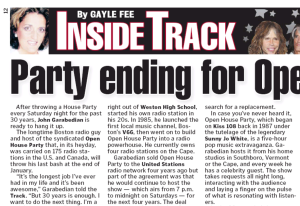
‘Inside Track’ columnist Gayle Fee is leaving the Herald

screen-shot-2016-12-29-at-2-01-52-pmTime was when the “Inside Track,” the Boston Herald‘s gossip column, was among the most read—and feared—media outposts in the city. For years, Laura Raposa and Gayle Fee tracked the famous and tormented the powerful. And before them was the late Norma Nathan, whose column was called “The Eye.”

Well, gossip isn’t what it used to be. Raposa retired a few years ago into order to become a professional foodie along with her husband (and former Media Nation roommate) Steve Syre, a retired business columnist for the Boston Globe. Together they operate the Foodsmith in Duxbury.

And now Fee is leaving the Herald, according to an email she sent to colleagues that I obtained a little while ago. Her last day is Friday, but she’s working right up until the end: today she has a piece on the retirement of local man-about-town John Garabedian as well as a compilation of tidbits.

Here is the text of Fee’s email:

Moving On …

Hello Everyone—Please excuse the mass email—I wanted to let you all know that Friday will be my last column for the Boston Herald. After 33 years at the paper, 25 at the Inside Track, it’s time for me to say goodbye….

I wanted to say what a pleasure it has been to work with all of you over the years and hopefully we will stay in touch.

Thanks for everything—

Best, Gayle

And best wishes to Fee as she embarks on the next phase of her life.

Talk about this post on Facebook.

Alphonse Mouzon, a great jazz drummer, has died

As 2016 draws to a close, another great artist has died. This one, though, was not a celebrity. Alphonse Mouzon was a terrific jazz drummer with a long, varied career. I know him best from McCoy Tyner’s Enlightenment (above), a suite that was recorded live at Montreux in 1973. (If you’ve never heard it, I recommend it. It is deeply spiritual in the manner of John Coltrane’s A Love Supreme, on which Tyner played.)

According to the New York Times obit, Mouzon “learned this fall that he had neuroendocrine cancer and used a crowdfunding platform to help pay for treatment.” Not that the deaths of Prince, David Bowie, George Michael, Carrie Fisher, et al. weren’t every bit as tragic. But that’s a detail you don’t often see when reading about the death of a musician who at one time was fairly well known.

Talk about this post on Facebook.

The Globe increases its weekly home-delivery price by—well, we’re really not sure

screen-shot-2016-12-29-at-10-28-51-am

A friend just forwarded this to me. I have edited out his name, but the blank spot after “Your new weekly rate will be” is entirely the doing of the Boston Globe. Note that you can’t respond to the email.

Adam Gaffin of Universal Hub got one of these as well.

Pay whatever you think it’s worth?

OK, I looked it up. Assuming this is up to date, a seven-day print subscription will cost you $14.34 a week after you get past the introductory offer.

Talk about this post on Facebook.

My five most-read WGBH News columns from the past year

dan_kennedy_raw

Usually this is the week when I post a list of the most-trafficked stories on Media Nation during the past year. Since this blog in 2016 was mainly a repository for my weekly column at WGBHNews.org, I don’t think that makes a lot of sense.

Fortunately, my friends at WGBH have compiled my five most-read columns from the past year. I hope you’ll take a look.

Talk about this post on Facebook.

The war against ‘fake news’ is over. So what’s next in restoring media credibility?

Rush Limbaugh. Photo (cc) by xxx.
Rush Limbaugh. Photo (cc) 2010 by Gage Skidmore.

Don’t say I didn’t warn you. A little over a month ago I wrote that if we tried to expand the definition of “fake news” beyond for-profit clickfarms, then the movement to eradicate hoaxes from Facebook and other venues would quickly degenerate into ideologically motivated name-calling.

And so it came to pass. The New York Times on Monday published two stories that, for all purposes, mark the end of the nascent battle against fake news.

The first, by Jeremy Peters, details the efforts of Rush Limbaugh, Breitbart, and other right-wingers to label anything they don’t like that’s reported by the mainstream media as fake news. The second, by David Streitfeld, documents how the right has unleashed its flying monkeys against Snopes.com, the venerable fact-checking site that is the gold standard for exposing online falsehoods.

Read the rest at WGBHNews.org. And talk about this post on Facebook.