H.F. “Gerry” Lenfest didn’t want to run a newspaper. In 2014 the Philadelphia billionaire, who died last week at the age of 88, unexpectedly won an auction to buy the city’s paper of record, the Inquirer, and its sister properties, the Daily News and Philly.com, media outlets that he already owned in part and was hoping to unload. “He did not expect to have to write a check that day,” Joel Mathis, a former reporter for Philadelphia magazine, told me. “He thought he was going to be getting a check that day.”
Just a few weeks later, Lenfest’s business partner, Lewis Katz, was killed in a plane crash along with six others, leaving Lenfest as the sole, unhappy proprietor. Lenfest’s solution to his dilemma was an act of generosity that continues to reverberate, and that could serve as a possible blueprint for saving the shrinking newspaper business. In early 2016 he donated the properties to a nonprofit organization, the Philadelphia Foundation. And he endowed the institute that the foundation set up to run the properties — now known as the Lenfest Institute for Journalism — with an initial $20 million from his fortune.
“Of all the things I’ve done, this is the most important. Because of the journalism,” Lenfest said when the complicated transaction was announced.
As it happened, I had already scheduled interviews with a number of Philadelphia journalists for a book project. I arrived on the Amtrak in the aftermath of a monumental snowstorm. What I encountered was a warm sense of (to invoke a cliché) cautious optimism.
Bill Marimow, the respected editor who had been fired or demoted twice through years of musical-chairs ownership, was particularly enthusiastic about the structure Lenfest had set up. Though the three properties would be owned by a nonprofit, they would be run as a for-profit “public-benefit corporation,” which meant that they would not be legally required to serve the financial interests of shareholders or investors.
“There’s parity between the mandate to do great journalism and the mandate to have an economically viable business,” Marimow said. “But the priority is no longer maximizing profits. It’s having sufficient profits to keep producing good journalism.”
These days, of course, there’s no guarantee that newspapers will have the resources to cover the communities they serve even without the pressure to turn a profit. Newspaper advertising, both in print and online, plunged from a high of $49.4 billion in 2005 to an estimated $16.5 billion in 2017, according to the Pew Research Center. Full-time newsroom employment fell by nearly half during roughly the same period.
Here and there a few wealthy newspaper owners are trying to figure out ways to revive their struggling businesses. Jeff Bezos’s efforts at The Washington Post are the best-known, but he runs what he has repositioned as a national digital news organization. The economics of large regional papers like the Inquirer are very different — and much more difficult. For every paper like The Boston Globe, where billionaire owner John Henry has attempted to minimize newsroom cuts while figuring out a path to sustainability, there are dozens owned by hedge funds and corporate chains that have plundered their newspapers in order to squeeze out their last remaining profits.
The nonprofit/for-profit hybrid model that Lenfest set up in Philadelphia is not a panacea. Ultimately, the papers still have to break even, an enormous challenge in the current environment. Still, the Philadelphia experiment has brought stable ownership, community-minded oversight and a journalism-first mindset to the Inquirer and its sister properties after years of chaos. That is a commendable legacy — and one worth emulating elsewhere.
Should a radical activist be allowed to publish instructions for using a 3D printer to create a fully operational plastic handgun? That’s the question facing U.S. District Court Judge Robert Lasnik, who has said he will hear arguments this Friday in a case that pits freedom of speech against public safety.
The activist, Cody Wilson, has been trying to upload those plans for five years but had been prevented from doing so by the federal government. He nearly succeeded last month, after the State Department withdrew its objections. But Lasnik issued a temporary restraining order in response to a lawsuit filed by eight states and the District of Columbia. Although Lasnik, who’s based in Seattle, acknowledged that the case presented “serious First Amendment issues,” he said there was “a likelihood of irreparable harm” if Wilson — described as a “techno-anarchist” in a 2015 Wired magazine profile — had been allowed to move ahead.
If Wilson wins, it is easy to conjure up the evils that might result: an endless supply of untraceable guns that could be smuggled past metal detectors at airports and elsewhere and that could be printed out by thrill-seeking adolescents once 3D technology becomes sufficiently cheap and reliable. But as an equally fraught case from a generation ago demonstrates, the concerns raised by dilemmas like these invariably prove to be overblown.
In 1979, The Progressive, a small left-wing magazine based in Madison, Wisconsin, sought to publish an article on how to build a hydrogen bomb. The magazine claimed that Howard Morland, an Air Force pilot-turned-freelancer writer, had obtained the information entirely from public sources. The government argued that some of the information Morland used wasn’t publicly available, and that in any case he had pulled the information together in such a way that it could accelerate the process of rogue nations acquiring nuclear weapons.
Publishing instructions on how to build a nuke might not seem strictly necessary. But The Progressive’s editor, Erwin Knoll, defended his motives. In an essay he wrote when Morland’s article was finally published, he said the article was meant to spark debate. “We hope that debate will be a beginning — a beginning of a process in which all of the nuclear policies pursued by our Government will be held up to public scrutiny and review,” he wrote. “We hope that the process will end in a reversal of those policies and an end to the suicidal nuclear arms race in which we have been unwitting, uninformed participants.”
Like Judge Laskin in the plastic-handgun case, U.S. District Court Judge Robert Warren issued a temporary restraining order against The Progressive, arguing that the harm caused by censorship paled in comparison to the prospect of nuclear war. “A mistake in ruling against The Progressive will seriously infringe cherished First Amendment rights,” Warren wrote. But, he added portentously, “A mistake in ruling against the United States could pave the way for thermonuclear annihilation for us all. In that event, our right to life is extinguished and the right to publish becomes moot.”
In arriving at his decision, Warren relied on two Supreme Court precedents. In Near v. Minnesota (1931), the court identified a few narrow exceptions to the First Amendment prohibition on censorship — including a serious breach of national security, which Warren applied to the Morland article. In New York Times v. United States (1971), the court ruled that the Times and The Washington Post could publish the Pentagon Papers, the federal government’s secret history of the Vietnam War, which would seem to cut against the government’s case regarding The Progressive. Warren, though, decided that the Pentagon Papers involved historical material rather than the possibility of future harm, and that The Progressive was also seeking to violate a specific federal law prohibiting the publication of atomic secrets.
Judge Warren was well aware of his responsibility as a guardian of the First Amendment, and he urged the two parties to come up with a voluntary agreement that would have allowed The Progressive to publish while omitting the most incendiary material. Before he could issue a final ruling, though, the matter was rendered moot when a newspaper in Madison published a letter containing substantially the same information as the Morland article. The case was dropped, and The Progressive published the Morland article under the headline “The H‐bomb secret: How we got it — why we’re telling it.”
The government’s and Judge Warren’s concerns proved to be unfounded. The information revealed by The Progressive has never been traced to the development of a nuclear weapon, even though terrorist groups such as Al-Qaeda and ISIS would love nothing better than to develop their own nukes. Building nuclear weapons involves a lot more than reading an article about it.
The threat posed by Cody Wilson’s plastic-handgun instructions is less existential but also more immediate. Though buying guns illegally (or stealing them) is easier than printing them out today, that is likely to change over the next few years. But the way to ensure public safety without violating the First Amendment is to outlaw activity, not speech. Plastic handguns are illegal unless they contain metal components. Guns without serial numbers are illegal.
“The distinction between regulating information about guns and regulating a tool that would automatically allow someone to manufacture a gun matters,” writes Boston University law professor Andrew Sellars at Slate. Echoing Erwin Knoll’s earlier argument, Sellars adds: “We protect speech so strongly under the First Amendment in part because we want to ensure unfettered discussion of policy matters.”
By temporarily preventing Wilson from publishing his blueprints, Judge Lasnik has already violated Wilson’s — and our — First Amendment rights. Let’s hope that on further reflection he comes to understand that when we try to ensure safety by suppressing free speech, we end up with neither.
A source sent this to me a little while ago. It’s a message from Vinay Mehra, the president and chief financial officer of Boston Globe Media. Not a lot of news here. For my money, the most interesting revelations are that Stat, the company’s health and life-sciences vertical, continues to grow, and that Design New England magazine has been discontinued. (Confession: I’m not sure I’ve ever seen an issue.)
For more on the Arc content-management system and the latest on the Globe’s digital subscriptions, see the email interview I did with publisher John Henry last week for WGBH News.
The full text of Mehra’s message follows.
Team,
Happy summer! As we go into the second half of the year, the Senior Leadership Team and I would like to share with you where things stand midpoint of this year. Here are some highlights:
The newsroom continues to hit it out of the park. The Spotlight Team was a finalist for the Pulitzer Prize for a series on race that spurred an unprecedented conversation in this region. Our recent TSA piece has made waves nationally. Day in, day out, there is uniquely compelling journalism on our site and print pages, including the launch of the latest reader advocacy initiative, the Help Desk.
We continue to invest in the future of the Globe. Our latest investment in our digital future is ARC, our new publishing platform that will result in the redesign of our Globe.com website, and the launch of an ioS and Android Boston Globe app in August. There has been great collaborative work across the company to get to this point, and I am grateful for everyone’s help.
We have been disciplined on reducing costs, from ensuring we establish a robust contract management process to more tightly managing expenses, and continue to push ourselves on creating new revenue opportunities and exploring new ways to meet readers where they are, leveraged by our entrepreneurial spirit.
While advertising sales continues to experience industry disruption, we are excited about the potential of BG BrandLabs and sponsored content — we have completed 21 customer campaigns since the beginning of the year and have 14 more in our pipeline. Leading companies across the region appreciate and seek out partnerships with us and we will continue to build on that momentum.
Subscription revenues are on budget with our digital subscriber base over 94,000, putting us #1 among U.S. major metros in terms of total digital subscription revenue. With Pete [Doucette]’s departure, I have made the decision to conduct a search for a new head of consumer revenues, and I am pleased with the initial results of the search and the caliber of candidates who are interested in the role.
After months of negotiation, we have an agreement with the Pressman, Mailers and the Drivers unions. We appreciated the partnership with the bargaining committees and these new contracts give us the flexibility we need to continue to meet the needs of the market and industry.
We made the difficult but necessary decision to discontinue publishing Design New England magazine in order to redirect resources into our growth. This was hard news for our colleagues affected by the change, but we were transparent with the decision making process and explored all options before coming to this decision.
STAT, our bold life sciences initiative, continues to see impressive growth – year over year growth in advertising by 59% and growth in subscribers by 308%.
The constant change we are experiencing is what it feels like to be in transformation, and frankly, it will continue. While it is no doubt challenging to navigate in a business as dynamic as ours, I can tell you that we are not alone in this challenge and I believe that our organization will be positioned for success. Since starting at the Globe, I have spent a lot of time out in the field speaking with CEOs in the greater Boston area, familiarizing myself with the unique perspectives within the region and forging relationships that will ultimately allow our organization to help tell the incredible stories of growth, disruption and innovation in our backyard. The good (and bad) news is that I hear the exact same set of challenges in all of these discussions. Everyone, in every industry, is experiencing the very real ups and downs of transformation. The key for us is to stay focused on why we do the work we do, because what I also hear in these conversations is that we, the Globe, are critical to this city.
Success will require that all of us — and particularly the Senior Leadership Team — work across boundaries as one Boston Globe and in harmony with our partners. In the coming month, the Senior Leadership Team and I will be engaging in a strategic planning process to determine our plans for long-term growth. Expect to hear more from us after some of that work is done.
Finally, I truly believe that each of us must find meaning in our work. The best work happens when you know that it’s not just work, but something that will inform and improve other people’s lives. This is the opportunity that drives each of us at this company.
Thank you for your ongoing support and hard work. I recognize we wouldn’t be where we are without the contributions made by each and every one of you.
Two Fridays ago the 37-year-old New York Times publisher met with President Trump at the White House for what he thought was an off-the-record discussion. Trump, as is his wont, later tweeted out his own dubious version of what had happened. “Spent much time talking about the vast amounts of Fake News being put out by the media & how that Fake News has morphed into phrase, ‘Enemy of the People,’” the president wrote. “Sad!”
Had a very good and interesting meeting at the White House with A.G. Sulzberger, Publisher of the New York Times. Spent much time talking about the vast amounts of Fake News being put out by the media & how that Fake News has morphed into phrase, “Enemy of the People.” Sad!
Which created a dilemma for Sulzberger. Should he act as though their off-the-record agreement was still in effect? Or should he push back at what he regarded as the president’s false characterization of their conversation? He chose the latter.
“I told the president directly that I thought that his language was not just divisive but increasingly dangerous,” Sulzberger said in a statement he issued this past Sunday, which the Times itself reported on. “I told him that although the phrase ‘fake news’ is untrue and harmful, I am far more concerned about his labeling journalists ‘the enemy of the people,’ I warned that this inflammatory language is contributing to a rise in threats against journalists and will lead to violence.”
Sulzberger’s reaction set exactly the right tone. By disclosing what he had said but not what Trump had said, he took the high road. But the Times also reported that Sulzberger and editorial-page editor James Bennet, who was also at the meeting, took “extensive notes” — a clear warning to Trump in the event that he decides to extend his Twitter war with the paper.
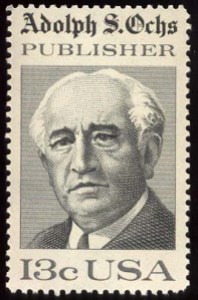
Sulzberger became publisher on Jan. 1. He was the latest member of Sulzberger-Ochs family to ascend to the top of the masthead, an unbroken chain that extends back to Adolph Ochs’ purchase of the Times in 1896. His father and predecessor, Arthur Sulzberger Jr., presided over the paper to mixed reviews. As Ken Auletta put it in a tough New Yorker profile in 2005, “Although he occupies perhaps the most august position in the nation’s press establishment, he seems to lack the weighty seriousness of his predecessors.”
A.G., by contrast, has struck observers as both serious and wise beyond his years. “The publisher of the Times sits in direct contrast to the president of the United States: demure, private, vegetarian, self-effacing, and reliant on proving himself through hard work rather than trading on his famous surname,” according to The Washington Post.
The lead author of the Times’ celebrated 2014 innovation report, A.G. is perhaps the ideal publisher to continue the paper’s metamorphosis into a primarily digital news organization. And unlike virtually all of his predecessors, he has a significant background in journalism, having worked as a reporter for The Providence Journal, The Oregonian, and the Times itself.
The Times is far from perfect. Though its coverage of the Trump White House has been admirably tough, the paper still lapses — as I wrote last January — into episodes of normalizing this abnormal president and of succumbing too readily to the temptations of access journalism. For instance, a substance-free story about Ivanka Trump and Jared Kushner that appeared over the weekend was widely derided, with New York University journalism professor Jay Rosen writing that “it feels like a report smuggled out of the summer castle after the ladies in waiting started talking.”
But the continued health of the Times is crucial to democracy. So far, A.G. Sulzberger seems like the right person at the right time to stand up to the Trump White House as well as for journalistic values.
Squint really hard and you can almost see a silver lining
A report issued Monday by the Pew Research Center documents the horrifying drop in newsroom employment over the past 10 years, with newspapers having by far the worst of it. The number of full-time newspaper journalists fell from 71,000 in 2008 to 39,000 in 2017, a decline of 45 percent. A modest increase in the number of journalists at digital-only outlets did not come close to making up the difference.
I’m not going to try to sugarcoat what’s happening. And we should always keep in mind that greedy corporate owners like Digital First and tronc are at least as responsible for the drop as the collapse of newspaper advertising. But I do want to offer a small countervailing data point: Because of technology, reporters today are far more efficient and can produce more useful work in the same amount of time than was previously possible.
A couple of examples from my own career will suffice. When I was a community newspaper reporter in the 1980s, I had to drive to Beacon Hill for campaign-finance reports. Once I had them, my options were to take notes by hand or, if I had enough quarters, make copies, assuming the copy machine was working. (And imagine if you worked in Western Massachusetts rather than 12 miles from Boston, as I did.) Now you can just look them up. Later, as the media columnist for The Boston Phoenix, I once spent an entire afternoon searching through unindexed microfilm for a half-remembered article that I wanted to write about. Today, I would have it in a few minutes.
Again, I’m not trying to argue that the collapse of newsrooms doesn’t matter. It matters a lot, and of course there’s no substitute for having actual human beings to sit through municipal meetings and develop sources. What I am saying is that the effects of this collapse would be even worse without the digital tools that have become available over the past 20 years.
Woodward and Bernstein back on the beat
How cosmically appropriate is it that just as special counsel Robert Mueller’s investigation into the Trump campaign and related issues nears its conclusion (or not), the two legendary Washington Post reporters who did more than anyone to bring down the Nixon presidency are back on the beat?
Carl Bernstein was one of three CNN reporters whose byline appeared on a devastating report that, according to former Trump lawyer Michael Cohen, the then-candidate knew in advance about a 2016 meeting at Trump Tower at which Russians had promised to reveal “dirt” on Hillary Clinton. And this week we learned that Bob Woodward is wrapping up a book called “Fear: Trump in the White House,” scheduled to be released on Sept. 11.
As I always tell my students: Everything — everything — can be traced back to Richard Nixon.
Many thanks to Cosmo Macero and everyone at O’Neill & Associates for a two-part interview on their podcast, “OA On Air,” about “The Return of the Moguls.” The first part is here; it starts at 11:30. The second is here.
You’ll find information on how to subscribe to “OA On Air” right here.
I recently had a chance to talk about “The Return of the Moguls,” fake news and other media issues on “SouthCoast Matters,” a local-access cable show carried by Taunton Community Access and Media. We did two half-hour programs, which you can see here and here.
Thanks to host Paul Letendre and Taunton Daily Gazette city editor Rebecca Hyman for a great conversation. The post-taping pizza was excellent as well.
Nearly five years after the billionaire financier announced that he would buy The Boston Globe, there’s a low but persistent buzz within the city’s media and political circles that Henry is tired of losing money and looking to get out. But Henry, who is also the principal owner of the Red Sox, insists there’s nothing to it.
“I don’t think of selling any local assets during my lifetime,” Henry said in an email interview. “Linda and I love and are committed to this city.”
Henry holds the title of Globe publisher. His wife, Linda Pizzuti Henry, is the managing director and, even more than her husband, is a regular presence at the Globe’s offices.
Henry responded to a range of questions I recently emailed to him. He declined to offer answers on two issues: whether he thought columnist Kevin Cullen could regain the trust of his readers after he returns from a three-month suspension for ethics violations; and how he plans to handle former Boston.com editor and reporter Hilary Sargent’s claims that she was sexually harassed by Globe editor Brian McGrory — claims that she has continued to assert even after the Globe’s recent announcement that investigators had interviewed Sargent and cleared McGrory. Henry did offer praise for McGrory’s performance as editor, saying, “Brian has done a terrific job of early on moving us primarily into local reporting and over the past year or so has really moved us to more and more relevant, interesting and compelling stories across New England. Every day there are ‘can’t miss’ stories.”
As is the case with many daily newspapers, the Globe has staked its future on its ability to sell digital subscriptions. The Globe missed its target of signing up 100,000 digital-only subscribers by the end of June — a crucial benchmark on the way to 200,000, which McGrory and other Globe executives have identified as one of the keys to long-term financial sustainability. Those efforts are about to get a significant boost. Earlier this year, it was announced that the paper would adopt The Washington Post’s highly regarded content-management system, Arc, both for internal operations and for re-energizing the Globe’s web and mobile platforms.
Globe spokeswoman Jane Bowman said the rollout would begin in August, with updates throughout the fall and full adoption by the end of the year. “The move to Arc will relaunch globe.com with a focus on site speed and driving user engagement,” Bowman said via email. “We will extend our mobile offerings, with Arc powering new iOS and Android apps for digital subscribers. The newsroom will have access to Arc’s advanced testing and analytics tools, giving us deeper insight into how readers engage with our content.”
Henry also had some provocative things to say about objectivity, telling me, “A news journalist (as opposed to a columnist) has an obligation to sift through whatever evidence he or she can find and give the reader what actually has happened or is happening to the best of his or her ability much like a juror in a courtroom is asked to do. Today we get the news interpreted far too often rather than reported.”
The financier-turned-publisher’s efforts to reinvent the Globe as a business have been mixed. Expanded print sections, for the most part, have not worked out, as advertising to support those sections failed to materialize. Crux, a free website devoted to covering the Catholic Church, was given away to its star columnist, John Allen. A new $75 million printing plant in Taunton got off to a slow start, resulting in poor quality, late and missed deliveries, and the loss of client publications such as the Boston Herald and USA Today. A revamped version of Boston.com, stripped of Globe content, never really achieved liftoff.
On the other hand, the standalone website Stat, which covers health and life sciences, keeps chugging along. The newsroom and business operations were moved from the paper’s hulking, outmoded plant in Dorchester (sold for about $80 million) to downtown Boston. The Globe’s journalism remains excellent, and the newsroom, with about 220 full-timers, is far larger than it would have been if the paper had fallen into the hands of a corporate chain — as we saw this week with New York’s Daily News, whose staff was cut in half by tronc, its bizarrely named owner.
According to The Washington Post, the Daily News had as many as 400 full-time editorial employees in the late 1980s. After this week’s cuts, that number is now about 45 — an indication not only of how fortunate the Globe has been to have Henry at the helm, but of how bad it might get if he can’t turn things around.
A transcript of my email conversation with Henry follows.
Q: From time to time people tell me that you are considering selling the Globe. Lately that kind of talk has been more persistent — I’ve heard people say that you’re tired of losing money and perhaps tired of the recent controversies. So: Are you planning to sell the Globe?
A: We have had no discussions about selling nor is anything contemplated. I don’t think of selling any local assets during my lifetime. Linda and I love and are committed to this city.
The Globe cannot ever seem to meet budgets — on either the revenue side or the expense side and I am not going to continue that. This has always been about sustainability rather than sizable, endless, annual losses. That is frustrating and due to a combination of mismanagement and a tough industry.
Q: If you are not planning to sell the Globe, are you committed to keeping it for the foreseeable future, which I’ll define as the next three to five years?
A: There is no time frame, honestly. We want to do our part and will, but ultimately the community’s support and the excellence of the paper will determine the long-term future.
I believe this community will support a news organization of this caliber. Brian has done a terrific job of early on moving us primarily into local reporting and over the past year or so has really moved us to more and more relevant, interesting and compelling stories across New England. Every day there are “can’t miss” stories.
Journalism is under attack in this country. We all know facts are under attack. Facts. What should be under attack in journalism these days are not facts but the lack of objective reporting. Personally I reject the notion that you can’t have highly objective reporting although the media seems to believe it isn’t possible. To me that is a long-held myth that has no place in a democracy. A news journalist (as opposed to a columnist) has an obligation to sift through whatever evidence he or she can find and give the reader what actually has happened or is happening to the best of his or her ability much like a juror in a courtroom is asked to do. Today we get the news interpreted far too often rather than reported.
Q: When I was doing my reporting for my book “The Return of the Moguls,” you and others told me that the Globe’s revenues were about $300 million a year. Could you tell me what they are today? What is the gap between revenues and expenses — in other words, how much are you losing?
A: The annual losses are just not sustainable but even if I personally felt that it was acceptable to continue losing significant sums, it does not put the news organization on the road to sustainability. Sooner or later it must sustain itself and it will — again though it will require the Globe convincing the community that it is worthwhile to support.
Q: Do you have concrete plans to fill the gap and move to break-even? You’ve had some success in charging for digital subscriptions, but what can you point to beyond that? How many digital-only subscribers do you now have — did you meet the 100,000 target that had been announced for the end of June?
A: Bridging the gap will not be easy but we have been working on it all year. Last week [early July] we were at 94,797 digital-only subscribers. While the numbers continue to grow, advertising revenues across the country are being gobbled up by Google and Facebook. Bloomberg today reported, “Omnicom Group suffered its biggest decline in nine years after posting sluggish results, renewing concerns that the ad giant can weather media disruption spurred by the likes of Google and Facebook.”
Q: Do you believe the Taunton printing problems have been straightened out or are at least under control? Contracted work was supposed to be a big part of your strategy, but you have lost customers, including the Boston Herald and USA Today. Do you have a strategy to sign up new customers or to lure back old ones (or both)?
A: Yes, and everyone there has been doing everything they can to reduce costs while at the same time getting used to new equipment that initially was extremely challenging.
Whether or not we print other publications comes down to cost primarily. Our cost structure was such that the Herald could be printed more cheaply out of the area. Our costs also led to minimal profit from printing other papers. If we can get our costs in line and be efficient enough we will have almost certainly have more commercial clients than The New York Times.
Q: When will you name a successor to editorial-page editor Ellen Clegg, who recently announced her retirement? [Clegg and I plan to work on a project together. See this disclosure.] Have you chosen anyone? Can you say who that is?
A: This is an extremely important position so we will take our time. Ellen has done a superb job for us and we will miss her.
Q: What do you expect the Globe’s adoption of The Washington Post’s Arc platform is going to accomplish for you? When will that be implemented?
A: I’m not the best person to talk with about this, but it is exciting. Our number one issue is reader experience and having an app experience across platforms as well as a new site will be great for readers.
It’s a basic tenet of press freedom: news organizations may publish public documents they lawfully obtained even if they got those documents by mistake. And so editors at the Los Angeles Times thought they were on solid ground last week when they reported the details of a plea agreement reached between a corrupt police officer and a federal judge — even though the Times obtained that information because the government had accidentally uploaded the plea agreement to a public database.
Judge John Walter ordered the Times to remove parts of the article after a lawyer for the police officer, a narcotics detective named John Saro Balian, argued that his client’s life would be in danger. The Times complied, though its new celebrity editor, Norman Pearlstine, has vowed to fight. “There is sort of a constant effort to nibble away at the First Amendment,” Pearlstine told The New York Times, “and I think there is an obligation to respond to that and push back. Once it’s out in the public record, it is our decision to decide whether it is newsworthy and we should publish.”
Pearlstine was recently hired by the Times’ new billionaire owner, the surgeon Patrick Soon-Shiong, in the hopes of leading the paper back to greatness following years of budget cuts and chaotic ownership. Though highly regarded, Pearlstine some years ago found himself on the wrong side of a major First Amendment case. As editor-in-chief of Time Inc., Pearlstine turned over reporter Matthew Cooper’s notes in the Valerie Plame investigation, thus complying with a court order. (No, I am not going to rehash that morass of a story. If you want to know more, click here.) Pearlstine said he acted because Cooper’s source, George W. Bush chief operative Karl Rove, wasn’t truly confidential and because Time Inc. had already lost its legal appeal.
“Although we were ready to spend millions of dollars on litigation, I had to ask whether this strange case was the one on which we wanted to draw the line by ignoring a contempt order,” Pearlstine wrote in his 2007 memoir, “Off the Record,” quoted by Douglas McCollum in the Columbia Journalism Review.
This time, Pearlstine is on the side of the First Amendment angels. Bruce Brown, executive director of the Reporters Committee for Freedom of the Press, put it this way in a statement: “It is plainly unconstitutional for a court to order a news outlet to remove public information from an article it has published. It does not matter whether the information was placed in a court file by mistake.”
Judge Walter’s temporary restraining order is under appeal. The standard for such issues was defined in 1979 by Chief Justice Warren Burger, who wrote in the 1979 case of Smith v. Daily Mail Publishing Co. that “if a newspaper lawfully obtains truthful information about a matter of public significance, then state officials may not constitutionally punish publication of the information absent a need to further a state interest of the highest order.”
What’s taking place in Los Angeles is censorship, plain and simple. Walter’s order should be overturned as quickly and decisively as possible.
An experiment in public funding of news
Government funding of the media has long been regarded as toxic to journalism’s watchdog role. Public media organizations such as WGBH receive indirect funding through the Corporation for Public Broadcasting. Smaller nonprofit news projects like the New Haven Independent and Voice of San Diego receive subsidies by way of their tax-exempt status. But government officials do not decide what news gets covered.
New Jersey, though, is going to try something different. Its recently passed budget includes $5 million for local news initiatives. Donations are being sought as well. Yes, there is still some protection. According to the Associated Press, the money will be distributed by a nonprofit organization to be called the Civic Information Consortium, with a 15-member board comprising appointees chosen by elected officials as well as representatives of the state’s colleges and universities, the news media, and the public. The idea was developed by the Free Press Action Fund, part of the media-reform group Free Press, which has done yeoman’s work in educating the public about net neutrality.
Caught between the New York and Philadelphia media markets, New Jersey suffers from a paucity of news coverage. As described by the AP, members of a community with no coverage of their city government could ask the consortium for money to fund a reporter. The idea brushes right up against the wall separating journalism from government interference, although it seems that those involved have made a good-faith effort to maintain at least some semblance of independence.
Still, as Al Tompkins of the Poynter Institute told the AP, “When you start taking public money you have to start with the suspicion that at some point the system will be corrupted by power.” This is a worthwhile experiment, but it will have to be monitored closely.
Marcia Chambers, 1940-2018
A remarkable journalist left us last week. Marcia Chambers, a former New York Times reporter and editor who spent her so-called retirement running the Branford Eagle, the small community news site she launched, died at the age of 78. Chambers operated her site beneath the umbrella of the New Haven Independent, whose founder and editor, Paul Bass, paid tribute to her over the weekend.
Marcia Chambers and Paul Bass at the New Haven Independent’s fifth-anniversary party in 2010. Photo (cc) 2010 by Dan Kennedy.
I wrote about one of Chambers’ exploits in “The Wired City,” my 2013 book about new forms of online journalism. While the Independent was investigating the murder of a Yale graduate student named Annie Le, Chambers somehow obtained a 2003 police report about an ex-girlfriend of the suspect, Raymond Clark, who claimed he had forced her to have sex when they were both students at Branford High School. As a condition of receiving the report, Chambers promised not to publish it until after an arrest had been made. But that didn’t mean there were not other uses to which the report could be put.
The Independent’s Melissa Bailey typed the woman’s name into Facebook, discovered that she had an account, and friended her, letting her know she was a reporter covering the murder. After Clark’s arrest (he was later convicted), Bailey and Chambers wrote a storywithout using the woman’s name. “I can’t believe this is true,” they quoted the woman as writing on her Facebook page. “I feel like im 16 all over again. Its jsut bringing back everything.”
The revelation that the Independent had the police report created a media stampede, Bailey said later. “People were calling us, begging us for this police report,” she told a researcher for Columbia University. “The New York Times came in and practically tried to arm-wrestle Paul.” It was a triumph for Chambers — one of many in a long and productive career.
Moments ago a source sent me a copy of an email that went out to Boston Globe staff members today about an internal investigation into allegations by former Boston.com editor Hilary Sargent that she had been sexually harassed by Globe editor Brian McGrory. The email is signed by Claudia Henderson, the Globe’s chief human resources officer, and Dan Krockmalnic, the Globe’s general counsel.
As you will see, we don’t learn much. But it sounds like, from the Globe’s point of view, it’s over. The key sentence: “While the investigation revealed a series of exchanges and interactions between Mr. McGrory and Ms. Sargent that were of a personal nature, the investigator found that they were initiated by and reciprocated by both parties, and did not violate our anti-harassment policy.”
The email in full is as follows.
Dear colleagues,
We write to let you know that the investigation conducted by outside counsel into the matter regarding Brian McGrory that was raised by Hilary Sargent has concluded. Over the past several weeks since these allegations first surfaced, the investigator has conducted a thorough review that included multiple interviews of both Mr. McGrory and Ms. Sargent. While the investigation revealed a series of exchanges and interactions between Mr. McGrory and Ms. Sargent that were of a personal nature, the investigator found that they were initiated by and reciprocated by both parties, and did not violate our anti-harassment policy.
We have addressed this personnel matter directly with Mr. McGrory, and will not comment further out of respect for the privacy of the individuals involved.
We very much appreciate that this has been a difficult time for the team. We are grateful for the complete cooperation of Ms. Sargent and Mr. McGrory, and we look forward to moving ahead
As you all know, earlier in the year, we introduced EthicsPoint, a confidential reporting tool to assist employees in addressing workplace misconduct or violations. We also conducted anti-harassment training for managers and will continue to host these on an annual basis.
Thank you for your patience and, most importantly, for the crucial work you do here every day.
Also, Sargent makes it clear on Twitter that the Globe’s announcement is far from an amicable resolution. For instance, she tweeted this morning: “If what I spent more than seven hours describing to the @BostonGlobe didn’t make them want to interview a SINGLE corroborating witness, you have to wonder why. What kind of investigation doesn’t have the truth as its goal? This kind.”
I want to call your attention to an interesting new project that’s in the works: North Suburban News, a nonprofit website that will cover eight communities north of Boston.
The journalist behind this project is Dan Marra, an alumnus of Patch and other local news organizations. I recently had a chance to meet with Dan and discuss his ideas, and I’ve agreed to serve on his volunteer advisory board. He’s also getting some advice and help from Paul Bass, the founder and editor of the New Haven Independent, one of the country’s leading nonprofit local news organizations.
North Suburban News will serve Malden, Melrose, Medford, Reading, Stoneham, Wakefield, Winchester and Woburn. There are existing newspapers in all of those communities, weeklies as well as the Daily Times Chronicle of Woburn, where I worked from 1979 to ’89, and the The Wakefield Daily Item. It’s my hope that North Suburban News will complement rather than compete with these papers — all of which are doing good work, all of which are understaffed.
Community journalism is where I have spent most of my career. It’s where journalists can have the biggest impact. Journalists and the news organizations they work for are the eyes and ears of the community. They are the watchdogs that keep the community flourishing, they are the ones that hold elected officials accountable, and they are the ones tasked with reporting the news.
It is why I’m working to start a different news organization, one that focuses on the key aspects of our region — community news, education, local politics, and housing and development. It’s where we won’t just report the news, but research it. Where we will ensure that our residents are informed of the issues that are affecting the region.
This nonprofit entity will focus on the communities of Malden, Melrose, Medford, Reading, Stoneham, Wakefield, Winchester and Woburn, and will rely on donations and sponsorships from the community to produce impactful stories that will educate, inform and inspire our readers.
In this initial round of fundraising we are looking to raise enough money to launch the site, pay freelancers to help cover stories and market our articles on social media in order to get the word out about this news organization. Send me an email and let me know what you think: dmarra at northsuburbannews dot org.
The North Suburban News advisory board includes:
Caren Connelly
• Caren Connelly is the Executive Director of the Winchester Foundation for Educational Excellence (WFEE), which supports innovation and excellence in the Winchester Public Schools. Prior to moving into a career in non-profit management, Caren was a journalist for 20 years, working as an investigative reporter and, most recently as an executive producer at WBZ-TV.
Anthony Guardia
• Anthony Guardia is a graduate of Suffolk University and Suffolk University Law School. He has devoted his professional career to public service and working with local non-profits. He was the Chairman of the Wakefield School Committee at age 23 and is known for his outspoken advocacy for equity in state aid and various local initiatives. His experience in non-profit development started at HomeStart, a non-profit in Greater Boston devoted to ending and preventing homelessness. His successful efforts allowed HomeStart to expand services to new populations such as veterans. Anthony’s efforts have led to an expansion of programs, capital improvements, and new initiatives. Anthony lives in Wakefield with his wife, Theresa.
Dan Kennedy
• Dan Kennedy, a Medford resident, is an associate professor of journalism at Northeastern University and a commentator on WGBH-TV’s “Beat the Press.” His most recent book is “The Return of the Moguls: How Jeff Bezos and John Henry Are Remaking Newspapers for the Twenty-First Century.” His previous book, “The Wired City: Reimagining Journalism and Civic Life in the Post-Newspaper Age,” explores new forms of local online journalism.
Dan Marra
• Dan Marra, a Wakefield resident and publisher of North Suburban News, has spent his entire career working in some capacity in community journalism. He started at weekly newspapers covering the Bronx, before moving to a Gannett-owned newspaper in Westchester County, New York. When he moved to the Boston-region, he became an editor at Patch.com. He is a lifelong advocate for community news and understands the affect a strong community news organization has on a region. You can reach him at dmarra at northsuburbannews dot org.
Mark Micheli
• Mark Micheli is a multimedia journalist, editor, documentarian and adjunct professor at Emerson College. He is co-founder of Reel Partners Media where he creates short-form videos for media companies, other businesses and non-profits. He worked as the news editor at Boston.com; a reporter at the Boston Business Journal; managing editor of Providence Business News; and as an online editor at several innovative internet companies including Lycos, AT&T New Media Services and AOL’s Patch.com.
Meredith Pizzi
• Meredith Pizzi is the Founder and Executive Director of Roman Music Therapy Services, a music therapy agency serving children and adults with social, emotional, cognitive, behavioral, physical, and educational needs, located in Wakefield. She also co-founded Raising Harmony: Music Therapy for Young Children, an organization that provides training to music therapists, parents and early childhood professionals on the use of music therapy strategies and tools with young children. Meredith is a member of the local Chamber of Commerce and her organization partners with many local for-profit, non-profit and government’s agencies. Meredith has a a Masters in Public Administration from Suffolk University.




.jpg)