It’s been such a long time since a Boston sports radio host got in trouble for making racist remarks on the air. But it’s time to reset the clock, as Tony Massarotti of the Sports Hub (98.5 FM) stepped in it big-time on Friday. According to Chris Novak of Awful Announcing, Massarotti and cohost Mike Felger were broadcasting from different locations, and Massarotti thought it was worthy of note that there were two Black men sitting behind Felger.
“I wanna know now who the two guys behind you are,” Massarotti said. “Because if I were you … They can’t hear us, right? OK, so I would be careful if I were you. Because the last time you were around a couple of guys like that, they stole your car.”
Good Lord. Massarotti was full of apologies on Monday, and, Novak wrote, appeared to be on the verge of tears. “When it comes to apologies, at least he alluded to the fact that no one had to accept his,” Novak continued. “A common refrain following apologies is that everyone is meant to accept it. That isn’t always the case, and being aware of that, in his defense, is at least an acknowledgment.”
Felger wasn’t exactly quick off the draw, which he took responsibility for later. “I knew it was wrong the moment it went out and I could have stopped the show,” Felger said, according to an account by WCVB-TV (Channel 5). “I could have stopped it and corrected it, and I didn’t in real time.”
It remains to be seen what additional fallout there might be, if any. Massarotti was part of NESN’s Red Sox broadcasts last year, but the network had already decided against bringing him back.
As I wrote last week, the matter of how the Alliance for Audited Media counts paid digital subscriptions is something that has confused me for a long time. In September 2021, I sent an email to Erin Boudreau, AAM’s senior marketing manager in which I asked her some of the questions that I asked here. She responded with links to two fact sheets (here and here), neither of which struck me as especially helpful.
Because of that, I wrote last week’s item without checking in with AAM again. I immediately heard from Boudreau, but still without the information I was looking for. Now, I have no reason to believe that Boudreau was being deliberately obtuse, and I’m also aware that AAM is at the mercy of the newspapers that pay them. AAM’s job is to be accurate and rigorous, but they’re dependent on the data that publishers provide.
In any case, I decided to try again with Boudreau, asking her a series of specific questions expanding on what I asked her a year and a half ago.
1930s Eugenics Society Exhibit. Photo (cc) from Wellcome Library.
One of the themes I explored in my 2003 book about dwarfism, “Little People,” was that in vitro diagnoses of genetic conditions — barely a glimmer 20 years ago — might one day lead to health-care providers, insurance companies and others pressuring parents to end pregnancies in order to save money and resources. I called my chapter on that topic “The New Eugenics.”
Now comes Michael Hugo, chair of the Democratic Committee in Framingham, who has managed to combine his support for abortion rights with a twisted argument in favor of eugenics. According the Framingham Source, Hugo urged the city council to pass a resolution supporting reproductive rights and to take a stand against so-called crisis pregnancy centers, which have been accused of using deceptive tactics in order to persuade women not to go through with abortions. So far, so good. But then he said this:
Our fear is that if an unqualified sonographer misdiagnoses a heart defect, an organ defect, spina bifida, that becomes a very local issue because our school budget will have to absorb the cost of a child in special education, supplying lots and lots of special services to children, who were born with the defect. So it’s our hope that the Council tonight will pass this ordinance, and by doing so perhaps one of the businesses that might be looking at coming to Framingham, will look at Framingham and decide, well, we better just keep driving and look for a different town or a different city.
The Source quotes several councilors who objected to Hugo’s remarks, using words and phrases like “repulsed,” “profoundly repugnant” and “horrified.” The resolution in favor of abortion rights passed, but the council overwhelmingly made it clear that had nothing to do with Hugo’s offensive remarks. According to a follow-up story in The Boston Globe, Hugo later took to Facebook and apologized.
Hugo’s bizarre reasoning is exactly the sort of thing that anti-abortion-rights forces like to jump on when arguing that abortion ought to be illegal. Hugo’s remarks were not only hurtful, but they were potentially damaging to the cause he allegedly supports. What on earth was he thinking?
The reason that Sarah Palin lost her libel suit against The New York Times was that the Times’ extraordinarily sloppy editorial page editor, James Bennet, was extraordinarily sloppy. (In an unrelated matter, Bennet left the paper after it was revealed that he hadn’t even bothered to read an op-ed piece by Sen. Tom Cotton suggesting that violent protesters be gunned down in the streets.)
Under the Supreme Court’s 1964 Times v. Sullivan standard, a public figure such as Palin can’t win a libel suit unless she can show that false, defamatory information about her was published with “actual malice” — that is, it was published in the full knowledge that it was false, or that the publication strongly suspected it was false.
That’s what makes the latest revelations in Dominion Voting Systems’ libel suit against Fox News so mind-boggling. As The New York Times reports, internal communications show that Fox stars such as Tucker Carlson, Sean Hannity and Laura Ingraham were fully aware that Donald Trump was lying about his claims that the 2020 election had been stolen. Yet they boosted those lies anyway, whose voting machines were a principal target of Trump and his allies. Dominion claims that Fox damaged its reputation and harmed its business.
As the Times story notes, Fox doubled down on the Trump camp’s claims after initially accepting his defeat — a move that resulted in many of its viewers shifting to even farther-right cable outlets like Newsmax and One America News. Fox wanted those viewers back, damn it. In a particularly revealing passage, we learn that Carlson wanted a Fox News journalist fired for tweeting the truth because it might harm Fox’s ratings:
On Nov. 12, in a text chain with Ms. Ingraham and Mr. Hannity, Mr. Carlson pointed to a tweet in which a Fox reporter, Jacqui Heinrich, fact-checked a tweet from Mr. Trump referring to Fox broadcasts and said there was no evidence of voter fraud from Dominion.
“Please get her fired,” Mr. Carlson said. He added: “It needs to stop immediately, like tonight. It’s measurably hurting the company. The stock price is down. Not a joke.” Ms. Heinrich had deleted her tweet by the next morning.
Ironically, right-wing figures such as Trump, Florida Gov. Ron DeSantis and Supreme Court Justices Clarence Thomas and Neil Gorsuch have all suggested that it might be time to get rid of the actual malice standard, which erects a nearly impossible barrier for public officials and public figures who want to sue media companies.
Under ordinary circumstances, Fox would be a prime beneficiary of that standard. Trouble is, the new revelations show that even Times v. Sullivan may prove insufficient to protect Fox from Dominion’s lawsuit. As Bill Grueskin of the Columbia Journalism School put it on Twitter:
It’s almost impossibly difficult in this country for a public figure to win a defamation suit.
One of the only ways to do that is to show that the defendant exhibited “a reckless disregard for the truth.”
Fox has come as close to doing that as any media company I’ve ever seen. https://t.co/rZ3dS7hOax
I asked ChatGPT to write a 300-word column about the MBTA in the voice of Herman Melville, and it gave me the single best description of the troubled public transportation system ever:
It is a system that demands both patience and cunning, for one must be quick of foot and mind to catch the right train, or else suffer the indignity of waiting upon a frigid platform for what seems an eternity.
Trolley ahoy! Hast seen the Green Line?
Update: I’ve removed the link to the full column, which I’m told doesn’t work for anyone but me. So here it is below:
Ah, the Massachusetts Bay Transportation Authority, what a grand and curious beast it is! A marvel of modernity, with its electric rails and clanging bells, carrying thousands of souls to and fro throughout the bustling metropolis of Boston. But also a beast with many heads, each bearing its own peculiarities and frustrations.
As I, Herman Melville, have had the occasion to travel upon this sprawling system of trains, buses, and subways, I cannot help but be struck by its contradictions. On the one hand, it is a great equalizer, bringing people of all classes and stations together in the common pursuit of transit. On the other, it is a labyrinthine maze, with its schedules and routes so convoluted that one might need a sextant and a compass to navigate them.
It is a system that demands both patience and cunning, for one must be quick of foot and mind to catch the right train, or else suffer the indignity of waiting upon a frigid platform for what seems an eternity. And yet, for all its idiosyncrasies and flaws, there is a certain romance to the MBTA, a sense of adventure that comes with exploring its many routes and stops.
I have traveled upon the Red Line, the Green Line, the Orange Line, and the Blue, each with its own distinct character and challenges. The Red Line, with its sleek trains and sweeping views of the city, is a joy to ride, though it can be overcrowded and prone to delays. The Green Line, with its jangling trolleys and labyrinthine routes, is a source of endless fascination, though it can be slow and unpredictable. The Orange Line, with its long stretches of underground tunnels and bustling stations, is a marvel of engineering, though it can be hot and stuffy in the summer months. And the Blue Line, with its sweeping views of the harbor and its ferries to the islands, is a delight to ride, though it can be crowded and prone to delays.
And yet, for all its charms and frustrations, the MBTA is an essential part of life in Boston, connecting people and places in a way that no other mode of transportation can. It is a beast that we must learn to love, even as we curse its many heads.
Gov. Maura Healey. Photo (cc) 2013 by ZGreenblatt.
Andrew Quemere, a journalist who doggedly follows open-government issues in Massachusetts at his newsletter, The Mass Dump, reports that newly minted Gov. Maura Healey may prove to be not quite the champion of Beacon Hill transparency that she claimed she would be.
No one should be too surprised — she is, after all, a two-time winner of the New England Muzzle Awards, a feature I wrote for 25 years for GBH News and, before that, The Boston Phoenix that tracked outrages against free speech. I’ll get to that. But first, the latest. Quemere’s item begins:
Massachusetts Governor Maura Healey’s administration said Monday that it will not release records from past administrations. The decision means that a vast amount of vital information about state government — including former Governor Charlie Baker’s response to the COVID-19 pandemic, the repeated safety problems at the Massachusetts Bay Transportation Authority, and the sprawling overtime-fraud scandal at the State Police — will remain secret.
Some background: Baker and previous governors declared that the state’s public records law did not cover either them or their immediate staff. Indeed, the notoriously weak law also doesn’t cover the legislative branch (see this 2020 report by Northeastern journalism students) or the judiciary, meaning that the only governmental groups that have to comply are cities, towns, the state’s executive agencies and quasi-independent authorities. (And county government, to the extent that we have county government, which we pretty much don’t.)
Healey told GBH News in December that she would end the exemption for her office — but then reversed herself, explaining, essentially, that she would take it on a case-by-case basis. Moreover, the Healey administration refused to provide Quemere with records pertaining to police and law enforcement dating back to Baker’s time in office, saying that the new, more open policy she has adopted is not retroactive.
So: Healey’s new policy of openness does not cover previous administrations; and we’re not clear what the new policy really means.
As for the Muzzle Awards, the most pertinent is from 2018, when she was singled out for upholding rulings that public information should, in some cases, remain private. Healey’s secretive approach to the people’s business when she was the state attorney general was revealed by then-Boston Globe reporter Todd Wallack, now with WBUR Radio. As I wrote at the time:
Wallack’s most startling finding: Healey’s office had upheld a ruling by the Worcester district attorney that records pertaining to the 1951 murder of a state trooper should not be made public. Healey’s decision reversed a ruling by Secretary of State Bill Galvin’s office and denied a friend of the murder victim the opportunity to follow up some leads on his own. The friend has since died.
Wallack documented numerous other examples of Healey’s penchant for siding with the secret-keepers, including her decision to appeal an order that the state police provide the Globe with dates of birth for state troopers. That would have made it possible for the paper to examine the driving records of officers who had been involved in motor-vehicle accidents. Robert Ambrogi, a First Amendment lawyer and the director of the Massachusetts Newspaper Publishers Association, told Wallack: “I would expect more based on the promises she has made about open government.”
Her previous Muzzle was less germaine: I criticized her in 2015 for filing a formal defense of “a 1946 state law criminalizing political lies aimed at influencing an election.” Go ahead. You tell me what what’s a lie, what’s a mistake and what’s political hyperbole. I wrote:
As the libertarian Cato Institute was quoted as saying in an article by the State House News Service, it can be “incredibly difficult to assess the truth of a politician’s claims, especially in the chaos of an election campaign.” A number of advocacy groups and media organizations opposed Healey, including the ACLU of Massachusetts and the New England First Amendment Coalition.
We live in a time of intense political polarization, but there is an issue that unites Democrats and Republicans: the intense desire to conduct the public’s business out of public view. Let’s hope that Gov. Healey’s first steps aren’t a sign of things to come.
The Burlington Free Press of Burlington, Vt. Photo (cc) 2019 by Dan Kennedy.
In reporting on the newspaper business, there are few matters more obscure or maddening than determining paid digital circulation. My example for this morning is the Burlington Free Press, a Gannett-owned daily that, I wrote recently, will soon be printed in either Auburn, Massachusetts, Worcester or Providence, hours away from its home base in northern Vermont.
The change is the result of the giant newspaper chain’s decision to shut its printing plant in Portsmouth, New Hampshire, which will affect several other papers as well. Gannett’s standard defense of moves like this is that they’re shifting to digital, so print doesn’t matter that much. But as I observed at the time, the Free Press sells more than twice as many print papers as it does digital subscriptions.
My item prompted someone to send me a “confidential and internal” Gannett circulation report.
On the latest “What Works” podcast, Ellen Clegg and I talk with Victor Pickard, a professor of media policy and political economy at the Annenberg School for Communication at the University of Pennsylvania. Before he was at Penn, he taught media studies at NYU. He is the author of several books, including “Democracy without Journalism,” which I reviewed a couple of years ago for GBH News.
Pickard has contributed to the debate about the local news crisis in many different settings. He worked on media policy in Washington at the New America Foundation, and he served as a policy fellow for former U.S. Congresswoman Diane Watson.
I’ve got a Quick Take on a legislative proposal that’s now being considered in Massachusetts, inspired by a federal bill that died in the last session. The proposal would provide tax credits to anyone who subscribes or donates to a local news organization.
Ellen’s Quick Take is on something close to home. She’s joined a group of Brookline residents who are launching an independent nonprofit news site called Brookline.News. The steering committee has been raising funds, and is recruiting for a founding editor-in-chief.
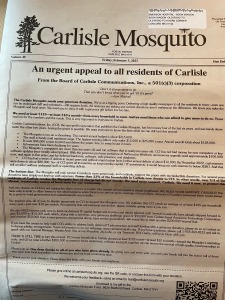
The Carlisle Mosquito, a free nonprofit weekly newspaper that has long stood as an example of how a community can take care of its own news and information needs, is in trouble. “We need at least $125 — at least $10 a month — from every household in town,” says a front-page editorial. “And we need those who can afford to give more to do so.”
The Mosquito spends about $44,000 a year on print and distribution, which adds up to about a fifth of its annual budget. “Ad revenues,” the editorial says, “have been declining for years.” I’m not sure why they’ve stuck with print, but they know their community better than I do. The editorial says that the paper’s top editors earn just $15,000 to $25,000 for what I have to assume are part-time positions.
I hope the Mosquito, which serves a wealthy rural community of about 5,000, can find a way forward. If it can’t, maybe The Concord Bridge, a well-funded nonprofit digital and print hybrid that was recently launched in a neighboring community, can provide some coverage.
The New Bedford Light is hiring an editor-in-chief. Congratulations to founding editor Barbara Roessner for getting this important project off the ground and moving in a good direction.
 Because of that, I wrote last week’s item without checking in with AAM again. I immediately heard from Boudreau, but still without the information I was looking for. Now, I have no reason to believe that Boudreau was being deliberately obtuse, and I’m also aware that AAM is at the mercy of the newspapers that pay them. AAM’s job is to be accurate and rigorous, but they’re dependent on the data that publishers provide.


._Image_from_Wellcome_Library.jpg)