[youtube http://www.youtube.com/watch?v=lJI87Ivk0PM&rel=0&color1=0xb1b1b1&color2=0xcfcfcf&hl=en_US&feature=player_embedded&fs=1]
You have got to watch this excerpt from “Oprah” of Roger Ebert “speaking” to his wife, Chaz, using a synthesizer programmed with clips from Ebert’s own voice (via @anamariecox).
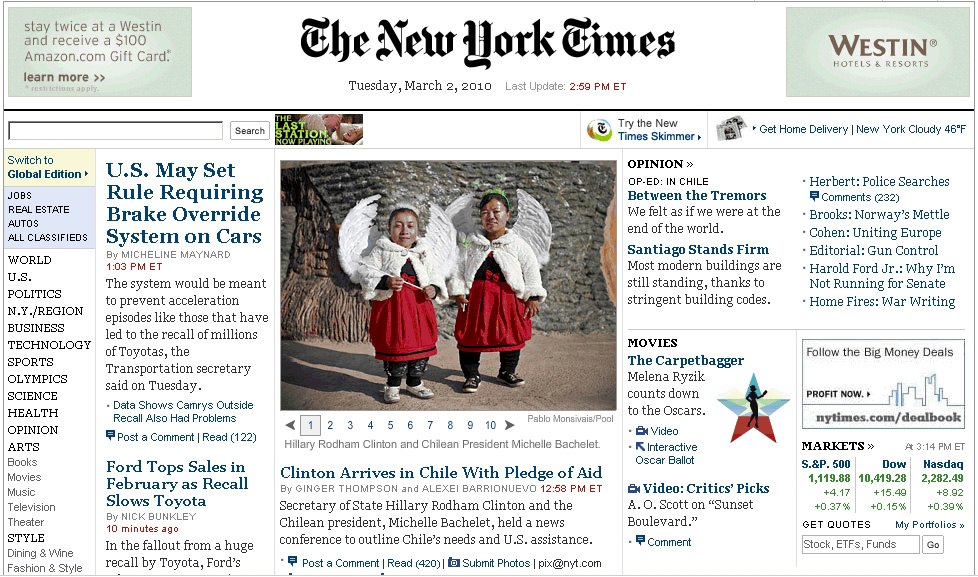
Seeing is believing (I)
Howard Kurtz calls this the “Best New York Times photo caption blunder OF ALL TIME.” He’s right! Click here.
Moving beyond Al Gore
In my latest for the Guardian, I argue that Al Gore, his admirable qualities notwithstanding, has used up his political capital when it comes to climate change. By contrast, Republican Senator Lindsey Graham of South Carolina offers the hope of substantive progress.
Charley Manning to replace Limbaugh
I am stunned to learn that Entercom has actually done something smart. Republican political consultant Charley Manning has been named to replace Rush Limbaugh’s syndicated noon-to-3 p.m. show on WRKO Radio (AM 680), reports the Boston Herald’s Jessica Heslam.
Limbaugh will be moving to Clear Channel’s WXKS (AM 1200), which is loading up on syndicated national shows. Perhaps Entercom can persuade Clear Channel to take Laura Ingraham and Michael Savage off its hands, too.
Congratulations to Manning, a good guy who, I’m sure, will do well.
The ghost in Mitt Romney’s machine

I’m always amazed when journalists find themselves unwilling to follow the simple ethical rules of our business. So this morning I find myself scratching my head over the news that Nina Easton, an ex-Boston Globe reporter who is still working as a journalist, helped former Massachusetts governor Mitt Romney write his new book, “No Apology.”
Globe reporter Sasha Issenberg writes that Romney pays tribute to Easton’s contributions in the acknowledgments. And Easton, now Washington bureau chief for Fortune magazine and a commentator on Fox News, has this to say for herself:
Mitt asked me — as a friend and a book author myself — for some input on an early draft. I offered some writer’s advice on things like structure and how to better tease out themes in his writing. It wasn’t much.
No, not much. Just enough to disqualify her from commenting on the 2012 presidential campaign as long as Romney is a candidate. (And please don’t tell me that he’s not a candidate. Romney’s 2012 campaign began the day he dropped out of the ’08 race.) At least Easton left the Globe in 2006; it wouldn’t be good if her fingerprints were found on the paper’s massive 2007 Romney series.
Here, by the way, is Easton on Fox’s “Hannity” on May 28, 2009, talking about efforts by the Bush and Obama administrations to bail out General Motors:
How is it all possible, Sean? How is it possible is that the Bush administration punted on this. They punted by giving TARP funds, bailing out GM, and punting it to the next administration when, in fact, we should have gone through a Mitt-Romney-style plan, which was a government-managed bankruptcy, which would have left this company far more in the private sector.
Clearly the two presidents should have been wearing a wristband that said “WWMD?” — “What Would Mitt Do?”
Easton, of course, is hardly a pioneer. Perhaps the most memorable of such breaches took place in 1980, when columnist George Will helped Republican presidential candidate Ronald Reagan prep for his debate with then-president Jimmy Carter, and subsequently enthused over Reagan’s “thoroughbred performance” on “Nightline” without disclosing his role.
And, yes, Globe journalists have been known to lend a hand in various ways to Democratic politicians over the years.
But it’s a lousy practice, and I can’t understand why some journalists are so attracted to it. I mean, how did Easton ever get to the point at which she considered Romney a “friend” in the first place? This is someone she covers. Period.
More: I had not anticipated the demand for details I’ve received regarding the aid and comfort Democratic politicians have gotten from the Globe. I did have a specific incident in mind when I wrote that sentence, but it was a long time ago and I have my reasons for not wanting to get into it. Indeed, anything I could come up with would predate not just Marty Baron’s tenure as editor, but his predecessor, Matt Storin’s, as well.
For some insight into how the Globe and Democratic politicians once benefited mightily from each other’s favors, you might want to take a look at this piece I wrote some years ago (pay no attention to the date at the top of the page) about Jack Farrell’s wonderful book “Tip O’Neill and the Democratic Century.”
Is the New York Times Co. for sale?
Apparently not, says Jon Friedman. But speculation that it is drove up the company’s stock price yesterday, Bloomberg reports.
According to Reuters, minority investor Carlos Slim, a Mexican billionaire, has denied rumors that he’ll seek to increase his stake. And that would appear to be that.
WBUR advances “Radio Boston” plans

Some news today about the debut of the daily “Radio Boston,” now set for Monday, May 3, on WBUR (90.9 FM). The “lead host” will be rising star Meghna Chakrabarti, although expect to hear other voices in the anchor chair as well. The executive producer will be Iris Adler, who’s returning to ‘BUR after many years at New England Cable News. And the hour-long program will air at either 1 or 3 p.m. — stay tuned for a final decision.
What follows is an internal e-mail from WBUR general manager Paul La Camera that Media Nation obtained a little while ago:
Title: “Radio Boston,” the sense being that we already have a great deal invested in this title and it says it all.
Premiere Date: Monday, May 3
Time Period: Either 1-2PM or 3-4PM. If its is the former, “Fresh Air” would shift to 2-3PM, Monday-Thursday. The first hour of “Talk of the Nation” would then be pre- empted those four days. However, on Friday, we would carry the full two hours of “Science Friday.” If we choose the latter scenario, we would pre-empt the second hour of “TON” all five days. If you have thoughts on this choice, please let us know.
Lead Host: Meghna Chakrabarti. Meghna, since her beginnings in 2002 as a producer on “On Point,” has grown quickly and formidably as a radio force and a radio voice, in just these recent days performing with skill and comfort the substitute hosting of the very challenging “Here and Now.”
Meghna will be the appropriately titled “lead host,” leaving room for many additional WBUR voices, including those of our unrivaled corps of reporters and young emerging voices lke those of Adam Ragusea and Andrew Phelps.
Leadership: We are pleased that Mark Navin will continue in his current role of senior producer and director of the new daily iteration. Mark deserves our full recognition and appreciation for how far his leadership has taken “Radio Boston” and positioned it for this major transition to a daily.
At the same time, we have created a new executive producer position for the daily “Radio Boston” and that will be filled by an individual familiar to many of us, Iris Adler. Iris is one of the most experienced and accomplished broadcast news and public affairs executives in our city. For the past 18 years, she has served New England Cable News, the nation’s pre-eminent regional cable news service, as both managing editor and executive editor. For the dozen years before that, some of you will remember Iris as a WBUR reporter, managing editor, and, from 1988-1992, the station’s news director. Iris will be joining us on Monday, March 22.
Other Staff: Weekly “Radio Boston” major players and key contributors Adam Ragusea and Jessica Alpert will be fill the respective roles of reporter/associate producer and assistant producer. And Tim Skoog will continue to apply his technical genius to the now daily production. Iris and Mark will soon be interviewing for a remaining unfilled associate producer position.
Geography: The expanded “Radio Boston” team will be housed in the current membership area next to the news department for all the obvious reasons. In turn, the membership group will move to a redesigned office area currently occupied by the weekly “RB.” This shift will take place the first week of April.
Let me also take this opportunity to acknowledge and thank Jane Clayson who has been a critically important force in preparing, professionalizing and positioning “Radio Boston” for this exciting step forward. As Jane stated in her gracious and moving farewell at the conclusion of Friday’s program, her family life is simply not compatible with the demands of a daily program. However, I am thrilled to share with you that not only will Jane remain the host of “On Point” when Tom is not there but now will also be the voice who will complement Robin Young on “Here and Now.” So, even with her departure from “Radio Boston,” we and our fortunate listeners will hear Jane virtually to the same degree as we have these past few years. Simply stated, Jane will remain a very active and important member of the WBUR family.
I hope you join me in the excitement of these developments. I have been eager for WBUR to have a daily local program since I arrived at this wondrous place four and half years ago today. And now I just have to wait until May 3 for that dream to be realized.
Paul
What does Times video campaign mean for the Globe?
 Trying to figure out where the Boston Globe stands in the New York Times Co. firmament is a little like analyzing the ins and outs of the old Soviet Politburo based on their position on the podium during the May Day parade.
Nevertheless, I couldn’t help but be struck by a story in today’s Times (it also appears in the Globe) reporting that Times content will soon be featured on 850 screens in public places in five cities — including Boston.
The content, according to the story, by Times media reporter Richard Pérez-Peña, will be shown on screens owned by RGM Networks in places such as coffee shops, casual restaurants and newsstands at airports.
Last year, of course, the Times Co. tried to sell the Globe after months of angst, including a threat to shut the paper down, if the paper’s unions wouldn’t agree to $20 million in givebacks. The sale was called off amid reports that neither of the two bidders was willing or perhaps able to come up with sufficient cash.
The Globe remains the Times Co.’s second-biggest paper. So you’d think that the company would avoid doing something that would benefit the Times at the expense of the Globe.
Not to make too much of this. It’s a modest venture, and it’s not as though the Times Co. never promotes its flagship in Boston. But it does play into the notion that, once the economy improves, Arthur Sulzberger and company will put the Globe on the market once again.
A sickening tale of abuse
Kudos to Boston Globe reporter Sean Murphy, who has produced a stomach-churning two-part series (part one; part two) on the phenomenally expensive health-insurance plans that are routinely given to public employees in Massachusetts.
Appalled as I am that state and local employees are having as much as 90 percent of the health-care costs covered by taxpayers, that really pales in comparison to those receiving free health care for serving a few years in part-time, mostly voluntary elected positions.
I’d like to see newspapers and bloggers in every city and town in the follow up by reporting exactly what the situation is in their community.
Chile and earthquake fatigue
I hope I’m not just channeling my own dysfunction, but it seems to me that interest in the Chilean earthquake is pretty limited. There’s plenty of coverage out there. But this is not a story people are talking about, especially in comparison to the Haitian earthquake. The reasons are pretty obvious:
- Haiti is close to the United States, and Chile is on the other side of the world. Related to that is the fact that Haitian-Americans are a large minority group. Chilean-Americans are not.
- Media consumers are suffering from earthquake fatigue.
- Even though the Chilean earthquake was much more powerful, it appears that the death toll and the suffering will be far less than was the case in Haiti.
With that, a few ever-so-slightly non-mainstream sources for you to look at: If you’re not accustomed to heading for the Boston Globe’s Big Picture blog after something like this, well you should be. The New York Times is gathering user-submitted photos. Global Voices Online — which is holding its annual conference in Santiago, Chile, in May — has posted two blog round-ups, here and here. And Boston-based GlobalPost has uploaded a number of stories and photos from the scene and the surrounding area.
And let’s not leave out Boston’s Christian Science Monitor, a leading non-profit source of international news. A story on why Chile seemed so well-prepared, for instance, yields this gem:
Chileans are well versed in what to do during earthquakes, with drills part of every child’s schooling. “Just in case” attitudes, which might seem obsessive in other parts of the world, are the norm here. One woman says she turns off the gas valve every time she leaves the house, just in case a quake strikes when she is out.