A Twitter thread on the decline and fall of the MBTA under Gov. Charlie Baker:
More than seven years ago, after Snowmaggedon brought the #MBTA to its knees, Gov. Baker was given unprecedented authority to fix it. We now know he didn’t use that opportunity wisely or well. (1/x)
If there was an assessment made of what work needed to be done, it was obviously inadequate. We’ve seen one issue after another come up during the past year, and especially the past few months. (2/x)
With proper planning, much of the work could have been done during the pandemic shutdown. Instead, we’re now dealing with Orange and Green Line closures just as employers are trying to entice their workers into returning to the office. (3/x)
It’s not all Baker’s fault. The last governor to take issues involving the T seriously was Michael Dukakis. There’s no political gain in fixing the T because the benefits are invisible. (4/x)
Baker does deserve credit for saving the GLX after Deval Patrick nearly gold-plated it into oblivion. Overall, though, Baker failed, and his term is ending with the T in a state of collapse. (5/x)
Notably silent: Maura Healey, who’s as sure a bet to be elected governor as you get in politics. This is not a time for caution. What is her vision for the T? If she remains silent, then she won’t have a mandate to carry it out. (6/x)
Like many, I depend on the MBTA to get to work and elsewhere. I use commuter rail, subways and buses. I really have no good alternatives, so I’m being patient. What choice do I have? But all of this is incredibly dispiriting. (7/7)
The late Gannett chairman Al Neuharth, who created USA Today, was no stranger to cost-cutting. But he’d be rolling over in his grave at what’s taking place now. Photo (cc) 2013 by George Kelly.
Gannett, the country’s largest local news chain, is in a tailspin. The publisher of some 200 daily papers reported a significant loss in the second quarter — $54 million on revenues of $749 million.
According to Rick Edmonds, who analyzes the media business for Poynter, the company is either down or missing its targets in digital and print advertising as well as print circulation. The sole bright spot: a steady rise in paid digital circulation. Extensive layoffs are on the way. Edmonds quoted a memo from Maribel Perez Wadsworth, head of the media division, in which she said: “In the coming days, we will … be making necessary but painful reductions to staffing, eliminating some open positions and roles that will impact valued colleagues.” It’s hard to see how shrinking an already diminished product is going to help.
Those of us who live in Eastern Massachusetts and environs might wonder where they are going to find any staff members to lay off. Over the past year, the chain has closed many of its community weeklies. Its dailies are still publishing, but with skeleton newsrooms.
The question with Gannett is how many of its problems are simply part of the overall local news crisis and how many are of its own making. Tim Franklin, senior associate dean and the John M. Mutz Chair in Local News at Northwestern’s Medill School, tweeted:
The existential question from this very sobering Gannett earnings report: Is this a bellwether for the entire local news industry, or is it a company issue? The next earnings report from Lee may answer that question. https://t.co/vs4fLRXBHw
As it turned out, Lee did reasonably well, which Chris Krewson, executive director of Local Independent Online News (LION) Publishers noted in a response to Franklin.
I would argue that though the challenges facing community journalism are very real, there are some unique factors at work with the current iteration of Gannett, which lost its way in the cradle back when GateHouse Media was born. GateHouse and Gannett merged a few years ago, but it was essentially a takeover by GateHouse, which has been pillaging its local titles for the past 15 or so years. Gannett’s schemes to overcome the mess in which it finds itself strike me as harebrained. Its plan to pursue sports betting isn’t going well, as Edmonds reports. Then there is its dream of getting into nonfungible tokens (NFTs). Seriously?
Gannett’s flagship is USA Today, which is still a solid paper. If I had to guess, I’d say they’ll leave it pretty much alone so that they can use it as a wire service to fill up their regional and local papers. I mean, even more than they’re already doing.
Sadly, Gannett’s journalists have been on a roll, with reporters at the Indianapolis Star and The Columbus Dispatch breaking the story about a pregnant 10-year-old rape victim — and then confirming it when it was questioned by right-wing propagandists and by Washington Post fact-checker Glenn Kessler. The Austin American-Statesman obtained and published video of the police (non)response to the school shootings in Uvalde, Texas, after editing out the children’s screams. This is outstanding journalism, and soon Gannett will have fewer journalists.
Gannett’s greed and incompetence are going to mean fewer jobs for reporters and less coverage for local communities. It’s an ongoing tragedy, but it does open up possibilities for entrepreneurs who are looking to start new projects.
On the latest “What Works” podcast, Ellen Clegg and I talk with Elizabeth Hansen Shapiro, CEO and co-founder of the National Trust for Local News. She is also a senior research fellow at the Tow Center for Digital Journalism at Columbia Journalism School in New York. At the Tow Center, Dr. Hansen Shapiro’s work focuses on the future of local journalism and the policies needed to assure that future. Her research involves audience engagement and revenue strategies, as well as the relationship between news and social platforms. She holds a Ph.D. in organizational behavior from Harvard Business School.
The National Trust for Local News is a nonprofit that is dedicated to “keeping local news in local hands.” The Trust works with local news publishers, philanthropists and socially conscious investors, and, as I’ve reported, worked with other collaborators to buy 24 weekly and monthly newspapers in the suburbs of Denver, Colorado, perhaps saving them from hedge fund ownership.
I’ve got a Quick Take on a recent newsletter by past “What Works” guest Kristen Hare of Poynter, who reported on local media people who are starting to fight back against the abuse they’re receiving from some of the more sociopathic members of their audience.
Ellen weighs in on the death of Tim Giago, the founder of the first independently owned Native American newspaper in the United States, and dives back into the Dumpster fire in the newsroom of The Aspen Times in Colorado.
It’s Baseball Hall of Fame Week here in Media Nation, so blogging will be somewhere between light and nonexistent. But watch for our latest “What Works” podcast by midweek.
I hadn’t intended to post about the Los Angeles Times matter twice in one day. But Paul Farhi of The Washington Post has a strong article (free link), including what I believe is the first objective look at the various drafts of Paul Pringle’s story. Farhi writes:
The former Times editors shared two drafts of the story with The Post to bolster their case that it grew stronger with each round of editing. A draft from February 2017, for example, doesn’t mention a key figure in the story — a “girlfriend” of [former USC medical school dean Carmen] Puliafito’s who allegedly overdosed in a hotel room with him. Pringle subsequently tracked her down and interviewed her. The reporting team also later added descriptions of videos and photos in which she and the dean are seen using drugs.
These critical details were included in a version of the article that was written by early April. “The new reporting is tremendous,” [LA Times managing editor Marc] Duvoisin wrote to Grad on April 6 [2017]. But to Pringle’s irritation, Duvoisin and [assistant managing editor for investigations Matthew] Doig asked for more reporting, including about two figures who subsequently added eyewitness corroboration.
Los Angeles Times investigative reporter Paul Pringle has responded to an essay by Matthew Doig, a former Times editor who claims that Pringle falsely accused him and other top executives of slow-walking his reporting on a sex-and-drugs scandal at the University of Southern California so as not to offend an important advertiser and business partner.
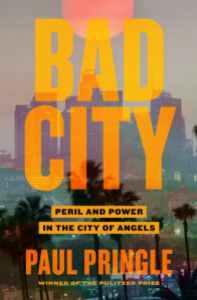
Pringle made his accusations in his new book, “Bad City.” The dispute is pretty complex, so you might want to read this for background and then come back. The New York Times also has a good overview (free link). Here’s part of what Pringle has to say in a rebuttal that was published by Los Angeles Magazine:
The Times fired Davan Maharaj, Marc Duvoisin and Matthew Doig after I and four other reporters complained about their handling of the story that is at the heart of “Bad City” — corruption at the University of Southern California. The firings came after an internal inquiry and were wildly popular in the Times’ newsroom. After the editors were gone, the USC reporting team continued to produce one major story after another about the school, and three of us eventually won a Pulitzer Prize for that work.
Maharaj was editor and publisher under the Times’ previous owner, the unfortunately named tronc; Duvoisin was managing editor, and Doig was assistant managing editor for investigations. Pringle also writes:
In the months leading up to the publication of the book, the three editors were given the opportunity to respond to the manuscript, including through an interview. They ultimately chose instead to retain attorneys to threaten lawsuits, with the clear intent of stopping publication of “Bad City.” Those threats similarly contained no factual challenges to my reporting.
Doig’s Medium post links to documents that make him look good but not to others that don’t, including his failed attempts to rewrite our drafts of the story, which focused on the drug-abusing and drug-trafficking dean of USC’s medical school. His rewrites were deemed unpublishable not just by the five reporters (we would have never put our bylines on them), but also by Duvoisin, who finally took the story away from him.
Duvoisin wrote his own response to Pringle’s allegations that I missed earlier. Despite Pringle’s contention that Duvoisin overruled Doig, Duvoisin’s defense parallels Doig’s, calling Pringle’s claims “entirely false.” Duvoisin continues:
The USC story was not killed; it was sent back for more reporting, which improved it immeasurably, and it was published on the front page. The reporters who worked on the story were never blocked; they were edited. They did not fight against dark newsroom corruption; they were held to high standards — and resented it. They did not work in secret. They merely thought they were working in secret, which is kind of amusing when you think about it.
Similarly, Maharaj posted a comment to Doig’s essay that begins: “Matt [Doig] did an excellent job shooting down the endless falsehoods in ‘Bad City,’ which accuses me of ‘killing’ the initial story. That is not true.”
Oliver Mill Park, Middleborough. Photo (cc) 2022 by Dan Kennedy.
Local news outlets are popping up left and right following the decimation of our Eastern Massachusetts weekly newspapers at the hands of Gannett. But I want to give a special shoutout to Anne Eisenmenger, who’s going to launch a new weekly paper in mid-August to cover Middleborough, the town where I grew up, and neighboring Lakeville.
Nemasket Week, which will debut on Aug. 18, will be a free, advertiser-supported newspaper with a website. It’s part of Beaver Dam Partners, which currently publishes Wareham Week, Dartmouth Week and Sippican Week, serving Marion, Mattapoisett and Rochester. Eisenmenger, a Boston Globe and GateHouse Media alum who began Beaver Dam 12 years ago, has a proven track record, and I’m looking forward to seeing what she can offer in Middleborough.
Gannett shuttered The Middleboro Gazette last November as part of a wave of weekly closures — about a half-dozen in 2021, followed by 19 in 2022, along with nine others that were merged into four titles. Even worse, nearly all of Gannett’s weekly reporters were reassigned to regional beats, which means that the chain’s papers and websites have little or no local news.
So best of luck to Nemasket Week. And though it’s well outside Eisenmenger’s region, may I suggest that she take a close look at Medford while she’s at it?
The full announcement follows. And by the way, Anne, it’s Middleborough, not Middleboro. Both spellings are in use, but the town is literally the middle borough between Plymouth and Bridgewater.
Elahe Izadi has an excellent account (free link) in The Washington Post on how two Gannett papers got the story about a pregnant 10-year-old rape victim right while elements of the national media expressed skepticism — or worse.
One shortcoming, though: The story plays down the role of Post fact-checker Glenn Kessler (who’s not even named) in mainstreaming the right-wing talking point that Dr. Caitlin Bernard might have been passing along a rumor she heard, or even lying. As we later learned, Bernard was the doctor who actually cared for the victim. Right from the start, though, the Indianapolis Star had Bernard on the record, and Kessler didn’t have enough information to call her account into question.
As we also know, the story was confirmed when The Columbus Dispatch reported that an arrest had been made. Overall, as I wrote several weeks ago, it was a fiasco for the media — especially on the right, but in the Post as well.
Nicholas Sandmann, the former Kentucky high school student who sued multiple media organizations after he was described as “blocking” a Native American activist in Washington, has just lost big-time. On Tuesday, a federal district court judge threw out his libel claims against The New York Times, CBS News, ABC News, Gannett and Rolling Stone. Erik Wemple of The Washington Post tweeted out the news Tuesday night:
A federal judge in Kentucky today granted summary judgment motions from five media companies (NYT, ABC News, Gannett, CBS News and Rolling Stone) in defamation cases from Nick Sandmann.
Judge William Bertelsman granted summary judgment, which means that he found Sandmann’s case so lacking that it should not proceed to a full trial, according to Hailey Konnath of Law360.
Sandmann achieved fame and notoriety in 2019 when he and his fellow students at Covington Catholic High School were confronted by a Native American activist named Nathan Phillips while they were demonstrating against abortion rights. Videos of the scene showed Sandmann wearing a “Make America Great Again” cap and standing his ground, apparently refusing to move for Phillips, who got extremely close to Sandmann while beating a drum.
Phillips told reporters that Sandmann “blocked my way and wouldn’t allow me to retreat,” a statement that formed the basis of Sandmann’s libel suits. Judge Bertelsman ruled that Phillips’ words were a matter of opinion, not fact, and that opinion that can neither be proved true or false was protected under the First Amendment. Bertelsman wrote that
a reasonable reader would understand that Phillips was simply conveying his view of the situation. And because the reader knew from the articles that this encounter occurred at the foot of the Lincoln Memorial, he or she would know that the confrontation occurred in an expansive area such that it would be difficult to know what might constitute “blocking” another person in that setting.
Sandmann had already settled out of court with The Washington Post, CNN and NBC News — actions I hope they now regret. Deep-pocketed media defendants in libel suits should refuse to settle when weak claims are filed against them lest they provide an incentive for others to file similar suits.
Sandmann’s lawyer says he plans to appeal. But of course.