Joan and Walter Mondale with Boston Mayor Ray Flynn. Photo (cc) Boston City Archives.
My favorite story about Walter Mondale (and how many people can say they have a favorite story about Walter Mondale?) has to do with something he supposedly said when a staffer from Jimmy Carter’s 1976 presidential campaign complained to him about his haircut.
Those of us who’ve reached a certain age may remember that one of Carter’s claims to fame was that he had really, really good hair. And apparently it just wouldn’t do that the Democratic nominee’s newly chosen running mate was, to put it mildly, tonsorially challenged. Mondale’s alleged retort: “The people of Minnesota like shitty haircuts.”
Mondale, often described as the first vice president who actually mattered, died on Monday at the age of 93. I recommend Steven R. Weisman’s masterful obituary in The New York Times.
Now, did my Mondale anecdote play out exactly as I’ve described it? It’s hard to say. But I found something very close in a 1992 book by Steven M. Gillon titled “The Democrats’ Dilemma: Walter F. Mondale and the Liberal Legacy.” Apparently once Mondale became vice president, he took to having his hair cut by a stylist in his office, a move that was seen by some as a sign that Fritz was leaving his humble roots behind. Gillon writes:
While in the Senate, Mondale had his hair cut by a local Washington barber. “The people in Minnesota like shitty haircuts,” he told friends. Now, a hair stylist came directly to the Vice President’s office. “He thinks he doesn’t have time” to go to a barber, a friend remarked skeptically.
Mondale was one of the finest people ever to win a presidential nomination — a model of personal rectitude and dedication to public service. I would say that we won’t see his likes again except that I think we have a pretty good example of that in the White House right now.
Please become a member of Media Nation. For $5 a month, you’ll receive a weekly newsletter with original content, a round-up of the week’s posts, photography and even a song of the week.
The local news crisis has some people talking seriously about government funding for journalism. The idea isn’t entirely new. Nonprofit news organizations enjoy tax benefits, and public broadcasters receive some federal money. As I recently reported for GBH News, federal pandemic relief actually meant that 2020 was a better year than 2019 for some media outlets.
But what comes next? Local media are being squeezed on one side by technology and on the other by avaricious chain ownership. Ideally, you would want to find ways to help independent news organizations without rewarding the corporations and hedge funds that are cutting newsrooms without conscience. But it’s hard to imagine how you would draw distinctions between the two.
Moreover, direct government assistance raises serious questions about how journalism can play its traditional watchdog role if it’s receiving money from the watchdog. It strikes me that it would be a hard sell with taxpayers, too. Nevertheless, some smart people are thinking about how we can provide communities with the news and information they need in an era of market failure.
Really, the administration’s push for a more capacious definition of infrastructure should encourage us to think even more creatively about what else should qualify for the next package as it takes shape. Can it seriously be argued, for instance, that access to the news isn’t an important feature of any well-functioning society? We all depend upon a steady stream of accurate information; obviously, we owe much of our awareness that America’s infrastructure is crumbling to the work of journalists who helped alert policymakers and the public to the problem in the first place.
Nwanevu notes that the $3 per capita we currently spend on public broadcasting is a pittance compared to the $90 that is the average in many other developed countries. He also writes favorably of ideas that Andrew Yang put forth during his presidential campaign for a fellowship program for journalists and a “Local Journalism Fund” to help news outlets transition to sustainability. But Nwanevu is also thinking bigger than that, calling for $30 billion to $40 billion over the next 10 years.
I’m not sold, though, mainly because Nwanevu only half-defines the problem. He cites the challenges posed by technology and the rise of Google and Facebook, but he makes no mention of corporate ownership, which has made the crisis much worse than it needed to be. With chains like Gannett and hedge funds like Alden Global Capital bleeding their newspapers dry, there is no money left over to invest in the future. Meanwhile, a number of independent news organizations across the country, for-profit and nonprofit, are doing a good job of serving their communities. We need more.
The Columbia Journalism Review recently published a conversation with the longtime media reformer Robert McChesney; Steve Waldman, the co-founder of Report for America; and the economist Andrea Prat. All of them offer their own ideas for providing some public assistance for news, with McChesney’s proposal for a “Green New Deal for journalism” being the most ambitious. He describes the challenge this way:
This is the public policy imperative facing the United States regarding journalism in 2021: we need the funding to support independent, competitive, professional local news media. That money must come from the government, but we cannot allow the government to pick and choose who gets the money. The policy must be like the postal subsidy of newspapers: large enough to get the job done, and it cannot discriminate on the basis of ideology or political viewpoint. Censorship is entirely unacceptable. It must allow the people to make of it what they will, and trust them in the process of self-government.
So how would McChesney accomplish that? Through elections at the county level (that wouldn’t really work in Massachusetts, which is pretty much county-free) to elect boards that would distribute between $32 billion and $35 billion a year over a five-year period to fund local news and foster the development of new nonprofit organizations. It’s pretty breath-taking, and McChesney admits there’s no support for such a plan in Washington at the moment. But the value McChesney has always brought to the table is that he thinks big and gives us a chance to wrap our minds around larger possibilities.
Waldman’s plan, by contrast, already has a great deal of support on Capitol Hill: a $250 refundable tax credit to pay for local news subscriptions or to donate to nonprofit media outlets. He would like to see a tax credit for hiring and retaining journalists as well, which is something currently being done in Canada.
Prat, though, argues that the tax credits would mainly benefit large news organizations, whereas “the most urgent problem is not the overall information level but its distribution across the population.” A voucher system, he says, “would give more access to information-poor people.”
So, has the moment come for government-funded news? My own guess is probably not, at least if we’re talking about the ambitious proposals put forth by Nwanevu and McChesney. But some modest assistance aimed at helping news organizations make the transition to a sustainable future might well be a good idea.
Waldman’s tax credits and Prat’s vouchers could be seen as extensions of the help we already provide through nonprofit tax incentives. And surely we can provide more funding for public media while broadening the definition to include community-based journalism.
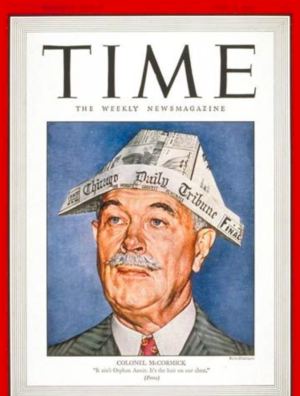
Col. Robert McCormick, legendary publisher of the Chicago Tribune
There was some very bad news Saturday in the race to save Tribune Publishing from the hedge fund Alden Global Capital. Hansjörg Wyss, who made his billions in the medical device field, ended his relationship with the hotel magnate Stewart Bainum, according to Katie Robertson of The New York Times.
Bainum insists he’s going to go it alone, but this is a major setback. Bainum and Wyss had outbid Alden, but it still wasn’t clear if they were going to succeed. Now Bainum has to find new investors.
Wyss’ main interest was the Chicago Tribune; apparently he got under the hood and discovered that the finances were a mess. He also reportedly came to the conclusion that his hope of transforming the Tribune into a national paper along the lines of what Jeff Bezos did with The Washington Post was unrealistic. Too bad that serving the third-largest metro area in the U.S. wasn’t good enough for him.
Back when this all started, Alden was going to increase its share in Tribune from 32% to 100%, keep eight of the chain’s nine major-market newspapers, and spin off The Baltimore Sun and several smaller sister papers to Bainum — who, in turn, planned to take them nonprofit. Bainum decided to bid for the entire chain after he concluded that Alden was chiseling him on fees, as Lukas Alpert reported in The Wall Street Journal.
What’s not clear is what happens if we return to the first iteration of the deal. Will Bainum still get The Baltimore Sun? Or is Alden now prepared to take charge of the entire chain — and start putting the squeeze on newsrooms that are already a shadow of their former selves?
NEWS ON TRIBUNE SALE: medical device billionaire Hansjorg Wyss drops out of bidding for TribPub after reviewing finances of Chicago Tribune; hotel magnate Stewart Bainum Jr “more committed than ever” to make bid for whole chain exceeding offer from hedge fund Alden Global/MORE
The New York Times has yet another story on the pressures being placed on publishers to cancel controversial books. The example in question is by Jonathan Mattingly, one of the Louisville police officers who took part in the fatal shooting of Breonna Taylor.
Probably the best known of such incidents was Simon & Schuster’s decision to cancel a contract with Sen. Josh Hawley earlier this year after he essentially endorsed the Jan. 6. insurrection. Hawley’s book was instantly picked up by the right-wing publisher Regnery, and Hawley has been talking ever since to whine about how he’s been silenced.
The Hawley situation shows that the marketplace can resolve disputes over speech. But I want to push it one step further by pointing out that publishing and distributing a book has become absolutely frictionless. Self-publishing a book, either in print or online, is cheap and easy — I’ve done it myself.
And though it is true that Amazon will occasionally decline to carry a book, as was the case recently with a work that had come under attack by the transgender community, DIY methods are always available, starting with the web, email lists and the like. (I’m leaving out Facebook because the service has been making efforts to take down disinformation and hate speech.)
What this comes down to is that fringe right-wing books will continue to be published and will continue to be promoted by fringe right-wing media, with the most prominent authors finding a voice on Fox News.
And even lesser authors can find creative ways to make money from their books. Just ask Sen. Ted Cruz, now facing allegations that he used campaign funds to promote his tome.
Gosh, it’s almost as if Donald Trump’s 2016 campaign colluded with the Russians. Now, remind me. Who hired Paul Manafort to run the campaign? Big guy … orange hair … give me a moment, OK?
The Washington Post’s Jeremy Barr has a must-read story about Fox News host Tucker Carlson’s habit of singling out journalists who’ve criticized him — or simply expressed views he doesn’t like — thus subjecting them to harassment and even death threats. Among them: NBC News reporter Brandy Zadrozny, Los Angeles Times columnist Virginia Heffernan and Grio reporter April Ryan. Barr writes:
Carlson cut his teeth jousting with the nation’s top elected officials and brand-name pundits on CNN’s “Crossfire” 20 years ago. But as his influence within the conservative media ecosystem has grown, with some calling for him to run for president in 2024, he has increasingly found fodder in criticizing lesser-known media figures whom he presents to his audience as symbols of liberalism run amok. And a subset of viewers are inspired to personally harass those journalists with threatening messages.
I’m of two minds about Substack. As a newsletter-and-blogging platform that is attractive and simplifies the task of writers charging readers for their work, it’s fine. As a venture capital-backed company whose leaders seem to have visions of world domination (and endless riches), well, I’m more than a little skeptical.
Which is to say that I’m dubious about Substack Local, a just-announced initiative under which 30 lucky local journalists will be able to get start-up funding and health insurance in order to cover their communities. Obviously the idea addresses the two biggest obstacles to going independent. And if it works, presumably there will be many more such Substack-backed local projects to come.
But is this really going to work? What happens when — as seems inevitable — the venture capitalists see no path to profitability and decide to cash out? I realize there may not be too many similarities, but this feels like Medium, with its ever-shifting business model, which has left many publishers holding the proverbial bag.
If I were starting such a site, I’d be much more interested in the Tiny News Collective, which is providing local news entrepreneurs with support for back-end services such as technology, business training and legal services for around $100 a month.
No, it’s not as lucrative as getting VC money via Substack. But as Sarah Scire points out at the Nieman Journalism Lab, the money isn’t all that much and is aimed at moving the sites toward sustainability — a goal that can be pursued without Substack’s help.
We seem to be moving toward peak Substack. My only advice to local news folks thinking about applying is that they should have a clear, detailed plan in place for how to move rapidly to a different platform if they wind up getting Medium’d.
• The white nationalist organization VDARE tweeted enthusiastically about Carlson’s endorsement of ideas that sound very much like “white replacement theory”: “This segment is one of the best things Fox News has ever aired and was filled with ideas and talking points VDARE.com pioneered many years ago. You should watch the whole thing.” (See the Southern Poverty Law Center’s take on VDARE.)
• New York Times columnist Farah Stockman reports that Carlson has been fueling opposition to President Biden’s nominee to run the civil rights division of the Department of Justice, Kristen Clarke, with a blizzard of lies. Among them:
He [Carlson] also claimed she was a purveyor of hate who wrote a “shocking” letter to Harvard’s student newspaper promoting the genetic superiority of Black people. In fact, the letter was a satirical response to “The Bell Curve: Intelligence and Class Structure in American Life,” a book that, among other things, portrayed Black people as intellectually inferior. Mr. Carlson might as well have done an exclusive investigation about cannibalism in Ireland following the publication of Jonathan Swift’s “A Modest Proposal.”
Carlson is flying awfully close to the sun. The Murdochs will put up with him until it’s no longer in their economic interest to do so.
Not too long ago, Tucker Carlson would go on vacation — always long-planned, of course — whenever one of his rancid descents into racism and white supremacy made life momentarily uncomfortable for his overlords at Fox News. He’d disappear for a few days, come back once the heat had died down and resume his hate-mongering ways.
But that was before former President Donald Trump’s lies about the 2020 election, before the insurrection of Jan. 6 and, most important, before Newsmax and One America News Network briefly put a scare into the Murdochs by showing that Fox’s audience, increasingly unmoored from reality, could no longer be taken for granted.
Thus we should have known that an uncontrite Carlson would be back at his perch Monday evening after enthusiastically endorsing “white replacement theory” the previous week. After all, Lachlan Murdoch, the heir to the throne, had defended Carlson earlier in the day in response to a letter from the Anti-Defamation League calling on Fox to fire its top-rated talk-show host.
“A full review of the guest interview indicates that Mr. Carlson decried and rejected replacement theory,” Murdoch said in his letter to ADL chief executive Jonathan Greenblatt. “As Mr. Carlson himself stated during the guest interview: ‘White replacement theory? No, no, this is a voting rights question.’”
This is how it works if you’re Tucker Carlson: You can express vile, unadorned racist views. And as long as you say the equivalent of “I’m not being racist,” you’re good to go. Or, rather, good to stay.
So what exactly happened last Thursday? Carlson popped up during the crossover from the 7 p.m. show to his own in order to banter with guest host Mark Steyn. Picking up on something Steyn had said earlier, Carlson excoriated Democrats for allowing immigrants into the country who would at some point be allowed to vote — thus diluting the votes of Americans who were already here.
“Now, I know that the left and all the little gatekeepers on Twitter become literally hysterical if you use the term ‘replacement,’ if you suggest that the Democratic Party is trying to replace the current electorate, the voters now casting ballots, with new people, more obedient voters from the Third World. But they become hysterical because that’s what’s happening, actually. Let’s just say it: That’s true,” Carlson said.
He then added the part that Lachlan Murdoch seems to think absolves him of racism: “Everyone wants to make a racial issue out of it. Oh, you know, the white replacement theory? No, no, no. This is a voting rights question. I have less political power because they are importing a brand new electorate. Why should I sit back and take that? The power that I have as an American guaranteed at birth is one man, one vote, and they are diluting it. No, they are not allowed to do it. Why are we putting up with this?”
This is, in fact, racism in its purest form: the belief that real Americans, defined by Carlson as people who were born here, have the right not to have to compete for political power with newcomers, and to be regarded as more worthy and more patriotic than those who immigrate here, become naturalized citizens and vote. Like, you know, Rupert Murdoch.
By the way, the aforementioned Steyn is a piece of work in his own right. A Canadian by way of the United Kingdom who once wrote dismissively of former Sen. Max Cleland’s devastating war injuries — the Georgia Democrat lost three limbs in Vietnam — Steyn came to Carlson’s defense in a post on his website.
Yet it wasn’t always sweetness and light between the two. In 2004, I wrote a profile of Steyn for The Boston Phoenix describing how he straddled the line between respectable conservatism and Ann Coulter-style gutter-dwelling. Steyn had criticized Carlson as a “conservative cutie” who had gone soft on the war in Iraq. So I called up Carlson, who had not yet begun his own descent into the intellectual abyss, and asked him what he thought.
“He’s kind of pompous,” Carlson said of Steyn. “He’s obviously smart, he can be quite witty. I mean, I agree with a lot of what he writes. But the problem with being a columnist for too long is that a) you tend to repeat yourself and b) you tend to forget that you need to marshal facts to support your opinions.”
But I digress. After all, this is about Carlson, who, no doubt charged up by Lachlan Murdoch’s endorsement, replayed his entire Thursday monologue to open his show on Monday and argued that he couldn’t possibly be racist because he believes the votes of Black people who were born in the U.S. are being diluted just as much as those of white people.
“Our leaders have no right to encourage foreigners to move to this country in order to change election results,” he said, and said this of Democrats: “Demographic replacement is their obsession because it’s their path to power.”
Not that any of this is new. The Atlantic’s Adam Serwer wrote about Carlson’s endorsement of white replacement theory back in 2018, after Carlson said that “Latin American countries are changing election outcomes here by forcing demographic change on this country.” That took place just a year after neo-Nazis in Charlottesville, Virginia — “very fine people,” as former President Donald Trump called them at the time — had chanted “Jews will not replace us! You will not replace us!”
So what is to be done? Advertisers have, on occasion, pulled out of Carlson’s show and other Fox programs. But that has a limited effect, since Fox makes most of its money from fees paid by the cable companies. As Angelo Carusone, president and CEO of the liberal media-watch organization Media Matters for America, recently told the public radio program “On The Media,” “They can have zero commercials and still have a 90% profit margin because they are the second most expensive channel on everybody’s cable box.”
That, in turn, has led the progressive media-form group Free Press to propose that Congress pass a law mandating à la carte cable service so that customers wouldn’t be forced to subsidize Fox and its ilk. That sounds promising, and I certainly wouldn’t mind not having to pay for the various flavors of ESPN. But I’m sure that such a move would have unintended consequences. For instance, how many people would choose to pay for CNN? Flawed though it is, it’s indispensable when there’s breaking news.
As for Carlson, nothing will change until, suddenly, it does. He may be the most powerful right-wing figure in the country right now — an heir to Trump and a possible future presidential candidate. Yet he’s playing with explosives, stirring up the hatred and resentment of his viewers in a way that could lead to some extremely ugly consequences.




.jpg)