The Boston Globe will partner with the Portland Press Herald on an unspecified investigative reporting project, according to the trade publication Editor & Publisher. The partnership will produce “a multi-part investigative report that will be published by both organizations this fall.”
The project will be funded by the Spotlight Investigative Journalism Fellowship, established by the Globe and Participant Media, the producers of the movie “Spotlight.” Grants of up to $100,000 are awarded to reporters or teams of reporters. This is the first time the Globe has partnered with another news organization. The series will be published by both papers.
Scott Allen, the Globe’s assistant managing editor for projects, declined in an email to say what the topic of the reporting would be — but when I noted that the Press Herald reporter who’ll be working on the project, Penelope Overton, covers the lobster industry, Allen said that “we expect to take full advantage of her considerable expertise.”
There are some interesting intersections between the Globe and the Press Herald. The E&P story points out that Press Herald managing editor Steve Greenlee worked at the Globe for 12 years. But it goes beyond that. Lisa DeSisto, who is chief executive officer of the Press Herald and its sister papers, was previously a high-ranking business-side executive at the Globe (and, before that, a colleague of mine at The Boston Phoenix).
The two papers also have the distinction of having been pursued by Boston-area businessman Aaron Kushner, who tried to buy the Globe in 2010 and nearly succeeded in buying the Press Herald in 2012. Kushner and a team of investors ended up purchasing the Orange County Register in Southern California later in 2012. They spent considerable resources in building up the Register and acquiring and launching other papers — only to tear it all down in short order when the hoped-for revenues failed to materialize. Today the Register is owned by the notorious hedge fund Alden Global Capital. (I tell the story of Kushner’s newspaper adventures in my book “The Return of the Moguls.”)
Today the Press Herald is owned by Reade Brower, a printer, who’s built a small chain of Maine newspapers and gets generally high marks for his stewardship. The Globe, of course, is owned by billionaires John and Linda Henry.
Walter Lippmann in 1905. Photo in the public domain.
Isaac Chotiner of The New Yorker has a terrific interview with Marty Baron, who’s retiring as executive editor of The Washington Post. I’m amused at the way Baron treats The New Yorker with the same brusqueness as he does other media outlets. For instance:
Chotiner: Why do you think [Jeff] Bezos decided to buy the Post?
Baron: You can look at what he’s said about that. I assume that you have. He’s talked about it many times.
Baron also expresses the view that local newspapers are going to have to save themselves the same way that national papers did: by persuading their readers to pay for it.
I was struck by how similar much of what Baron said was to my 2016 interview with him for “The Return of the Moguls.” Baron has his lodestar, and he follows it. But how journalists should and shouldn’t use social media is a bigger issue today than it was in 2016, so he and Chotiner talk about that quite a bit. And Baron also defines objectivity in exactly the way that I try to get it across to my students:
I do think that people have been routinely mischaracterizing what objectivity means. It really dates back a hundred years. Walter Lippmann essentially was the originator of the idea. What was the idea? It was a recognition that all of us as journalists, all of us as human beings, have preconceptions. Those preconceptions arrived from our own backgrounds, our life experiences, the people we associate with, you name it. And it’s important as we go about our reporting that we try to set those preconceptions aside — and almost approach our work in as scientific a way as possible — and to be open-minded, to be honest, to be fair, to listen generously to people, to hear what they have to say, to take it seriously into account, to do a thorough job of reporting, to do a rigorous job of reporting.
The idea of objectivity — I should make clear — it’s not neutrality, it’s not both-sides-ism, it’s not so-called balance. It’s never been that. That’s not the idea of objectivity. But once we do our reporting, once we do a rigorous job and we’re satisfied that we’ve done the job in an appropriate way, we’re supposed to tell people what we’ve actually found. Not pretend that we didn’t learn anything definitive. Not meet all sides equally if we know that they’re not equal. It’s none of that. It’s to tell people in an unflinching way what we have learned, what we have discovered.
Louisiana Attorney General Jeff Landry. Photo (cc) 2011 by Gage Skidmore.
Well, this is certainly a novel response to receiving a public-records request. The Republican attorney general of Louisiana, Jeff Landry, has sued a reporter for The Advocate and The Times-Picayune. The newspapers are seeking records about an official in the AG’s office who’s been accused of sexual misconduct. Landry has asked a judge to issue a declaratory judgment turning down the request and sealing the proceedings.
“In my 40 years as an editor, I’ve never seen a journalist get sued for requesting a public record,” Peter Kovacs, the newspaper’s editor, was quoted as saying. “We’re not intimidated. In fact, we’re more determined.” The reporter, Andrea Gallo, took to Twitter to warn: “I worry about reverse FOIA [Freedom of Information Act] suits against those who do not have my level of resources to fight back. Another reason to support local journalism!”
Just wanted to thank everyone who has reached out about this! I'm overwhelmed by the support. I worry about reverse FOIA suits against those who do not have my level of resources to fight back. Another reason to support local journalism!https://t.co/ClI1M96WxS
In fact, Gallo’s fears are already coming true. According to The Washington Post, such lawsuits are on the rise, with University of Georgia professor Jonathan Peters citing such examples as a lawsuit against a student newspaper filed by a university and an education agency that sued a nonprofit seeking enrollment information. Peters told the Post:
Government officials generally claim that these actions are initiated in good faith and that it is prudent for courts to step in immediately if an agency’s disclosure obligations are unclear. But suing record requesters is unwise, democratically dangerous, and usually unlawful.
Here in Massachusetts, reporters have long since grown accustomed to having their public-records requests ignored. Thanks to a weak state law, penalties for ignoring a valid public-records request are minimal, and government officials take full advantage of that. But suing journalists for seeking public records takes matters to a new and dangerous level.
Don McNeil of The New York Times has been one of my trusted sources on COVID. His long conversations with Michael Barbaro on “The Daily” have been reassuring while at the same time never minimizing the dangers posed by the pandemic. Now he’s gone over a 2019 incident in which he used racially offensive language with a group of students.
There are problems here that speak to the broken culture that seems to permeate the Times. On the one hand, McNeil was quietly disciplined at the time of the incident. It seems unfair to push him out now simply because his behavior has become public. On the other hand, his explanation of what happened doesn’t hold up. As David Folkenflik of NPR writes:
In his parting letter to colleagues, McNeil said he had used a racial slur in a context that he had thought defensible at the time, but now realizes was not.
“I was asked at dinner by a student whether I thought a classmate of hers should have been suspended for a video she had made as a 12-year-old in which she used a racial slur. To understand what was in the video, I asked if she had called someone else the slur or whether she was rapping or quoting a book title. In asking the question, I used the slur itself.”
According to the Daily Beast, parents complained that McNeil had been racially offensive at several different moments [my emphasis].
McNeil’s explanation simply doesn’t square with what parents were saying.
Folkenflik also reports on further fallout from the Times’ “Caliphate” debacle. Audio producer Andy Mills is gone because he’d been accused of what Folkenflik calls “inappropriate behavior toward female colleagues” back when he was working for public radio. Yes, and, of course, helping to create a Times podcast that turned out to be based on a massive fabrication didn’t help.
Barbaro’s own behavior regarding “Caliphate,” including intervening behind the scenes on behalf of his fiancée, has come under fire from public radio stations that carry “The Daily,” with some dropping the podcast altogether. But unlike Mills and “Caliphate” host Rukmini Callimachi, who’s been demoted, Barbaro is one of the Times’ biggest stars. We’ll have to see if this story has come to a conclusion or not.
Shiva Ayyadurai, in white hat. Photo (cc) 2019 by Marc Nozell.
Massachusetts Republican gadfly Shiva Ayyadurai has been banned from Twitter, most likely for claiming that he’d lost his most recent race for the U.S. Senate only because Secretary of State Bill Galvin’s office destroyed a million electronic ballots. Adam Gaffin of Universal Hub has the details.
In 2018, I gave the City of Cambridge a GBH News New England Muzzle Award for ordering Ayyadurai to dismantle an wildly offensive sign on his company’s Cambridge property that criticized Democratic Sen. Elizabeth Warren. City officials told him that the sign, which read “Only a REAL INDIAN Can Defeat the Fake Indian,” violated the city’s building code.
Ayyadurai threatened to sue, which led the city to back off.
In a time of national crisis — make that crises — there’s plenty of important news that gets overlooked. Vaccine delays, President Joe Biden’s economic-rescue package and, of course, Impeachment: The Sequel have overshadowed other topics to which we ought to be paying attention.
Every semester, I ask my journalism ethics students at Northeastern University to come up with a list of undercovered stories. Their answers are always intriguing. Invariably they find Washington, D.C., politics to be less compelling than what’s going on internationally and locally.
From a farmers’ strike in India to Australia’s crackdown on Google and Facebook, from good news about the coronavirus to still more good news about struggling Massachusetts cities like Chelsea and Brockton, my students have come through with stories we all ought to know more about. Even better, they’ve pretty much written my column for me this week.
Here are some highlights. The ranking is mine, but the ideas are all theirs.
7. Pandemic puppies. The isolation created by COVID-19 has led to an enormous upsurge in pet adoption — which, in turn, has fueled demand for purebred puppies, a problematic development for anyone who cares about animal welfare.
“During lockdown, puppies appealed both to single people facing months without human contact and to desperate parents seeking playmates for their lonely, screen-addicted children,” according to the Robb Report.
But as Robb and The Guardian reported, this demand has kept so-called puppy mills in business and has given rise to dogs that are genetically predisposed to health issues such as epilepsy and immune-system disorders.
6. Chelsea morning. During the pandemic, the news out of low-income cities in the Boston area such as Chelsea and Brockton has usually been bad — people of color working in service jobs and living in cramped quarters have had some of the highest rates of disease in the state.
This challenge, though, has also created an opportunity for activists to improve life in the state’s gateway communities. The Boston Globe’s “On The Street” series has documented some of those efforts. In Chelsea, for instance, Roseann Bongiovanni, the executive director of GreenRoots, told the Globe that the pandemic has led to new levels of cooperation among the city’s social-service providers.
“We’ve really broken down the silos,” Bongiovanni was quoted as saying. “I think post-pandemic you’re going to see a lot of collaboration, and this might give us an opportunity to think about the larger structural issues. Like why are so many people in Chelsea food insecure? Why is it that Chelsea was so sick?”
5. A revolution in sports viewing. In some parts of the mediasphere this is very big news indeed: The New York Times reports that NBCUniversal is shutting down the NBC Sports Network, moving some of its programming to the USA Network and — of more relevance — some of it to Peacock, its internet streaming service.
As more and more viewers are cutting cable and moving to streaming, media companies are attempting to move with them. The result is a dizzying array of options that, when you add them up, start to look like the same high price tag that viewers were paying for cable for so many years.
Media executives in charge of sports programming have been slow to embrace streaming because their viewers tend to be older and more likely to stick with cable. Yet the revolution is coming. GeekWire observes that some NFL games are already being shown exclusively on Amazon Prime.
4. Down under with Big Tech. In a case that ought to be watched closely in the United States, Australian regulators are waging war against the American technology giants Google and Facebook. At issue: The Aussies are insisting that the platforms pay for the news content that they use. Google and Facebook say they’ll delete news from what they publish before they let that happen.
The BBC reported that Australian Prime Minister Scott Morrison said his government has the right to set its own rules for how the internet is governed within its borders. “Let me be clear: Australia makes our rules for things you can do in Australia,” Morrison said. “That’s done in our parliament.”
At a time when disgust with Big Tech has led to calls for regulation in the U.S., the standoff in Australia is well worth keeping an eye on. Local news is in crisis. If Google and Facebook can be persuaded — or pressured — into helping to fund community journalism, it could make an enormous difference to news organizations’ bottom lines.
3. The feminization of unemployment. The pandemic-related economic collapse has hit different communities and groups of people in different ways. Some have hardly been affected. Others are really suffering. What few news organizations point out, though, is that the burden of lost jobs has been disproportionately borne by women.
In December, according to the National Women’s Law Center, 156,000 jobs were lost in sectors that traditionally employ women, while male-dominated jobs actually increased by 16,000. Overall, since February of last year, women have lost more than 5.4 million jobs, amounting to 55% of net job losses since the beginning of the pandemic. The situation is even worse among Black and Latina women, the center reports.
This trend, though, has not broken through in media reports. A recent article in The New York Times made little mention of the disproportionate effect of pandemic-related unemployment on women, and a Washington Post story made no mention of it at all.
2. Farmers’ strike in India. One of the biggest stories on the planet right now is getting scant attention from the American media. Tens of thousands of farmers in India, the world’s largest democracy, are on strike, protesting attempts by the government of Prime Minister Narendra Modi to impose new laws that they say will make it harder for them to sell their crops at a fair price.
According to The New York Times, one of the few U.S. outlets to cover the strike in any detail, the farmers’ action represents a significant challenge to Modi. Hartosh Singh Bal of The Caravan, a New Delhi-based magazine, wrote in a Times op-ed: “For the first time in six years, Mr. Modi is encountering opposition that he has not been able to stifle or tar with his extensive propaganda machinery.”
Modi is one of a number of authoritarian-minded rulers who have dominated the international stage in recent years. But now Russia’s Vladimir Putin faces massive protests. Brazil’s Jair Bolsonaro is losing popularity over his handling of the pandemic and corruption. And, of course, former President Donald Trump is gone after encouraging an inept but deadly assault on Congress. Seen in that context, the challenges facing Modi may be further evidence that the autocratic wave has crested.
1. Good news on COVID-19. Despite the shimmering promise of highly effective vaccines that, so far, not nearly enough people have been able to get, the day-to-day news about the pandemic remains grim. Hospitals in some parts of the country are full, dangerous new variants are spreading across the globe and the U.S. death toll will likely hit an unimaginable 500,000 in a few weeks.
Yet the curve of new cases nationwide is trending sharply downward, The New York Times reports. In Massachusetts, too, the most recent surge is easing, from a seven-day average of more than 6,000 new daily cases in mid-January to around 3,400 today, as this Boston Globe chart shows. Maybe it’s because enough people have now been vaccinated to make a difference. Maybe it’s because admonitions about masking and social-distancing are being taken more seriously. Or maybe it’s just a lull before the next storm.
Regardless, fewer cases and fewer deaths are good news for all of us — and a reminder that, just like pandemics of decades past, this one, too, will end.
Gen. Michael Flynn. Photo (cc) 2016 by Gage Skidmore.
On Monday, The New York Times published the results of a massive investigation into Donald Trump’s attempts to overturn the results of the election.
Today comes the tragicomic conclusion: a report by Axios on an insane meeting that took place at the White House on Dec. 18 at which the conspiracy-addled lawyer Sidney Powell tried to get herself named a special counsel to investigate Dominion voting machines while Gen. Michael Flynn (he of the two guilty pleas) and the White House staff screamed profanities at each other.
The reporters are Jonathan Swan, who conducted a hard-hitting interview of Trump last year, and Zachary Basu. The whole thing is so crazy that it’s hard to pick any one excerpt, but this will do. Below, Byrne is Patrick Byrne, the chief executive of Overstock.com and a Trump backer. Herschmann is Eric Herschmann, a White House senior adviser. Patrick Cipollone was the White House counsel. Swain and Basu write:
At one point, with Flynn shouting, Byrne raised his hand to talk. He stood up and turned around to face Herschmann. “You’re a quitter,” he said. “You’ve been interfering with everything. You’ve been cutting us off.”
“Do you even know who the fuck I am, you idiot?” Herschmann snapped back.
“Yeah, you’re Patrick Cipollone,” Byrne said.
“Wrong! Wrong, you idiot!”
Herschmann and others who were at least partly tethered to reality were afraid that Trump was going to go along with Powell and unleash her upon state and local election officials. As Swain and Basu write, “Trump expressed skepticism at various points about Powell’s theories, but he said, ‘At least she’s out there fighting.'”
In the end, though, Trump was somehow coaxed into listening to reason. How bad was it? Toward the end, we see that Rudy Giuliani actually had a calming effect on the situation, which is surely the first time anyone has said that about him in many years.
Correction: I originally misspelled Jonathan Swan’s name.
The Philadelphia Inquirer is getting rid of most of its comments. Why?
Commenting on Inquirer.com was long ago hijacked by a small group of trolls who traffic in racism, misogyny, and homophobia. This group comprises a tiny fraction of the Inquirer.com audience. But its impact is disproportionate and enduring.
A few years ago, after a content-management system upgrade, GBH News killed its comment sections. If anyone complained, I’m not aware of it. Every news organization should consider emulating the Inquirer — including The Boston Globe.
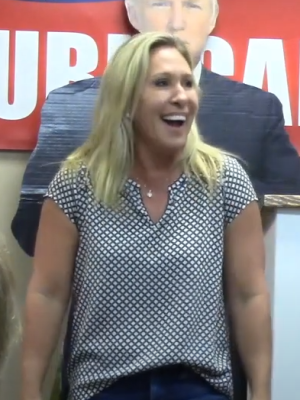
Marjorie Taylor Greene. Photo (cc) 2020 by FYNTV FetchYourNews.
Many mainstream news organizations are genuinely struggling to come to terms with the current dynamic in Washington: an often feckless Democratic Party opposed by crazy and dangerous Republicans. It’s not an entirely new scenario, and has in fact been building since Newt Gingrich’s speakership in the mid-1990s. But it’s become acute since the Trump-inspired insurrection of Jan. 6 and the embrace of QAnon and sedition by large swaths of the GOP.
But while responsible journalists are trying to figure out how to navigate this reality, there’s another group that continues to embrace #bothsides-ism at its most mindless. At the center of this is Axios, which combines the politics-as-sports sensibility of Politico, whence it sprang, with bullet points and lots of boldface.
Take, for instance, “The Mischief Makers.” According to Axios reporters Alayna Treene and Kadia Goba, leaders in each of the two major parties are being tormented by “troublemakers” and “political thorns” within their ranks. And who are these feisty backbenchers?
Well, on the Republican side is House member Marjorie Taylor Greene, who has called for the execution of Speaker Nancy Pelosi and other top Democrats and who believes that wildfires are caused by a Jewish-controlled laser in outer space. Also getting a nod are Matt Gaetz, Louie Gohmert and Mo Brooks, all of whom supported the insurrection.
What Democrats could possibly be as dastardly as that? Why, the Squad, of course! Because they’re liberal and/or progressive. So Alexandria Ocasio-Cortez, Ilhan Omar and Ayanna Pressley all get a shoutout, as well as like-minded newcomers such as Jamaal Bowman and Cori Bush.
In the Senate, Republicans Ted Cruz, Rand Paul and Josh Hawley, all of whom supported Trump’s coup attempt, are equated with Democrats Kyrsten Sinema and Joe Manchin, who are more conservative than most of their party peers, and independent Bernie Sanders, who’s to the left of most of his colleagues but who’s been notably supportive of President Joe Biden.
But wait! There’s to-be-sure paragraph buried amid all this:
Not all are created equal. Democrats often contend with an outspoken, very progressive wing of their caucus and try to keep centrists from crossing party lines. Republicans have senators who led efforts to invalidate the 2020 election results and flirted with the same conspiracy theories that fueled groups involved in the Capitol siege.
No kidding.
So, does anything Axios publishes cause genuine harm? It’s hard to say. But Axios is aimed primarily at insiders — congressional staff members, lobbyists and other journalists. And many of them would love nothing more than validation that they can return to business as usual.
Cynical takes such as this can serve to normalize what’s going on in Washington, providing the narcotic drip we need to help us forget that many powerful Republicans attempted to overthrow the results of the election less than a month ago. Five people died, and we haven’t even begun to get to the bottom of what happened.
Perhaps the only thing I’ll miss about the Trump era is “Trumpcast,” a podcast produced by Slate and hosted by the longtime journalist Virginia Heffernan. Wise, witty and profane, Heffernan has guided us through the insanity for the past five years. I started listening about two years ago, and I didn’t catch every episode. But I appreciated the way she and her guests guided us through a terrible time in our history. So it was with a sense of instant nostalgia that I listened to her final episode while I was out on a walk Saturday.
The guest on the grand finale was New York University journalism professor and PressThink blogger Jay Rosen. Rosen summarized his most recent piece, in which he argued that the media finally found their voice and stood up for democracy once it became clear in the aftermath of the election that Donald Trump really did intend to steal a second term. Before that, he said, the press too often wallowed in bothsides-ism and normalized Trump’s corrupt, authoritarian behavior.
As I wrote recently, I don’t think the media’s performance was quite that bad. Sure, there was some normalization that took place, which was inevitable in covering the president day to day. But after turning in a horrendous performance during the 2016 campaign, I think much of the media dug in and covered Trump with the harshness and investigative zeal that he deserved. The problem is larger than journalism alone can solve. Our culture has become profoundly tribal, and any negative coverage of Trump was seen by his supporters as just further evidence that the media were out to get their hero. The 52% disapprove/42% approve dynamic never budged.
After Rosen left, Heffernan and her producer, Melissa Kaplan, kicked around the show’s greatest hits. They sounded like they’re going to miss “Trumpcast” too, though not the reason for its existence. It was a fun retrospective, and I think both of them accurately identified what made “Trumpcast” special — its giving a voice to alternative perspectives and not just those from the “normcore.”
As for what’s next, they’re both going to continue to be involved in podcasting. Heffernan will be hosting a show about the aftermath of Trumpism for Lawfare, which I’m looking forward to hearing.
 The Boston Globe will partner with the Portland Press Herald on an unspecified investigative reporting project, according to the trade publication Editor & Publisher. The partnership will produce “a multi-part investigative report that will be published by both organizations this fall.”






.jpg)
