Earlier this week, I wrote for GBH News about a study showing little support for the core principles of journalism. Joshua Benton of the Nieman Journalism Lab has done an exceptionally deep dive into the numbers and has concluded that they don’t say what the study’s authors claim.
Benton’s explanation is that the Media Insight Project took unambiguous support for certain journalistic verities and watered it down by pairing it with findings that showed a more dubious view of the press. Benton writes:
Its top-line finding — summarized by a [Washington] Post headline writer as “Bad news for journalists: The public doesn’t share our values” — is bogus. Or, at a minimum, unsupported by the methodology in use here. There is no reason to believe, based on this data, that Americans have somehow abandoned the basic values of democratic governance, or that we noble journalists are left to fight the lonely fight for accountability.
But Tom Rosenstiel, executive director of the American Press Institute, one of the organizations that sponsored the study, replies at the Columbia Journalism Review that Benton’s methodology is itself flawed:
Researchers caution against trying to draw conclusions from any one individual item without considering the full set.
We fear this is the mistake Josh has made.
My quick takeaway is that Benton gets the better of the dispute. But read both pieces and see what you think.
I just finished wrapping up this week’s Media Nation member newsletter, which will go out Friday morning. Every week I offer some exclusive content, a round-up of the week’s posts, photography and a song of the week. If you’d like to join, membership is just $5 a month. Just click here.
Media Nation remains free and open. By becoming a member, you can support my work and receive some extra goodies. Thank you!
Well, this is sad news, but not exactly shocking. Sue O’Connell and Jeff Coakley are putting Bay Windows and the South End News up for sale after 18 years of ownership. Sue and Jeff were both colleagues of mine at The Boston Phoenix. They’ve had a great run, and of course Sue has gone on to considerable success as a host at NBC 10 and NECN as well as at GBH News. Here’s the announcement.
BAY WINDOWS AND SOUTH END NEWS ARE UP FOR SALE!
What a time to be alive.
It doesn’t matter if you read this phrase as a meme or think we’re quoting Drake, this really is an amazing time to be alive.
As we emerge from the COVID-19 pandemic, one thing will become clear, if it hasn’t already: we’re living in a new world. This means new ways of doing business and accessing health care and education. Innovations in art, cultural, and culinary spaces. Wholesale reimaginings of community life and work space.
Nothing will ever return to “normal.” Nor would we want it to. Over the past year, movements for social justice based on race have accelerated. Our schools, businesses, nonprofit institutions, government agencies, elected officials, and community-based organizations are incorporating demands for change. In many cases, they are leading it.
In these times of change, we invite one more. After publishing Bay Windows and South End News for 18 years, we are putting both publications up for sale.
The business of local news has changed in the two decades we’ve owned both papers. But the news and its importance to the community has not. That is why we are inviting community leaders, business owners, nonprofits, educational institutions and others to consider purchasing Bay Windows and South End News, either separately or together. We are committed to thinking creatively and working with potential buyers to provide an equitable path to ownership.
Models to consider including nonprofit conversion, government support, a public and/or digital media merger, and community ownership.
When we purchased Bay Windows and South End News in 2003, we’d like to tell you that we did it out of a high-minded commitment to the vital role that community newspapers play in our communities. But that would not be true.
We bought these papers because we thought it would be fun.
Was it? Absolutely.
Almost immediately after purchasing the papers, Bay Windows became the primary source of news and information related to the political, legal, and public opinion battles being waged to bring marriage equality to Massachusetts. This role was similar to the one the paper had played in its early years as a source of information about AIDS that could not be found anywhere else. Since its founding, the paper has been home to information about political, arts, entertainment, and cultural news relevant to the LGBTQ community.
South End News has played the same role in the life of the South End, a neighborhood that has shaped the city of Boston’s nonprofit sector, biomedical research, culinary scene, and arts and cultural offerings. It has also been home to groups and individuals who have played influential roles in Puerto Rican, Black, and LGBTQ activism in the city of Boston.
Over the past two decades, we have met business owners, nonprofit leaders, artists, activists, chefs, politicians, city employees and community members. It has been the experience of a lifetime.
Now it is someone else’s turn.
We can promise you three things: It will take a lot of work to make it work. You will exercise great influence in the South End and the state’s LGBTQ community. And you will have fun.
As you may have read elsewhere, the original police account of George Floyd’s death was mostly accurate yet completely false. It read in part:
Officers were able to get the suspect into handcuffs and noted he appeared to be suffering medical distress. Officers called for an ambulance. He was transported to Hennepin County Medical Center by ambulance where he died a short time later.
Floyd’s murder at the hands — or, rather, at the knee — of Derek Chauvin is likely to have long-lasting repercussions. One of those repercussions should be a rethinking of how journalists report routine police news. It has long been the custom for reporters at small community news organizations to visit the police station every morning, flip through the publicly available log, and report what’s there. If something seems interesting, the journalist might ask to see the incident report written up by an officer. And then this gets regurgitated, the ultimate in one-source reporting.
That’s how I did it in the 1970s and ’80s. It’s how we were all taught to do it. And in a large city like Minneapolis, a man who, according to police, died from medical issues while being arrested for forgery would probably not warrant a follow-up. You’d report it, and then you’d be on your way.
Interestingly enough, one of the papers I worked for in the early part of my career would not publish the names of people who’d been arrested and charged with a crime unless it was fairly big news. We younger reporters thought it was ridiculous, and we chafed at not being able to tell the whole story. But the editor, who was also one of the owners, explained that since our coverage of the court system was spotty at best, we’d likely never know if the person had been convicted or acquitted — and if it were the latter, we’d have smeared their reputation without cause. My editor was right, and ahead of his time. We were wrong.
Earlier this week The Washington Post reported on a case in Loveland, Colorado, where police last year arrested a 73-year-old woman who’d walked out of a Walmart with $13.88 worth of stuff without paying. It turns out that she had dementia and, as is clear from the police video, presented no threat to anyone. Yet she was thrown to the ground and handcuffed, with an officer twisting her arm in such a way that she suffered from a broken bone and a dislocated shoulder.
Can you imagine what the police log item might have looked like? No big deal, right?
The problems presented by taking the police at their word was the subject of an exchange the other day involving my GBH News colleague Saraya Wintersmith, South End News and Bay Windows publisher Sue O’Connell and me. (Note: Within the last few minutes I received a press release saying that O’Connell’s papers are up for sale. More to come.)
Totally guilty of that. And part of it also has to do with staffing. If you publish a community or small paper the resources are limited and it’s impossible to verify every police report. We would look to larger news kegs to do that heavy lifting.
Well, it’s an interesting dilemma, isn’t it? I’ve worked for some very small news organizations. Standard practice is to regurgitate the police log and incident reports. All that needs to be rethought.
— @dankennedy_nu@threads.net (@dankennedy_nu) April 21, 2021
That, in turn, drew a comment from Julie Manganis, who covers the courts for The Salem News and its sister papers.
I'm no self-promoter but I have to say, if more news outlets had reporters in the courthouses on a more regular basis, more news outlets would know that most defense lawyers and many judges also do a pretty good job of dissecting "official" accounts.
Manganis is right, but the News is unusual in its ongoing dedication to court reporting — and even then, most routine police news doesn’t rise to that level.
An additional complication is that many police departments now post their logs online. Under the state’s public records law, police departments must keep daily records of incidents and, in the case of arrests, the name, address and charge against the person who was detained. Members of the public, including journalists, are entitled to see this information. But now these items don’t even get the light vetting that might take place when a reporter asks an officer to explain something. It’s right out there for everyone to see.
Indeed, as I’m writing this, I’m looking at a report from one of the larger cities in the Boston area about a woman who was arrested and charged with trespassing. It’s a pretty thorough entry, and yes, it includes her name, age and address. It is probably accurate. I have no idea if it’s also true — that is, if it offers all the context we need to know to understand what happened.
Major crimes will always receive journalistic scrutiny. Official sources may have the upper hand early on, but as reporters keep digging, they’ll generally ferret out the truth. But we need a serious rethink of how we cover routine police news. And we need to do it at a time when local news resources are stretched to the limit.
One rule we might follow is that if an incident is so minor that it’s not worth devoting the resources to getting all sides, then it’s probably not worth reporting in the first place. But this is just the beginning of a conversation about how to practice ethical journalism at a time when the old ways of doing things are no longer good enough. And never were.
More: I’m pasting Paul Bass’ comment here because I think it adds some important information on how to do it the right way. Bass is the founder and editor of the New Haven Independent, a nonprofit digital news organization.
We have always felt strongly at the Independent that media should not print names of arrestees unless we have their side, we have seen independent evidence corroborating the charges, an immediate threat exists to public safety requiring divulging the name, or a court has adjudicated the charge. I have personally gotten flak over the years from mainstream corporate journalists who felt outraged that we were being so “elitist.” The policy began after noticing that many Black people in new Haven were charged with crimes they didn’t commit. (See this Nieman Journalism Lab story.)
Life imitates art imitates life. I was thinking of that on Tuesday as the three guilty verdicts were being announced in the case of Derek Chauvin, who killed — and we can now definitively say murdered — George Floyd.
Last summer, as part of a series of discussions our church was holding on racism, we watched “Do the Right Thing,” Spike Lee’s classic 1989 movie about race, police brutality and so much more. It is a great film. We saw it when it first came out, and it was a revelation to view it again more than 30 years later, with its rich depiction of life in Bedford-Stuyvesant and the uneasy truce between the white pizza shop owner and his Black customers.
But the climactic scene — the killing of Radio Raheem at the hands of a police officer — shows that Lee’s imagination did not anticipate the depravity of Derek Chauvin. Raheem is killed in a moment of panic as chaos erupts at the pizza shop. Chauvin deliberately jammed his knee into George Floyd’s neck for more than nine minutes until his victim was good and dead.
Did Chauvin mean to kill Floyd? No one can know exactly what was in his tiny heart. But I’m guessing that the answer is yes. Maybe not before. And certainly not after, if only because he had to realize he’d just gotten himself into a world of trouble. But during, as he felt the power surge through him while Floyd gasped for air and called out for his mother? Yes. He had to know what he was doing. How could he not?
If you’ve never seen “Do the Right Thing,” well, do the right thing and watch it. And think about how little has changed over the past three decades. The Floyd family received some measure of justice, but it’s difficult to imagine what the outcome would have been if not for the video shot by Darnella Frazier. Or maybe it’s not difficult to imagine.
Pulsing throughout “Do the Right Thing” is Public Enemy’s “Fight the Power.” The fight isn’t over by any means.
How can the news media attract an audience that’s skeptical of journalism’s most deeply ingrained principles? Well, consider two different treatments of the same story.
In our first example, the headline reads, “New Recreation Center For Low-Income Neighborhood A Casualty Of Parks Scandal.” The lead: “A project aimed at helping the city’s most marginalized, low-income neighborhood has been abandoned in the wake of a misuse of city funds by the parks director, according to documents obtained by a local media investigation.”
That seems straightforward enough — newsy and with an emphasis on the victims of a corrupt city official.
Now, here’s the second version. The headline: “Parks Boss Deceived Mayor, Misused Taxpayer Money.” The lead: “The city’s parks director intentionally defied the orders of the mayor and diverted city money from a key recreation project to businesses owned by his friends and family, according to documents obtained by a local media investigation.”
This treatment introduces the mayor as a key player right at the top and portrays her or him as an authority figure who was betrayed by an underling. And that, in turn, makes a significant difference in how the story is perceived, according to a major new study by the Media Insight Project, a collaboration of the American Press Institute and the Associated Press-NORC Center for Public Affairs Research.
As the study’s authors explain it, the first version appeals mainly to readers who place a high value on caring and fairness, which correlates with stronger support for journalism. The second appeals to readers who value loyalty and authority, which correlates with lower support for journalism. The good news is that the second version broadened the potential audience for the story without diminishing its appeal among those who value caring and fairness.
At this point you might ask why I’m hacking my way through the weeds of the study rather than focusing on the topline results. The reason is that the major takeaways just seem too depressing unless you take a close look at how they might be applied in the service of making journalism better and more appealing.
The survey of more than 2,700 Americans found majority support — 67% — for only one of the five core journalism values identified by the authors, “the idea that more facts get us closer to the truth.” By contrast, just 29% embraced a focus on social problems. Giving a voice to the less powerful, transparency and oversight — that is, the watchdog function of journalism that is so often stressed as being of crucial importance to democratic governance — all fall somewhere between 44% and 50%. Only 11% of respondents support all five functions.
As the report puts it, “When journalists say they are just doing their jobs, in other words, the problem is many people harbor doubts about what the job should be.”
The study also attempts to match those five core functions with some pretty sophisticated personality modeling based on the work of the social psychologist Jonathan Haidt and his colleagues. They identified five moral foundations that govern us: care versus harm, fairness versus cheating, loyalty versus betrayal, authority versus subversion and purity versus degradation.
The first two tend to be associated with liberals and Democrats, who are more trusting of journalism. The next three are more associated with conservatives and Republicans, who are less trusting. But as the two versions of the same scandal story demonstrate, tweaks can sometimes be made that don’t alter the substance of the story and that can broaden its appeal so that both liberals and conservatives will read it.
Dispiriting though the topline findings may be, they contain actionable information — which puts this at a considerably higher plane than your typical survey showing that, yes, the public still hates the press.
“I must confess that my first impulse was to resist these findings,” wrote Washington Post media columnist Margaret Sullivan. “After all, I’ve spent decades with the ideas described above as my lodestar, convinced that journalism serves the public good. And after all, investigative journalism is built on the idea of being society’s watchdog.
“However, given that trust in the news media has fallen from about 70% in the early 1970s to about 40% now, according to Gallup — it seems worth viewing this report with an open mind.”
As Tom Rosenstiel, the executive director of the American Press Institute, told Sullivan, “This at least opens a new window. It gets us out of the endless loop.”
For years, and especially since Election Day 2016, the mainstream media have been wringing their collective hands and wondering how they can understand conservatives, Republicans and Trump voters, three categories that overlap mostly but not entirely. The New York Times, in particular, has subjected us to endless stories from the heartland that could all be headlined, “Trump Supporters Support Trump.”
The Media Insight Project may show us that there’s a different, more nuanced way of understanding the public — and that, by appealing to their sense of values, journalism may be able to bridge gaps that often seem unbridgeable.
Joan and Walter Mondale with Boston Mayor Ray Flynn. Photo (cc) Boston City Archives.
My favorite story about Walter Mondale (and how many people can say they have a favorite story about Walter Mondale?) has to do with something he supposedly said when a staffer from Jimmy Carter’s 1976 presidential campaign complained to him about his haircut.
Those of us who’ve reached a certain age may remember that one of Carter’s claims to fame was that he had really, really good hair. And apparently it just wouldn’t do that the Democratic nominee’s newly chosen running mate was, to put it mildly, tonsorially challenged. Mondale’s alleged retort: “The people of Minnesota like shitty haircuts.”
Mondale, often described as the first vice president who actually mattered, died on Monday at the age of 93. I recommend Steven R. Weisman’s masterful obituary in The New York Times.
Now, did my Mondale anecdote play out exactly as I’ve described it? It’s hard to say. But I found something very close in a 1992 book by Steven M. Gillon titled “The Democrats’ Dilemma: Walter F. Mondale and the Liberal Legacy.” Apparently once Mondale became vice president, he took to having his hair cut by a stylist in his office, a move that was seen by some as a sign that Fritz was leaving his humble roots behind. Gillon writes:
While in the Senate, Mondale had his hair cut by a local Washington barber. “The people in Minnesota like shitty haircuts,” he told friends. Now, a hair stylist came directly to the Vice President’s office. “He thinks he doesn’t have time” to go to a barber, a friend remarked skeptically.
Mondale was one of the finest people ever to win a presidential nomination — a model of personal rectitude and dedication to public service. I would say that we won’t see his likes again except that I think we have a pretty good example of that in the White House right now.
Please become a member of Media Nation. For $5 a month, you’ll receive a weekly newsletter with original content, a round-up of the week’s posts, photography and even a song of the week.
The local news crisis has some people talking seriously about government funding for journalism. The idea isn’t entirely new. Nonprofit news organizations enjoy tax benefits, and public broadcasters receive some federal money. As I recently reported for GBH News, federal pandemic relief actually meant that 2020 was a better year than 2019 for some media outlets.
But what comes next? Local media are being squeezed on one side by technology and on the other by avaricious chain ownership. Ideally, you would want to find ways to help independent news organizations without rewarding the corporations and hedge funds that are cutting newsrooms without conscience. But it’s hard to imagine how you would draw distinctions between the two.
Moreover, direct government assistance raises serious questions about how journalism can play its traditional watchdog role if it’s receiving money from the watchdog. It strikes me that it would be a hard sell with taxpayers, too. Nevertheless, some smart people are thinking about how we can provide communities with the news and information they need in an era of market failure.
Really, the administration’s push for a more capacious definition of infrastructure should encourage us to think even more creatively about what else should qualify for the next package as it takes shape. Can it seriously be argued, for instance, that access to the news isn’t an important feature of any well-functioning society? We all depend upon a steady stream of accurate information; obviously, we owe much of our awareness that America’s infrastructure is crumbling to the work of journalists who helped alert policymakers and the public to the problem in the first place.
Nwanevu notes that the $3 per capita we currently spend on public broadcasting is a pittance compared to the $90 that is the average in many other developed countries. He also writes favorably of ideas that Andrew Yang put forth during his presidential campaign for a fellowship program for journalists and a “Local Journalism Fund” to help news outlets transition to sustainability. But Nwanevu is also thinking bigger than that, calling for $30 billion to $40 billion over the next 10 years.
I’m not sold, though, mainly because Nwanevu only half-defines the problem. He cites the challenges posed by technology and the rise of Google and Facebook, but he makes no mention of corporate ownership, which has made the crisis much worse than it needed to be. With chains like Gannett and hedge funds like Alden Global Capital bleeding their newspapers dry, there is no money left over to invest in the future. Meanwhile, a number of independent news organizations across the country, for-profit and nonprofit, are doing a good job of serving their communities. We need more.
The Columbia Journalism Review recently published a conversation with the longtime media reformer Robert McChesney; Steve Waldman, the co-founder of Report for America; and the economist Andrea Prat. All of them offer their own ideas for providing some public assistance for news, with McChesney’s proposal for a “Green New Deal for journalism” being the most ambitious. He describes the challenge this way:
This is the public policy imperative facing the United States regarding journalism in 2021: we need the funding to support independent, competitive, professional local news media. That money must come from the government, but we cannot allow the government to pick and choose who gets the money. The policy must be like the postal subsidy of newspapers: large enough to get the job done, and it cannot discriminate on the basis of ideology or political viewpoint. Censorship is entirely unacceptable. It must allow the people to make of it what they will, and trust them in the process of self-government.
So how would McChesney accomplish that? Through elections at the county level (that wouldn’t really work in Massachusetts, which is pretty much county-free) to elect boards that would distribute between $32 billion and $35 billion a year over a five-year period to fund local news and foster the development of new nonprofit organizations. It’s pretty breath-taking, and McChesney admits there’s no support for such a plan in Washington at the moment. But the value McChesney has always brought to the table is that he thinks big and gives us a chance to wrap our minds around larger possibilities.
Waldman’s plan, by contrast, already has a great deal of support on Capitol Hill: a $250 refundable tax credit to pay for local news subscriptions or to donate to nonprofit media outlets. He would like to see a tax credit for hiring and retaining journalists as well, which is something currently being done in Canada.
Prat, though, argues that the tax credits would mainly benefit large news organizations, whereas “the most urgent problem is not the overall information level but its distribution across the population.” A voucher system, he says, “would give more access to information-poor people.”
So, has the moment come for government-funded news? My own guess is probably not, at least if we’re talking about the ambitious proposals put forth by Nwanevu and McChesney. But some modest assistance aimed at helping news organizations make the transition to a sustainable future might well be a good idea.
Waldman’s tax credits and Prat’s vouchers could be seen as extensions of the help we already provide through nonprofit tax incentives. And surely we can provide more funding for public media while broadening the definition to include community-based journalism.
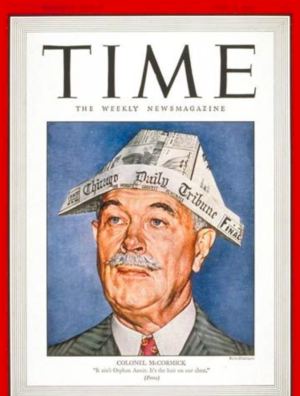
Col. Robert McCormick, legendary publisher of the Chicago Tribune
There was some very bad news Saturday in the race to save Tribune Publishing from the hedge fund Alden Global Capital. Hansjörg Wyss, who made his billions in the medical device field, ended his relationship with the hotel magnate Stewart Bainum, according to Katie Robertson of The New York Times.
Bainum insists he’s going to go it alone, but this is a major setback. Bainum and Wyss had outbid Alden, but it still wasn’t clear if they were going to succeed. Now Bainum has to find new investors.
Wyss’ main interest was the Chicago Tribune; apparently he got under the hood and discovered that the finances were a mess. He also reportedly came to the conclusion that his hope of transforming the Tribune into a national paper along the lines of what Jeff Bezos did with The Washington Post was unrealistic. Too bad that serving the third-largest metro area in the U.S. wasn’t good enough for him.
Back when this all started, Alden was going to increase its share in Tribune from 32% to 100%, keep eight of the chain’s nine major-market newspapers, and spin off The Baltimore Sun and several smaller sister papers to Bainum — who, in turn, planned to take them nonprofit. Bainum decided to bid for the entire chain after he concluded that Alden was chiseling him on fees, as Lukas Alpert reported in The Wall Street Journal.
What’s not clear is what happens if we return to the first iteration of the deal. Will Bainum still get The Baltimore Sun? Or is Alden now prepared to take charge of the entire chain — and start putting the squeeze on newsrooms that are already a shadow of their former selves?
NEWS ON TRIBUNE SALE: medical device billionaire Hansjorg Wyss drops out of bidding for TribPub after reviewing finances of Chicago Tribune; hotel magnate Stewart Bainum Jr “more committed than ever” to make bid for whole chain exceeding offer from hedge fund Alden Global/MORE
The New York Times has yet another story on the pressures being placed on publishers to cancel controversial books. The example in question is by Jonathan Mattingly, one of the Louisville police officers who took part in the fatal shooting of Breonna Taylor.
Probably the best known of such incidents was Simon & Schuster’s decision to cancel a contract with Sen. Josh Hawley earlier this year after he essentially endorsed the Jan. 6. insurrection. Hawley’s book was instantly picked up by the right-wing publisher Regnery, and Hawley has been talking ever since to whine about how he’s been silenced.
The Hawley situation shows that the marketplace can resolve disputes over speech. But I want to push it one step further by pointing out that publishing and distributing a book has become absolutely frictionless. Self-publishing a book, either in print or online, is cheap and easy — I’ve done it myself.
And though it is true that Amazon will occasionally decline to carry a book, as was the case recently with a work that had come under attack by the transgender community, DIY methods are always available, starting with the web, email lists and the like. (I’m leaving out Facebook because the service has been making efforts to take down disinformation and hate speech.)
What this comes down to is that fringe right-wing books will continue to be published and will continue to be promoted by fringe right-wing media, with the most prominent authors finding a voice on Fox News.
And even lesser authors can find creative ways to make money from their books. Just ask Sen. Ted Cruz, now facing allegations that he used campaign funds to promote his tome.