Washington Post reporters Elahe Izadi and Sarah Ellison have a terrific account of how the campaign to save Tribune Publishing from Alden Global Capital got started.
It began with Save Our Sun, a group launched by several Baltimore Sun reporters. And as recently as a few weeks ago, it looked like they had won a significant but limited victory: Alden would take ownership of eight of Tribune’s nine major-market dailies, spinning the Sun and several affiliated papers off to nonprofit ownership.
That’s when things got more interesting. When Stewart Bainum, the hotel magnate behind the nonprofit plan, grew frustrated with Alden’s terms, he put together a group of billionaires and outbid Alden for the entire chain. Though Bainum’s victory is not yet assured, things are moving in the right direction. The papers would be spun off to local owners, some of them nonprofits, which would represent the biggest victory over chain journalism in many years.
Among the papers that would be saved from Alden’s clutches: the Chicago Tribune, New York’s Daily News and the Hartford Courant.
Meanwhile, Joshua Benton of the Nieman Journalism Lab explains how Alden can win even if it loses: the hedge fund already owns 32% of Tribune. So if the Bainum group ends up paying a premium, Alden will be among the beneficiaries.
It’s a rare day when we encounter as blatant an example of liberal media bias as in the “60 Minutes” report last Sunday on Florida Gov. Ron DeSantis. It’s not that the mainstream media aren’t broadly liberal — they are. But such bias normally affects things like story selection and tone, and does not interfere with a fair presentation of the facts. Unfortunately, the botched story on DeSantis, a Republican, will be cited by conservatives for a long time as evidence that you just can’t trust the media.
So what happened? “60 Minutes” reported that DeSantis awarded a contract to the supermarket chain Publix to distribute COVID vaccines after Publix had made a $100,000 campaign donation to the governor’s political action committee. The governor refused to give “60 Minutes” an interview. But in a confrontation at a DeSantis news conference, “60 Minutes” reporter Sharyn Alfonsi asserted that the vaccine contract was a “reward” and asked him: “How is that not pay to play?”
There are two problems here. First, the story accurately describes the quid but never manages to nail down the quo. It would be strange indeed if Publix did not make campaign contributions to DeSantis, as he is a major political figure. Large businesses do what they have to do to get along. Moreover, Publix stores would be obvious, logical places for administering vaccines.
The system was far from perfect. The report points out that, in some cases, Publix markets are far from communities of color, requiring two bus rides in one example. But that doesn’t prove DeSantis acted as he did because Publix had given him money. As media ethics expert Al Tompkins of the Poynter Institute puts it:
In the story, there was a direct line between the campaign contribution and the rewarding. And they never proved that. I think they owe it to everybody — they owe it to the governor, they owe it to Publix, they owe it to the public — to explain to us how they came to that conclusion.
Second, having watched the news conference confrontation as edited for broadcast and compared it to the full, unedited version (above), I think it’s clear that DeSantis’ remarks were edited to cast him in the worst possible light. Journalists are free to use as little or as much as they like of an interview or, in this case, remarks at a news conference. But they are not free to edit those remarks in a way that changes their meaning or leaves out important context.
Among the people who have come to DeSantis’ defense, according to The Palm Beach Post, is Palm Beach County Mayor Dave Kerner, a Democrat. “They are hellbent on dividing us for cheap views and clicks,” Kerner said in a written statement. “‘60 Minutes’ should be ashamed.” (Not every elected Democrat agrees with Kerner, including County Commissioner Melissa McKinlay.)
I doubt the problems with this story were the result of liberal bias in the sense of deliberately making things up in order to make DeSantis look bad. Nor do I think it was the only form of bias at work. There is the bias for confrontation and controversy, which is the most pervasive type of media bias that there is. There is the bias in favor of producing a “gotcha” story.
As for how liberal bias figures into this, I would say — and this is only guesswork, of course — that “60 Minutes” decided DeSantis had done a bad job of managing the COVID pandemic in Florida, and that he had been getting undeserved praise for reopening the state at a time when numbers are continuing to rise. So when Alfonsi confronted DeSantis with the revelation about Publix’s campaign contribution, she and her crew had already come to a conclusion and were simply looking for some good video to go with it.
Which brings us to another form of bias. As one of my graduate students said, the story also looks like an example of confirmation bias. “60 Minutes” didn’t take the necessary steps to verify its story because no one could see any problems with it. And that may be the most pernicious effect of all when it comes to having a newsroom that is populated almost exclusively by liberals.
Trust in the media is scraping the bottom, especially among Republicans. The “60 Minutes” report on DeSantis certainly doesn’t help.
Bad news about the media business is nothing new. From the moment that the commercial web slipped into view in the mid-1990s, news organizations have been on the losing end of a long war over how — and even whether — journalism should be paid for.
Some recent developments, though, offer reasons for hope amid the gloom. Consider:
• BuzzFeed recently acquired HuffPost and immediately took an axe to it, laying off 47 employees, with the threat of more cuts to come. I will concede there’s nothing positive about that. But the debacle points to the limits of media funded by venture capital and could encourage more sustainable models.
• The notorious hedge fund Alden Global Capital was on the verge of acquiring Tribune Publishing, whose nine large-market daily papers include the Chicago Tribune, New York’s Daily News and, locally, the Hartford Courant. But a group of billionaire investors led by Baltimore hotel magnate Stewart Bainum stepped forward to propose breaking up the chain and operating the papers locally, some of them on a nonprofit basis. And, at least at the moment, it looks like they might win.
• As media observers had long feared, the departure of former President Donald Trump from the White House led to an immediate decline in news consumption — not just at the cable news networks, but at national and regional newspapers too. Yet the post-Trump slump represents a chance to emphasize local news, which has more of an effect on readers’ actual lives and helps build community.
What a lot of this comes down to is the end of the idea that scale will save the digital news business. “Local doesn’t scale” has long been the motto of community-based entrepreneurs. But now it’s looking like scale doesn’t work at the national level, either, with a few notable exceptions like The New York Times and The Washington Post.
Josh Marshall, founder of a small but successful political website called Talking Points Memo that depends mainly on reader revenue, described the dilemma in a recent essay for The Atlantic. For years, he wrote, venture capitalists kept pouring more and more money into digital news outlets hoping that they would someday become large enough to dominate their rivals, rake in a bounty of ad revenues and give the investors a chance to cash in.
Instead, the digital ad money went to Google and Facebook, leaving these outlets without any way forward.
“The whole digital news industry has been based on lies,” Marshall wrote, adding: “Investors realized that the tantalizing prospect of ad revenue lock-in that had always appeared just over the horizon was an illusion, so they shut off the investment spigot … In digital publishing, scale was the god that failed.”
If bigger isn’t necessarily better, that points to an opportunity for local news, whose tribulations have been the subject of considerable discussion over the past several years. Last November, I wrote that reviving community journalism could help overcome the angry polarization of the Trump era. Now three scholars have conducted a study showing there may be something to it.
According to an overview by Joshua Benton of the Nieman Journalism Lab, the researchers — Joshua Darr of Louisiana State University, Matthew Whitt of Colorado State University and Johanna Dunaway of Texas A&M — conducted a survey of readers after The Desert Sun of Palm Springs, California, decided to drop from its opinion pages all syndicated columns and references to national politics for one month.
Darr, Whitt and Dunaway compared The Desert Sun’s readers to those of a control paper and found that polarization was less than what might otherwise have been expected. The numbers were small and didn’t really prove anything one way or the other. But, as the three wrote, the effect was notably salutary regardless of the actual numbers, since the experiment pushed the paper to pay more attention to what was taking place in its own backyard.
“Local newspapers are uniquely positioned to unite communities around shared local identities, cultivated and emphasized through a distinctive home style, and provide a civil and regulated forum for debating solutions to local problems,” they wrote. “In Palm Springs, those local issues were architectural restoration, traffic patterns and environmental conservation. The issues will differ across communities, but a localized opinion page is more beneficial for newspapers and citizens than letters and op-eds speckled with national political vitriol.”
It’s worth noting, too, that The Desert Sun — a Gannett paper — is small enough to be regarded as a truly local paper. According to the Alliance for Audited Media, the Sun’s combined digital and print weekday paid circulation is 15,862, and 16,993 on Sundays. But will the experiment have a lasting impact?
According to Julie Makinen, the paper’s executive editor, the answer is yes. Although the ban on national politics lasted only lasted for a month, she wrote approvingly about the study last week and added that it “is useful to us in that it helps point the way for further improving our opinion pages as we bring on a new editor for the section.”
Which brings me back to where I started. If scale is “the god that failed,” as Josh Marshall puts it, and if local news and opinions are an answer to rebuilding both journalism and civic engagement, what should come next?
Damon Kiesow of the Missouri School of Journalism, whose professional stops include a stint on the digital side at The Boston Globe, recently tweeted out a link to a piece he wrote more than a year ago that seems even more relevant now than it did then.
Because most local newspapers are owned by national chains, he wrote, those papers often end up getting caught in a strategy of pursuing scale even though it makes no sense for them. Journalistically, it means loading up on syndicated content. On the business side, it means chasing advertising dollars — or pennies — that are going to go to Google and Facebook in any case.
“To succeed,” he wrote, “local media have to abandon scale and refocus on community. Advertising remains part of the equation. But reader revenue, donations, foundation funding — yard sales if necessary — are all in the mix.” He concluded that “the internet is infinite; your community is not. Go small, or we are all going home.”
For a generation now, much of the news media have been seeking magical one-size-fits-all solutions to the economic destruction created by technology and out-of-control capitalism. The problem is that there are no easy answers, and scaling up has only made things worse. Those who have succeeded have done so through the hard work of figuring out what their communities need — and then going about the business of serving those needs.
The Boston Globe and the Boston University Center for Antiracist Research should have come up with a name other than The Emancipator for the digital publication they announced last month, according to the editor and publisher of The Bay State Banner.
Melvin Miller, who founded the Banner in 1965 to cover the Black community in Greater Boston, wrote recently that The Emancipator — which takes its name from a 19th-century abolitionist newspaper — conjures up images of white people seeking to free African Americans from oppression when in fact the real need is for whites to overcome their own racism. He wrote:
Even with its best intentions, the Emancipator was an organization of substantial white men to eliminate slavery. Its objective now, apparently, is to end white racism. That is a cultural impediment of white Americans. Nonetheless, the name “Emancipator” still implies that Blacks are the ones impaired by slavery or its aftereffects.
Miller added that the Globe’s role “does little to elevate the trust and confidence of Black citizens of Boston. Over the years the Boston Globe has not been overly friendly to the development of Black institutions in Boston.”
Globe opinion editor Bina Venkataraman, who’s heading up The Emancipator along with Ibram X. Kendi, director of BU’s antiracism center, referred my inquiry to Kendi, who did not return several emails seeking comment. But in a recent interview with Ben Smith of The New York Times, Venkataraman and Kendi said they decided on the name because they wanted to evoke the great abolitionist publications of the 19th century. Their first choice was The Liberator, the legendary newspaper founded by William Lloyd Garrison, but that name was already in use.
If anything, Miller’s commentary shows why The Emancipator is needed. Boston is a city that is still haunted by its racist past. And though the atmosphere has improved to the point at which the acting mayor is a Black woman, we still have a long way to go. The venture gives the Globe an opportunity to overcome the distrust that Miller refers to as well.
And as the Banner’s senior editor, Yawu Miller (also no fan of the name), said recently of The Emancipator in an email to “Beat the Press,” “There’s never enough coverage of race, justice and inequality.”
The Emancipator is currently seeking editors-in-chief to be based at the Globe and at BU, and is scheduled to make its debut later this year.
MediaNews Group, the newspaper chain owned by Alden Global Capital, has named a new senior editor at The Sun of Lowell and the Sentinel & Enterprise of Fitchburg: Bruce Castleberry, who will remain as regional sports editor for Massachusetts.
Castleberry replaces Tom Shattuck, who left late last month.
The group of billionaire investors headed by Baltimore hotel magnate Stewart Bainum has pulled out ahead of the hedge fund Alden Global Capital in the bidding for Tribune Publishing’s nine daily newspapers. The Bainum group would split the chain apart and run at least some of the papers as nonprofits. Cara Lombardo and Lukas I. Alpert report in The Wall Street Journal:
If Alden loses the deal, it would mark a stunning, 11th-hour turnaround for the New York hedge fund, and a major victory for critics who say its model of aggressive cost-cutting has hurt the local news industry. Alden had spent nearly a year-and-a-half positioning itself to take over Tribune, publisher of nine large-market daily newspapers including the Chicago Tribune, New York Daily News and the Baltimore Sun.
I don’t think any of us believe that Trumpism is going away. To the extent that we take any comfort from the current chaotic state of the Republican Party, it’s that it seems mainly to be defined by the QAnon craziness of Marjorie Taylor Greene, the alleged perversion of Matt Gaetz and the cartoonish cynicism of Josh Hawley. Yes, we need to keep an eye on them. But they’re so out there on the fringes that the amount of damage they could do would appear to be limited.
Which is why an essay published recently by Glenn Ellmers of the Claremont Institute should chill you to the bone. Running at more than 3,200 words, Ellmers’ screed is nothing less than an assertion of authoritarianism and white supremacy, dressed up in intellectual garb. I don’t mean to suggest that he advances a coherent argument — he keeps telling the reader that he’s going to explain what he means, and he never actually gets around to it. But Ellmers can write, and he’s got a worldview that he wants to impose on all of us. “Pure, undiluted fascism,” tweeted my GBH News colleague Adam Reilly.
"[A] majority of people living in the United States today can no longer be considered fellow citizens."
Ellmers begins by asserting that more than half of his fellow countrymen are “not Americans in any meaningful sense of the term.” And what does he mean by that? Well, he wants you to know that his definition of not-Americans goes well beyond those he bluntly labels as “illegal immigrants” and “aliens.” He writes:
I’m really referring to the many native-born people—some of whose families have been here since the Mayflower—who may technically be citizens of the United States but are no longer (if they ever were) Americans. They do not believe in, live by, or even like the principles, traditions, and ideals that until recently defined America as a nation and as a people. It is not obvious what we should call these citizen-aliens, these non-American Americans; but they are something else.
So who are the real Americans? Why, Trump voters, of course. That is, “the 75 million people who voted in the last election against the senile figurehead of a party that stands for mob violence, ruthless censorship, and racial grievances, not to mention bureaucratic despotism.”
There’s the hate, right out in the open. I really don’t need to quote any more except to say that Ellmers goes on at great length, in pseudo-intellectual language, to tell us that action must be taken. What kind of action he doesn’t say. But I would assume that his only regret about the insurrection of Jan. 6 is that it failed.
What’s especially chilling about this is that there’s none of the unseriousness that often defines hardcore Trumpism — no pedophilia rings masterminded by Hillary Clinton and George Soros, no claims that the election was stolen. Just a pure will to power, which is a defining characteristic of fascism.
If you don’t want to read the whole thing, I recommend this analysis by Zack Beauchamp of Vox. Under the headline “The conservative movement is rejecting America,” Beauchamp writes:
Ellmers’s essay should be taken seriously because it makes the anti-democratic subtext of this kind of conservative discourse into clearly legible text. And it is a clear articulation of what the movement has been telling us through its actions, like Georgia’s new voting law: It sees democracy not as a principle to respect, but as a barrier to be overcome in pursuit of permanent power.
The Claremont Institute, based in California, is what might be called a right-wing think tank that at some point in recent years abandoned ultraconservatism for something much more dangerous. In 2016 it published a pseudonymous essay called “The Flight 93 Election,” arguing that — just like the passengers who brought down a planeload of terrorists on Sept. 11, 2001 — voters had to vote for Donald Trump lest they allow Hillary Clinton to destroy the country. As Conor Friedersdorf explained it in The Atlantic at the time:
The most radical, least conservative people in American politics right now are the so-called conservatives who are imprudently counseling the abandon of core values and norms to avoid a point-of-no-return that is a figment of their imagination, often with rhetorical excesses that threaten the peaceful transition of power at the core of America’s success insofar as the excesses are taken seriously.
I couldn’t find a whole lot about Ellmers other than his bio at the Claremont Institute, which describes him as a visiting research scholar at Hillsdale College, another bastion of the far right, as well as a minor politico of sorts. Of local note: According to the bio, he holds a bachelor’s degree in international relations from Boston University.
More than anything I’ve seen since Jan. 6, though, Ellmers’ essay defines and explains the ongoing threat we face from Trumpism.
President Joe Biden speaks often about his desire to unite the country, and poll numbers suggest that he’s having some success. Until and unless the fever breaks, though, it’s clear that a large minority of Americans — 25%, 30%, 40% — are going to regard themselves as the only true patriots and the rest of us as the Other.
It’s a horrifying dilemma, and there’s no clear path forward.
The Orlando Sentinel — one of nine Tribune Publishing newspapers that are either on the verge of being bought and destroyed by Alden Global Capital or rescued by a group of would-be billionaire saviors — has published a remarkable editorial about its fate.
“Alden’s history with newspaper ownership is akin to a biblical plague of locusts — it devours newsroom resources to maximize profits, leaving ruin in its wake,” the editorial says. Indeed, Alden, the hedge fund behind MediaNews Group, has destroyed papers from coast (the Orange County Register) to coast (the Boston Herald) and at various points in between (The Denver Post).
The Sentinel’s local and regional coverage would be valuable to its community in any case. But as the editorial notes, it’s the paper’s reporting on indicted former elected official Joel Greenberg that led the national press to U.S. Rep. Matt Goetz, a Florida Republican whose meltdown encompasses so much alleged wrongdoing that it can’t be easily summarized here.
As I wrote earlier this week, a group led by the hotel magnate Stewart Bainum, who hopes to take Tribune’s Baltimore Sun nonprofit, has offered Tribune’s board slightly more money than Alden ($650 million to $630 million). But the board has been leaning Alden’s way because the Bainum group hasn’t pulled its financing together yet. The Sentinel editorial puts it this way:
This is the kind of principled ownership the Sentinel and other Tribune papers like the Chicago Tribune and South Florida Sun Sentinel need to survive and thrive, investors who see not just an opportunity to make money (because many papers, ours included, still make money) but also a way to strengthen their communities.
With chains of varying levels of greed such as Gannett, Advance and McClatchy controlling almost everything else, the fight of Tribune really feels like it’s the last battle in a long war for the soul of American newspaper journalism.
If the Bainum group loses, the only thing left will be the hard work of building an alternative local news ecosystem.
The U.S. Supreme Court on Thursday unanimously upheld a 2017 ruling by the FCC to loosen media ownership regulations, including an end to the so-called cross-ownership ban. That ban prohibits one entity from owning a newspaper and a TV or radio station in the same market.
The FCC’s long, tortured history on cross-ownership shaped the Boston media scene from the 1950s through the ’80s. Although the ban wasn’t formalized until 1975, the FCC had much to say about the issue well before that. No one told the story better than John Aloysius Farrell in his 2001 book “Tip O’Neill and the Democratic Century,” which I wrote about for The Boston Phoenix.
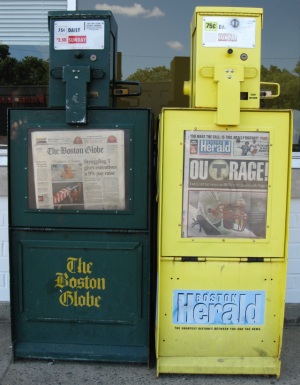
It’s a pretty amazing tale, and it’s crucial if you want to understand how the dynamic between The Boston Globe and the Boston Herald played out over the course of those decades. The very short version: the Boston Herald Traveler, with the support of the Kennedys, obtained the license to Channel 5 in the 1950s through corrupt means. The Globe, with the help of O’Neill, then a young congressman, exposed that corruption. That, in turn, led to the Herald’s losing the license to Channel 5 in the early 1970s, thus cementing the Globe’s status as the city’s dominant daily newspaper.
The final act played out in the late 1980s when Rupert Murdoch, who then owned the Herald, bought Channel 25 and sought a waiver from the FCC that would have allowed him to keep both. Sen. Ted Kennedy slipped an amendment into a bill that made it virtually impossible for the FCC to grant such a waiver. Several years later Murdoch sold the Herald to Pat Purcell, a longtime lieutenant. Although the Herald enjoyed a few years of prosperity under Purcell, it eventually entered a long, slow decline, ending in bankruptcy and the sale to the hedge fund Alden Global Capital in 2018.
So now that the cross-ownership ban is gone, what’s next? A number of organizations, including the media-reform group Free Press, opposed the FCC’s move, arguing that it will make it more difficult for local groups, including those representing women and people of color, to acquire media outlets. I agree, although there’s also a case to be made that newspapers and, to some extent, broadcast media are so moribund that ownership regulations are more about the last century than this one.
It does seem likely to me that we’re going to see newsrooms that combine newspaper and broadcast operations in an attempt to save money. We’ll see less diversity and less coverage as a result. But given that virtually all media have shifted to the unregulated internet, the ultimate effect of such consolidation is yet to be determined.