Stat is up and Design New England is out: A message from the Globe’s president

A source sent this to me a little while ago. It’s a message from Vinay Mehra, the president and chief financial officer of Boston Globe Media. Not a lot of news here. For my money, the most interesting revelations are that Stat, the company’s health and life-sciences vertical, continues to grow, and that Design New England magazine has been discontinued. (Confession: I’m not sure I’ve ever seen an issue.)

For more on the Arc content-management system and the latest on the Globe’s digital subscriptions, see the email interview I did with publisher John Henry last week for WGBH News.

The full text of Mehra’s message follows.

Team,

Happy summer! As we go into the second half of the year, the Senior Leadership Team and I would like to share with you where things stand midpoint of this year. Here are some highlights:

  • The newsroom continues to hit it out of the park. The Spotlight Team was a finalist for the Pulitzer Prize for a series on race that spurred an unprecedented conversation in this region. Our recent TSA piece has made waves nationally. Day in, day out, there is uniquely compelling journalism on our site and print pages, including the launch of the latest reader advocacy initiative, the Help Desk.
  • We continue to invest in the future of the Globe. Our latest investment in our digital future is ARC, our new publishing platform that will result in the redesign of our Globe.com website, and the launch of an ioS and Android Boston Globe app in August. There has been great collaborative work across the company to get to this point, and I am grateful for everyone’s help.
  • We have been disciplined on reducing costs, from ensuring we establish a robust contract management process to more tightly managing expenses, and continue to push ourselves on creating new revenue opportunities and exploring new ways to meet readers where they are, leveraged by our entrepreneurial spirit.
  • While advertising sales continues to experience industry disruption, we are excited about the potential of BG BrandLabs and sponsored content — we have completed 21 customer campaigns since the beginning of the year and have 14 more in our pipeline. Leading companies across the region appreciate and seek out partnerships with us and we will continue to build on that momentum.
  • Subscription revenues are on budget with our digital subscriber base over 94,000, putting us #1 among U.S. major metros in terms of total digital subscription revenue. With Pete [Doucette]’s departure, I have made the decision to conduct a search for a new head of consumer revenues, and I am pleased with the initial results of the search and the caliber of candidates who are interested in the role.
  • After months of negotiation, we have an agreement with the Pressman, Mailers and the Drivers unions. We appreciated the partnership with the bargaining committees and these new contracts give us the flexibility we need to continue to meet the needs of the market and industry.
  • We made the difficult but necessary decision to discontinue publishing Design New England magazine in order to redirect resources into our growth.  This was hard news for our colleagues affected by the change, but we were transparent with the decision making process and explored all options before coming to this decision.
  • STAT, our bold life sciences initiative, continues to see impressive growth – year over year growth in advertising by 59% and growth in subscribers by 308%.

The constant change we are experiencing is what it feels like to be in transformation, and frankly, it will continue. While it is no doubt challenging to navigate in a business as dynamic as ours, I can tell you that we are not alone in this challenge and I believe that our organization will be positioned for success. Since starting at the Globe, I have spent a lot of time out in the field speaking with CEOs in the greater Boston area, familiarizing myself with the unique perspectives within the region and forging relationships that will ultimately allow our organization to help tell the incredible stories of growth, disruption and innovation in our backyard. The good (and bad) news is that I hear the exact same set of challenges in all of these discussions. Everyone, in every industry, is experiencing the very real ups and downs of transformation. The key for us is to stay focused on why we do the work we do, because what I also hear in these conversations is that we, the Globe, are critical to this city.

Success will require that all of us — and particularly the Senior Leadership Team — work across boundaries as one Boston Globe and in harmony with our partners. In the coming month, the Senior Leadership Team and I will be engaging in a strategic planning process to determine our plans for long-term growth.  Expect to hear more from us after some of that work is done.

Finally, I truly believe that each of us must find meaning in our work. The best work happens when you know that it’s not just work, but something that will inform and improve other people’s lives. This is the opportunity that drives each of us at this company.

Thank you for your ongoing support and hard work. I recognize we wouldn’t be where we are without the contributions made by each and every one of you.

Vinay

Talk about this post on Facebook.
Media roundup: Sulzberger sends a message; tech and layoffs; and the return of Woodward and Bernstein

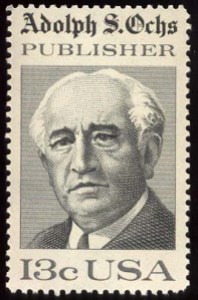
The patriarch: Adolph Ochs

Previously published at WGBHNews.org.

A.G. Sulzberger passed the audition.

Two Fridays ago the 37-year-old New York Times publisher met with President Trump at the White House for what he thought was an off-the-record discussion. Trump, as is his wont, later tweeted out his own dubious version of what had happened. “Spent much time talking about the vast amounts of Fake News being put out by the media & how that Fake News has morphed into phrase, ‘Enemy of the People,’” the president wrote. “Sad!”

Which created a dilemma for Sulzberger. Should he act as though their off-the-record agreement was still in effect? Or should he push back at what he regarded as the president’s false characterization of their conversation? He chose the latter.

“I told the president directly that I thought that his language was not just divisive but increasingly dangerous,” Sulzberger said in a statement he issued this past Sunday, which the Times itself reported on. “I told him that although the phrase ‘fake news’ is untrue and harmful, I am far more concerned about his labeling journalists ‘the enemy of the people,’ I warned that this inflammatory language is contributing to a rise in threats against journalists and will lead to violence.”

Sulzberger’s reaction set exactly the right tone. By disclosing what he had said but not what Trump had said, he took the high road. But the Times also reported that Sulzberger and editorial-page editor James Bennet, who was also at the meeting, took “extensive notes” — a clear warning to Trump in the event that he decides to extend his Twitter war with the paper.

Sulzberger became publisher on Jan. 1. He was the latest member of Sulzberger-Ochs family to ascend to the top of the masthead, an unbroken chain that extends back to Adolph Ochs’ purchase of the Times in 1896. His father and predecessor, Arthur Sulzberger Jr., presided over the paper to mixed reviews. As Ken Auletta put it in a tough New Yorker profile in 2005, “Although he occupies perhaps the most august position in the nation’s press establishment, he seems to lack the weighty seriousness of his predecessors.”

A.G., by contrast, has struck observers as both serious and wise beyond his years. “The publisher of the Times sits in direct contrast to the president of the United States: demure, private, vegetarian, self-effacing, and reliant on proving himself through hard work rather than trading on his famous surname,” according to The Washington Post.

The lead author of the Times’ celebrated 2014 innovation report, A.G. is perhaps the ideal publisher to continue the paper’s metamorphosis into a primarily digital news organization. And unlike virtually all of his predecessors, he has a significant background in journalism, having worked as a reporter for The Providence Journal, The Oregonian, and the Times itself.

The Times is far from perfect. Though its coverage of the Trump White House has been admirably tough, the paper still lapses — as I wrote last January — into episodes of normalizing this abnormal president and of succumbing too readily to the temptations of access journalism. For instance, a substance-free story about Ivanka Trump and Jared Kushner that appeared over the weekend was widely derided, with New York University journalism professor Jay Rosen writing that “it feels like a report smuggled out of the summer castle after the ladies in waiting started talking.”

But the continued health of the Times is crucial to democracy. So far, A.G. Sulzberger seems like the right person at the right time to stand up to the Trump White House as well as for journalistic values.

Squint really hard and you can almost see a silver lining

A report issued Monday by the Pew Research Center documents the horrifying drop in newsroom employment over the past 10 years, with newspapers having by far the worst of it. The number of full-time newspaper journalists fell from 71,000 in 2008 to 39,000 in 2017, a decline of 45 percent. A modest increase in the number of journalists at digital-only outlets did not come close to making up the difference.

I’m not going to try to sugarcoat what’s happening. And we should always keep in mind that greedy corporate owners like Digital First and tronc are at least as responsible for the drop as the collapse of newspaper advertising. But I do want to offer a small countervailing data point: Because of technology, reporters today are far more efficient and can produce more useful work in the same amount of time than was previously possible.

A couple of examples from my own career will suffice. When I was a community newspaper reporter in the 1980s, I had to drive to Beacon Hill for campaign-finance reports. Once I had them, my options were to take notes by hand or, if I had enough quarters, make copies, assuming the copy machine was working. (And imagine if you worked in Western Massachusetts rather than 12 miles from Boston, as I did.) Now you can just look them up. Later, as the media columnist for The Boston Phoenix, I once spent an entire afternoon searching through unindexed microfilm for a half-remembered article that I wanted to write about. Today, I would have it in a few minutes.

Again, I’m not trying to argue that the collapse of newsrooms doesn’t matter. It matters a lot, and of course there’s no substitute for having actual human beings to sit through municipal meetings and develop sources. What I am saying is that the effects of this collapse would be even worse without the digital tools that have become available over the past 20 years.

Woodward and Bernstein back on the beat

How cosmically appropriate is it that just as special counsel Robert Mueller’s investigation into the Trump campaign and related issues nears its conclusion (or not), the two legendary Washington Post reporters who did more than anyone to bring down the Nixon presidency are back on the beat?

Carl Bernstein was one of three CNN reporters whose byline appeared on a devastating report that, according to former Trump lawyer Michael Cohen, the then-candidate knew in advance about a 2016 meeting at Trump Tower at which Russians had promised to reveal “dirt” on Hillary Clinton. And this week we learned that Bob Woodward is wrapping up a book called “Fear: Trump in the White House,” scheduled to be released on Sept. 11.

As I always tell my students: Everything — everything — can be traced back to Richard Nixon.

Talk about this post on Facebook.