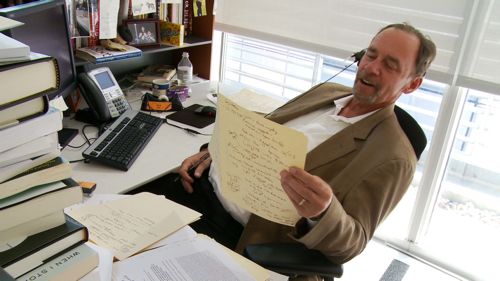
John Henry in October 2007
This article was published earlier in the Nieman Journalism Lab and The Huffington Post.
John Henry’s nearly 2,900-word message to readers of The Boston Globe could have been little more than an exercise in public relations, standing up for what is good and deploring what is bad.
There’s a lot of that, of course. We’re only into the second paragraph before he dutifully informs us that the Globe “is the eyes and ears of the region in some ways, the heartbeat in many others.” But Henry, a billionaire financier who is the principal owner of the Boston Red Sox, is also unexpectedly revealing about himself and how he intends to run the Globe. (Henry purchased the Globe, its BostonGlobe.com and Boston.com websites, the Telegram & Gazette of Worcester and several smaller properties from the New York Times Co. for $70 million. The sale, announced in August, closed last week following a brief delay over a labor dispute at the T&G. Henry also made a bit of news when folks at the T&G noticed that his message omitted Worcester entirely.)
Henry’s piece, headlined “Why I bought the Globe,” takes up a full page in the Opinion section of Sunday’s paper. It’s teased on the front page as well. He writes about his life, the Red Sox, the financially struggling news business and what he thinks needs to be done to set it on a sustainable path. Here are what I think are the most important takeaways.
1. He plans to be an activist owner. Just the atmospherics of the essay itself are a pretty strong indication that Henry does not see this as a passive investment. He wants to be the face of the Globe.
To counter his image as a reserved, slightly eccentric rich guy who dabbles in sports, Henry goes into some detail about his involvement in the civil-rights movement and his subsequent retreat “into what most of my friends thought was my primary talent at the time — writing and performing rock music.”
Somewhere along the way he made a lot of money, but he writes about that only briefly. Instead, he describes his stewardship of the Red Sox as a possible model for what he intends to do with the Globe:
When we acquired the Red Sox, profit was literally at the bottom of our list of goals. We were determined to do whatever it took to win.
Now I see The Boston Globe and all that it represents as another great Boston institution that is worth fighting for.
Here’s another intriguing example of what sort of profile Henry intends for himself as the Globe’s owner: Recently the Boston Business Journal reported that toxic waste at the Globe’s Dorchester property could complicate any plans Henry might have to develop the site and move the paper to a cheaper location. Henry used his Twitter feed to dispute the BBJ’s story and slam an earlier piece about the Globe’s break-up with a classified-ad site called Cars.com:
A feisty newspaper owner who fights back in public? Bring it on. That’s certainly an improvement over the gray management style of the Times Co.
2. He’s looking for advice in all the right places. If the Globe and other large regional dailies are going to survive and prosper, they need to develop new ways of doing business. So it’s encouraging that Henry mentions alliances the paper already has with Harvard’s Shorenstein Center, the MIT Media Lab and the Nieman Journalism Lab.
Henry also gives a shout-out to Clay Shirky, which I take as a signal that Henry is reading and talking to the right people. It doesn’t sound like he intends to take the approach adopted by Aaron Kushner, a one-time Globe suitor who’s winning plaudits for trying to revive the Orange County Register by focusing on the print edition. The Globe has been a leader in digital journalism. So it’s good news that Henry sounds like he’s going to double down on innovation.
3. He has some retro ideas about paid content. Near the top of his commentary, Henry repeats an old trope, writing that newspapers have been losing money because “Readers were flocking from the papers to the Internet, consuming expensive journalism for free.”
Now, I’ve got nothing against charging for digital subscriptions, and the Globe has had some success with that — 39,000 at last count. But it’s important to keep in mind what newspaper owners are up against in asking readers to pay for online access.
As has often been said, newspaper readers never paid for the news — they paid for the expense of printing and delivering the paper, with advertisers picking up the rest. These days, readers are paying — a lot — for their own printing presses (computers, tablets and smartphones) and their own delivery (broadband and cellular access). It’s perfectly understandable that they don’t want to pay more.
What went wrong was not that newspapers started giving away their content but, rather, that the advertising model collapsed, especially from classifieds. Henry understands this, writing, “I feel strongly that newspapers and their news sites are going to rely upon the support of subscribers to a large extent in order to provide what readers want.”
I wish any newspaper owner well in persuading readers to pay for journalism. But we have to understand that we are asking them to do something they’ve never done before: pay for news in addition to paying for printing and delivery. We need to be humble about how much we’re asking of our audience.
4. He wants the Globe to act as a guide to the larger conversation. One of the most important roles professional journalism can play is to aggregate and curate the torrent of information — not just when big news breaks, but on a daily basis.
The New York Times does this with The Lede; the Globe does it from time to time, as it did following the Boston Marathon bombing. The idea is to become the go-to place for trustworthy links to other news sources, blogs and citizen media. Henry clearly gets that, writing:
We will provide what we will call the Globe Standard when it comes to curated links that will ensure our readers do not waste their time when they click on news, reviews, writers, columnists, ecommerce, events, opportunities, and social engagement from any of our platforms.
One thing Henry gets absolutely right is that the newspaper business is not now and never was compatible with ownership by publicly traded corporations and the quarterly demands of Wall Street. For more than a generation, corporate chains slashed newsrooms, first to drive up profit margins, later to stave off mounting losses. The debt they took on to build their chains is one of the prime reasons for their inability to set themselves on a new path. Henry understands that.
“I soon realized that one of the key things the paper needed in order to prosper was private, local ownership, passionate about its mission,” Henry writes. Farther down, he adds: “But this investment isn’t about profit at all. It’s about sustainability. Any great paper, the Globe included, must generate enough revenue to support its vital mission.”
Leaving aside the obvious fact that profit is a key to sustainability, Henry articulates a vision in which journalism comes first — which is another way of saying the customer comes first. Too many newspaper owners have forgotten that.
Photo (cc) by Patrick Mannion and published under a Creative Commons license. Some rights reserved.
 By Bill Kirtz