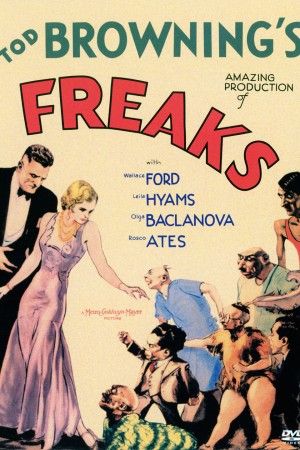
 Nicolas Rapold has a fascinating essay in The New York Times (free link) about “Freaks,” a rarely seen 1932 horror movie directed by Tod Browning and starring a troupe of sideshow performers — people with dwarfism, microcephaly, missing limbs and other conditions. As Rapold writes, “Freaks” has been embraced by some disability activists, as it conveys a “sense of both community and agency among the characters.” It’s also become such a cult classic that a friend of ours shows it at his birthday party every year.
In my 2003 book about dwarfism, “Little People,” I wrote about several artistic depictions of dwarfism, from “Freaks” to an Argentine film called “De eso no se habla” to “CSI.” Unfortunately, “The Station Agent,” starring the soon-to-be-well-known actor Peter Dinklage, was not released until shortly after the book was published, and that remains the gold standard in depiciting someone with dwarfism.
Here’s an excerpt from “Little People” in which I discuss “Freaks.”
***
For anyone who’s part of what the sociologist Erving Goffman calls a “stigmatized group,” identity as part of that group can all too easily take precedence over individual identity. Our changing attitudes toward dwarfism can be seen through artistic representations. Mini-Me and the late Hank the Angry, Drunken Dwarf aside, these representations are considerably more enlightened than they used to be. But the individual within is rarely shown, and even when he is, it is strictly within the confines of a group context.
Not long ago I rented the 1932 film “Freaks,” directed by the horror-movie pioneer Tod Browning. “Freaks” is a monumentally bad movie, and it was considered so offensive in its day that it was virtually impossible to see for many decades, excoriated in the United States and actually banned in Britain. Yet what fascinated me most was not its exploitive nature, which I had expected, but Browning’s apparent good intentions. At the beginning of the film, we are told that “freaks” — that is, the disabled freak-show actors who made up much of the cast — are as human as anyone else. And in fact, the first two-thirds of the movie consists of such folks as proportionate dwarfs, an achondroplastic dwarf, mentally retarded* microcephalics (“pinheads,” as they were known; think of Bill Griffith’s cartoon strip “Zippy the Pinhead”), and people without any limbs, all of them going about their business as normally as possible. It’s voyeuristic yet progressive at the same time.
Later, though, the movie transforms itself into the nightmarish vision of disability that the earlier images seem designed to counteract. When the average-size trapeze artist and her strongman boyfriend attempt to poison the dwarf she had married for his inheritance, the “freaks” murder the boyfriend and mutilate the bride, turning her into a monster that is part-woman, part-chicken. (Like I said, it’s a bad movie.) As the critic Joan Hawkins observes, the dénouement “directly contradicts the argument for tolerance that we are given at the beginning of the film. Having been initially reminded by the barker that physical difference is an ‘accident of birth,’ not the visible sign of some inner monstrosity, we are ultimately presented with a woman who has been turned into a freak as punishment for her immorality and greed.” Browning tells us that difference is morally neutral; then he shows us that it’s anything but.
One night when Becky was still a baby, we rented an Argentine film called “De eso no se habla” (“I Don’t Want to Talk About It”), a 1994 movie directed by Maria Luisa Bemberg. One of the stars is an achondroplastic woman named Alejandra Podesta, who marries a mysterious stranger played by Marcello Mastraoianni. We’d heard good things about it, and for the most part we were rewarded with a well-rounded coming-of-age portrait of a young woman with dwarfism. At the end, though, she runs away from the carefully constructed life that her overbearing mother (Luisiana Brando) has built for her so that she can discover her own individuality — which she accomplishes by joining the circus. We see her being greeted by a circus dwarf as she embarks on her new life. The message is muddled but unmistakable: despite being well-educated, happily married, and apparently accepted by her community, she can’t truly discover herself except by being with her own kind.
The modern version of this attitude was portrayed on television not too long ago, on the popular CBS show “CSI.” A murder has taken place at a Little People of America conference, and the crime-scene investigators have been called in to solve it. In the course of the next hour, we are treated to an earnest, politically correct, if not entirely accurate, seminar on the world of dwarfs and dwarfism. The dwarf actors themselves play characters who come across as capable and competent, yes, but also as prickly, defensive, bitter, even angry at their lot in life. The murderer turns out to be a dwarf who didn’t want his average-size daughter to marry a dwarf man — a rather nasty bit of self-hatred that was so predictable I’m surprised it made the final cut.
I don’t mean to be overly critical. The “CSI” episode stood out in many ways because of how good it was. We’ve certainly come a long way since “Freaks.” But I was struck by how even the most well-intentioned scriptwriters manage to fall into the trap of portraying dwarfs as associating mainly with other dwarfs (the LPA conference setting, after all, was an artistic decision, not a necessity) and as profoundly damaged by the mere fact of their dwarfism.
The one dwarf who might have been able to assert his individuality was the man who had been carrying on an affair with an average-size woman. And he was dead before the opening credits had finished rolling.
The group identity portrayed in “CSI” is clearly more progressive than that in “Freaks,” or even in “De eso no se habla.” But true individual identity is reserved for the average-size people who direct the dwarfs’ lives. For the most part, the dwarfs are not actors; they are acted upon. And when they do act, it is in negative, even horrifying ways: to kill and mutilate, to join the circus, to plan and carry out a complicated murder in a twisted effort to negate one’s own dwarfism.
* In 2003, the word “retarded” was not considered an offensive description for people with developmental disabilities; that came later. In fact, I also go into quite a bit of detail in “Little People” of how the word “midget” morphed from an accepted term for someone with proportionate dwarfism to an epithet on par with the n-word. Times change.



.jpg)
